Pearson+ LogoPearson+ Logo

Intro to Projectile Motion: Horizontal Launch quiz #2 Flashcards

Back
Intro to Projectile Motion: Horizontal Launch quiz #2
Control buttons has been changed to "navigation" mode.
1/10
  • How can the motion of a projectile be analyzed to solve problems?

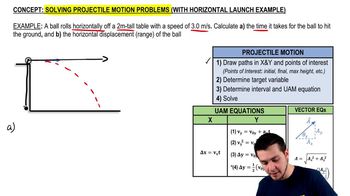
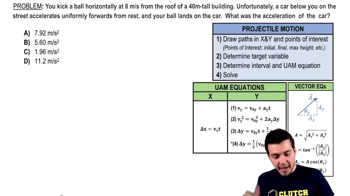
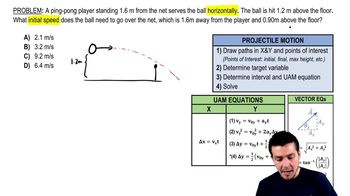
    Projectile motion can be analyzed by decomposing it into horizontal (X-axis) and vertical (Y-axis) components, using constant velocity equations for the X-axis and kinematic equations for the Y-axis, and identifying points of interest and intervals for applying the correct equations.
  • What is the shape of the path followed by an object in projectile motion under gravity?

    The path is a parabola due to the combination of constant horizontal velocity and vertical acceleration from gravity. This results in a curved, two-dimensional trajectory.
  • Why is the acceleration in the x-axis zero for projectile motion problems?

    There are no forces acting horizontally on the projectile after launch, so the horizontal acceleration is zero. This means the horizontal velocity remains constant throughout the motion.
  • How do you determine the initial velocity components for a horizontally launched projectile?

    The initial velocity in the x-axis is equal to the given launch speed, and the initial velocity in the y-axis is zero. This is because the launch is perfectly horizontal, making the angle with the x-axis zero degrees.
  • What convention is typically used for positive and negative directions in projectile motion problems?

    Upward and to the right are usually considered positive directions. Downward displacements and velocities are therefore negative.
  • When solving for time in projectile motion, why might you need to use the y-axis equations instead of the x-axis equation?

    If you do not know the horizontal displacement, you cannot solve for time using the x-axis equation. In such cases, you use the y-axis kinematic equations, which often have enough known variables to solve for time.
  • What is the significance of identifying points of interest in projectile motion problems?

    Points of interest, such as initial and final positions, help define the intervals over which you apply equations. This ensures you use the correct values for displacement, velocity, and time.
  • How does the vertical displacement sign affect calculations in projectile motion?

    A negative vertical displacement indicates the object moves downward relative to its starting point. This sign must be used correctly in equations to obtain accurate results.
  • Why does the horizontal velocity remain unchanged during projectile motion?

    There is no horizontal acceleration acting on the projectile after launch. As a result, the horizontal velocity stays constant for the entire flight.
  • What should you do if you cannot solve for a variable using one axis in projectile motion?

    Switch to the equations for the other axis and check if you have enough known variables to solve for the unknown. This approach often allows you to find the missing value needed to complete the problem.