Ch. 9 - Correlation and Regression
Larson - Elementary Statistics: Picturing the World 8th Edition
Larson8th EditionElementary Statistics: Picturing the WorldISBN: 9780137493470Not the one you use?Change textbook
Chapter 9, Problem 9.1.20

"In Exercises 19-22, two variables are given that have been shown to have correlation but no cause-and-effect relationship. Describe at least one possible reason for the correlation.
20. Alcohol use and tobacco use"

Verified step by step guidance
1
Understand the concept of correlation: Correlation measures the strength and direction of a linear relationship between two variables. It does not imply causation, meaning one variable does not necessarily cause the other to change.
Identify the variables in the problem: The two variables given are alcohol use and tobacco use. These are behaviors that may be related but do not necessarily have a cause-and-effect relationship.
Consider possible reasons for the correlation: One possible reason for the correlation could be a shared underlying factor, such as social environments or peer influence, where individuals who use alcohol are more likely to be in settings where tobacco use is also prevalent.
Explore another potential explanation: Both alcohol use and tobacco use might be influenced by psychological factors, such as stress or risk-taking behavior, which could lead to a correlation between the two without one directly causing the other.
Summarize the key point: The correlation between alcohol use and tobacco use is likely due to external factors or shared influences, rather than a direct cause-and-effect relationship between the two behaviors.

Verified video answer for a similar problem:

This video solution was recommended by our tutors as helpful for the problem above.
Video duration:
3m
Was this helpful?

Key Concepts

Here are the essential concepts you must grasp in order to answer the question correctly.

Correlation vs. Causation

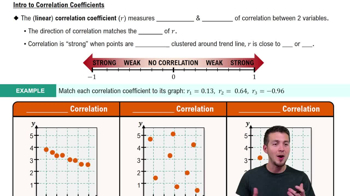
Correlation refers to a statistical relationship between two variables, indicating that they tend to move together in some way. However, this does not imply that one variable causes the other to change. Understanding this distinction is crucial, as many correlations can arise from confounding factors or coincidental relationships rather than direct causation.
Recommended video:
Guided course
05:43
Correlation Coefficient

Confounding Variables

Confounding variables are external factors that may influence both variables in a correlation, leading to a false impression of a direct relationship. For instance, social or environmental factors may drive both alcohol and tobacco use, making it appear that they are directly related when they are not. Identifying these variables is essential for accurate interpretation of data.
Recommended video:
Guided course
07:09
Intro to Random Variables & Probability Distributions

Spurious Correlation

A spurious correlation occurs when two variables appear to be related but are actually influenced by a third variable or are coincidentally correlated. This can mislead researchers into assuming a causal link where none exists. Recognizing spurious correlations is important in statistical analysis to avoid incorrect conclusions about relationships between variables.
Recommended video:
Guided course
05:43
Correlation Coefficient
Related Practice
Textbook Question

"Constructing and Interpreting a Prediction Interval In Exercises 21-30, construct the indicated prediction interval and interpret the results.

26. Voter Turnout Construct a 99% prediction interval for number of ballots cast in Exercise 16 when the voting age population is 210 million."

56
views
Textbook Question

"In Exercises 7-10, use the value of the correlation coefficient r to calculate the coefficient of determination r^2. What does this tell you about the explained variation of the data about the regression line? about the unexplained variation?

10. r =0.881"

117
views
Textbook Question

"Confidence Intervals for y-Intercept and Slope

You can construct confidence intervals for the y-intercept B and slope M of the regression line y = Mx + B for the population by using the inequalities below.

y-intercept B :

b - E < B < b + E

where

E = t_c s_e \(\sqrt{\frac{1}{n}\) + \(\frac{\overline{x}\)^2}{\(\sum\) x^2 - \(\frac{(\Sigma x)^2}{n}\)}}

slope M :

m - E < M < m + E

where

E = \(\frac{t_c s_e}{\sqrt{\sum x^2 - \frac{(\Sigma x)^2}{n}\)}}

The values of m and b are obtained from the sample data, and the critical value t_c is found using Table 5 in Appendix B with n - 2 degrees of freedom.

In Exercises 37 and 38, construct the indicated confidence intervals for B and M using the gross domestic products and carbon dioxide emissions data found in Example 2.

38. 99% confidence interval"

119
views
Textbook Question

"Predicting y-Values In Exercises 3-6, use the multiple regression equation to predict the y-values for the values of the independent variables.

5. Black Cherry Tree Volume The volume (in cubic feet) of a black cherry tree can be modeled by the equation

y =- 52.2+0.3x_1 +4.5x_2

where x_1 is the tree's height (in feet) and x_2 is the tree's diameter (in inches). (Source: Journal of the Royal Statistical Society)

a. x_1 = 70, x_2 = 8.6

b. x_1 = 65, x_2 = 11.0

c. x_1 = 83, x_2 = 17.6

d. x_1 = 87, x_2 = 19.6"

40
views
Textbook Question

"Constructing and Interpreting a Prediction Interval In Exercises 21-30, construct the indicated prediction interval and interpret the results.

25. Mean Wage Construct a 99% prediction interval for the mean annual wage in Exercise 15 when the percentage of employment in STEM occupations is 13% in the industry."

61
views
Textbook Question

1. Two variables have a positive linear correlation. Does the dependent variable increase or decrease as the independent variable increases? What if the variables have a negative linear correlation?

170
views