Ch. 8 - Hypothesis Testing with Two Samples
Larson - Elementary Statistics: Picturing the World 8th Edition
Larson8th EditionElementary Statistics: Picturing the WorldISBN: 9780137493470Not the one you use?Change textbook
Chapter 8, Problem 8.T.2b

Take this test as you would take a test in class.For each exercise, perform the steps below.
b.Determine whether the hypothesis test is left-tailed, right-tailed, or two-tailed, and whether to use a z-test or a t-test. Explain your reasoning.


A real estate agency says that the mean home sales price in Olathe, Kansas, is greater than in Rolla, Missouri. The mean home sales price for 39 homes in Olathe is \$392,453. Assume the population standard deviation is \$224,902. The mean home sales price for 38 homes in Rolla is \$285,787. Assume the population standard deviation is \$330,578. At α=0.05, is there enough evidence to support the agency’s claim? (Adapted from Realtor.com)

Verified step by step guidance
1
Identify the null hypothesis (H_0) and the alternative hypothesis (H_a). Since the agency claims that the mean home sales price in Olathe is greater than in Rolla, the hypotheses are: \(H_0: \mu_{Olathe} \leq \mu_{Rolla}\) \(H_a: \mu_{Olathe} > \mu_{Rolla}\) This indicates a right-tailed test because the claim is about one mean being greater than the other.
Determine whether to use a z-test or a t-test. Since the population standard deviations are known (\(\sigma_{Olathe} = 224,902\) and \(\sigma_{Rolla} = 330,578\)), and the sample sizes are reasonably large (39 and 38), a z-test is appropriate for comparing the two means.
Calculate the test statistic using the formula for the difference between two means with known population standard deviations: \(Z = \frac{(\bar{x}_1 - \bar{x}_2) - (\mu_1 - \mu_2)}{\sqrt{\frac{\sigma_1^2}{n_1} + \frac{\sigma_2^2}{n_2}}}\) Here, \(\bar{x}_1\) and \(\bar{x}_2\) are the sample means, \(\sigma_1\) and \(\sigma_2\) are the population standard deviations, and \(n_1\) and \(n_2\) are the sample sizes. The hypothesized difference \((\mu_1 - \mu_2)\) under the null hypothesis is 0.
Determine the critical value for the right-tailed test at the significance level \(\alpha = 0.05\). This critical value corresponds to the z-score where the area to the right is 0.05.
Compare the calculated test statistic to the critical value. If the test statistic is greater than the critical value, reject the null hypothesis and conclude there is enough evidence to support the agency's claim. Otherwise, do not reject the null hypothesis.

Verified video answer for a similar problem:

This video solution was recommended by our tutors as helpful for the problem above.
Video duration:
3m
Was this helpful?

Key Concepts

Here are the essential concepts you must grasp in order to answer the question correctly.

Hypothesis Testing and Tail Types

Hypothesis testing involves making a claim about a population parameter and using sample data to test it. The test can be left-tailed, right-tailed, or two-tailed depending on the claim: a right-tailed test checks if the mean is greater, left-tailed if less, and two-tailed if different. In this question, since the claim is that Olathe’s mean price is greater, a right-tailed test is appropriate.
Recommended video:
05:52
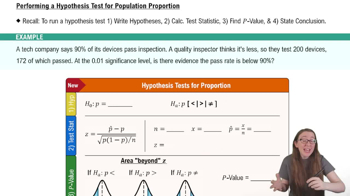
Performing Hypothesis Tests: Proportions

Z-test vs. T-test

A z-test is used when the population standard deviation is known and the sample size is large (usually n > 30), while a t-test is used when the population standard deviation is unknown and/or the sample size is small. Here, population standard deviations are given and sample sizes are above 30, so a z-test is appropriate for comparing means.
Recommended video:
Guided course
06:28
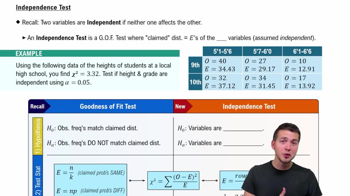
Independence Test

Comparing Two Independent Sample Means

When comparing means from two independent samples, the test statistic measures the difference between sample means relative to the variability and sample sizes. The formula incorporates means, standard deviations, and sample sizes to determine if the observed difference is statistically significant at the chosen significance level (α = 0.05).
Recommended video:
06:53
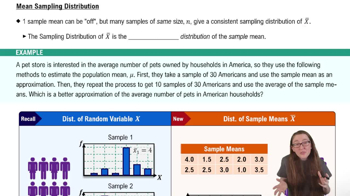
Sampling Distribution of Sample Mean
Related Practice
Textbook Question

In Exercises 4 and 5, use technology to perform a two-sample t-test to determine whether there is a difference in the mint dates and in the values of coins found on a street from 1985 through 1996 for the two mint locations. Write your conclusion as a sentence. Use α = 0.05.


Value of coins (dollars)


Philadelphia: x̅1=\$0.034, s1=\$0.054


Denver: x̅2=\$0.033, s2=\$0.052


Assume population variances are equal.

43
views
Textbook Question

Find the critical value(s) for the alternative hypothesis, level of significance , and sample sizes and . Assume that the samples are random and independent, the populations are normally distributed, and the population variances are (a) equal

Ha:μ1≠μ2 , α=0.10 , n1=11 , n2=14

48
views
Textbook Question

Take this test as you would take a test in class.For each exercise, perform the steps below.

e. Decide whether to reject or fail to reject the null hypothesis.


A real estate agency says that the mean home sales price in Olathe, Kansas, is greater than in Rolla, Missouri. The mean home sales price for 39 homes in Olathe is \$392,453. Assume the population standard deviation is \$224,902. The mean home sales price for 38 homes in Rolla is \$285,787. Assume the population standard deviation is \$330,578. At α=0.05, is there enough evidence to support the agency’s claim? (Adapted from Realtor.com)

30
views
Textbook Question

In Exercises 4 and 5, use technology to perform a two-sample t-test to determine whether there is a difference in the mint dates and in the values of coins found on a street from 1985 through 1996 for the two mint locations. Write your conclusion as a sentence. Use α = 0.05.


Mint dates of coins (years)


Philadelphia: x̅1=1984.8, s1=8.6


Denver: x̅2=1983.4, s2=8.4


Assume population variances are equal.

44
views
Textbook Question

Take this test as you would take a test in class.For each exercise, perform the steps below.


a. Identify the claim and state and


b.Determine whether the hypothesis test is left-tailed, right-tailed, or two-tailed, and whether to use a z-test or a t-test. Explain your reasoning.


c.Find the critical value(s) and identify the rejection region(s).


d. Find the appropriate standardized test statistic.


e. Decide whether to reject or fail to reject the null hypothesis.


f. Interpret the decision in the context of the original claim.


A demographics researcher claims that the mean household income in a recent year is different for native-born households and foreign-born households. A sample of 18 native-born households has a mean household income of \$69,474 and a standard deviation of \$21,249. A sample of 21 foreign-born households has a mean household income of \$64,900 and a standard deviation of \$17,896. At α=0.01, can you support the demographics researcher’s claim? Assume the populations are normally distributed and the population variances are not equal. (Adapted from U.S. Census Bureau)

72
views
Textbook Question

Confounding Variables A pharmaceutical company has applied for approval to market a new arthritis medication. The research involved a test group that was given the medication and another test group that was given a placebo. Describe some possible confounding variables that could influence the results of the study.

78
views