
Ch. 6 - Normal Probability Distributions
Triola - Elementary Statistics 14th Edition
Triola14th EditionElementary StatisticsISBN: 9780137366446Not the one you use?Change textbook
Chapter 6, Problem 6.4.2

Small Sample Weights of M&M plain candies are normally distributed. Twelve M&M plain candies are randomly selected and weighed, and then the mean of this sample is calculated. Is it correct to conclude that the resulting sample mean cannot be considered to be a value from a normally distributed population because the sample size of 12 is too small? Explain.

Verified step by step guidance
1
Understand the problem: The question is asking whether the sample mean of a small sample size (n = 12) can still be considered as coming from a normally distributed population. This involves understanding the relationship between sample size, normality, and the Central Limit Theorem.
Recall the Central Limit Theorem (CLT): The CLT states that for a sufficiently large sample size, the sampling distribution of the sample mean will be approximately normal, regardless of the population's distribution. However, if the population itself is already normally distributed, the sample mean will also be normally distributed, even for small sample sizes.
Identify the key information: The problem states that the weights of M&M plain candies are normally distributed. This means the population distribution is already normal, so the sample mean will also follow a normal distribution, regardless of the sample size (n = 12 in this case).
Address the concern about sample size: While a sample size of 12 is considered small, the normality of the population ensures that the sample mean is normally distributed. The sample size does not need to be large in this case because the population is already normal.
Conclude: It is correct to conclude that the sample mean can still be considered as coming from a normally distributed population, even with a small sample size of 12, because the population itself is normally distributed. The sample size does not invalidate this conclusion.

Verified video answer for a similar problem:

This video solution was recommended by our tutors as helpful for the problem above.
Video duration:
3m
Was this helpful?

Key Concepts

Here are the essential concepts you must grasp in order to answer the question correctly.

Central Limit Theorem

The Central Limit Theorem states that the distribution of the sample mean will approach a normal distribution as the sample size increases, regardless of the population's distribution, provided the sample size is sufficiently large (typically n ≥ 30). In this case, with a sample size of 12, while it may not be large enough for the theorem to fully apply, the underlying population is already normally distributed, which allows for valid conclusions about the sample mean.
Recommended video:
Guided course
04:52
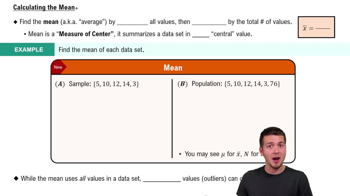
Calculating the Mean

Normal Distribution

A normal distribution is a continuous probability distribution characterized by its bell-shaped curve, defined by its mean and standard deviation. In this scenario, since the weights of M&M candies are stated to be normally distributed, any sample mean calculated from this population will also follow a normal distribution, even if the sample size is relatively small.
Recommended video:
Guided course
09:47
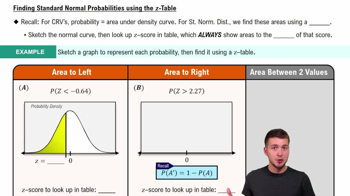
Finding Standard Normal Probabilities using z-Table

Sample Size and Statistical Inference

Sample size plays a crucial role in statistical inference, affecting the reliability of estimates and conclusions drawn from data. While larger samples generally provide more accurate estimates of population parameters, a sample size of 12 can still yield valid insights when drawn from a normally distributed population, allowing for reasonable conclusions about the sample mean despite its smaller size.
Recommended video:
05:11
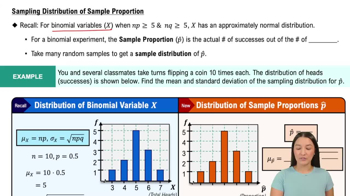
Sampling Distribution of Sample Proportion
Related Practice
Textbook Question

Tennis Replay In a recent year, there were 879 challenges made to referee calls in professional tennis singles play. Among those challenges, 231 challenges were upheld with the call overturned. Assume that in general, 25% of the challenges are successfully upheld with the call overturned.


a. If the 25% rate is correct, find the probability that among the 879 challenges, the number of overturned calls is exactly 231.

122
views
Textbook Question

Basis for the Range Rule of Thumb and the Empirical Rule. In Exercises 45–48, find the indicated area under the curve of the standard normal distribution; then convert it to a percentage and fill in the blank. The results form the basis for the range rule of thumb and the empirical rule introduced in Section 3-2.


About __ % of the area is between z = -1 and z = 1 (or within 1 standard deviation of the mean).

163
views
Textbook Question

Finding Bone Density Scores. In Exercises 37–40 assume that a randomly selected subject is given a bone density test. Bone density test scores are normally distributed with a mean of 0 and a standard deviation of 1. In each case, draw a graph, then find the bone density test score corresponding to the given information. Round results to two decimal places.


Find the bone density scores that are the quartiles Q1, Q2, and Q3.

136
views
Textbook Question

Pulse Rates. In Exercises 13–24, use the data in the table below for pulse rates of adult males and females (based on Data Set 1 “Body Data” in Appendix B). Hint: Draw a graph in each case.


" style="" width="340">


Find the probability that a male has a pulse rate between 70 beats per minute and 90 beats per minute.

390
views
Textbook Question

IQ Scores. In Exercises 5–8, find the area of the shaded region. The graphs depict IQ scores of adults, and those scores are normally distributed with a mean of 100 and a standard deviation of 15 (as on the Wechsler IQ test).

204
views