Ch. 2 - Descriptive Statistics
Larson - Elementary Statistics: Picturing the World 8th Edition
Larson8th EditionElementary Statistics: Picturing the WorldISBN: 9780137493470Not the one you use?Change textbook
Chapter 2, Problem 2.4.48

Comparing Variation in Different Data Sets In Exercises 45–50, find the coefficient of variation for each of the two data sets. Then compare the results.
Heights and Weights The heights (in inches) and weights (in pounds) of every France national soccer team player that started the 2018 FIFA Men’s World Cup final are listed. (Source: ESPN)
Table displaying the heights (in inches) and weights (in pounds) of players from the 2018 FIFA Men’s World Cup final.

Verified step by step guidance
1
Step 1: Understand the coefficient of variation (CV). The CV is a measure of relative variability and is calculated as the ratio of the standard deviation (SD) to the mean (μ), expressed as a percentage: CV = (SD / μ) × 100.
Step 2: Calculate the mean (μ) for each data set. For the heights, sum all the values and divide by the number of players. Repeat the same process for the weights.
Step 3: Calculate the standard deviation (SD) for each data set. Use the formula: SD = sqrt(Σ(xi - μ)^2 / n), where xi represents each individual value, μ is the mean, and n is the number of values in the data set.
Step 4: Compute the coefficient of variation (CV) for each data set using the formula CV = (SD / μ) × 100. Perform this calculation separately for the heights and weights.
Step 5: Compare the CVs of the two data sets. A higher CV indicates greater relative variability in the data set. Discuss the implications of the comparison in terms of the variability of heights versus weights.

Verified video answer for a similar problem:

This video solution was recommended by our tutors as helpful for the problem above.
Video duration:
12m
Was this helpful?

Key Concepts

Here are the essential concepts you must grasp in order to answer the question correctly.

Coefficient of Variation

The coefficient of variation (CV) is a statistical measure of the relative variability of a data set. It is calculated as the ratio of the standard deviation to the mean, expressed as a percentage. This metric allows for the comparison of the degree of variation between different data sets, regardless of their units or scales, making it particularly useful in fields like finance and quality control.
Recommended video:
Guided course
06:14
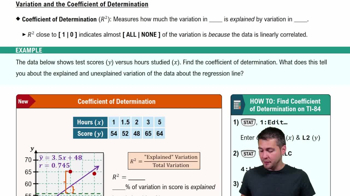
Coefficient of Determination

Standard Deviation

Standard deviation is a measure of the amount of variation or dispersion in a set of values. A low standard deviation indicates that the values tend to be close to the mean, while a high standard deviation indicates that the values are spread out over a wider range. It is a crucial component in calculating the coefficient of variation, as it quantifies the extent of variability in the data.
Recommended video:
Guided course
08:45
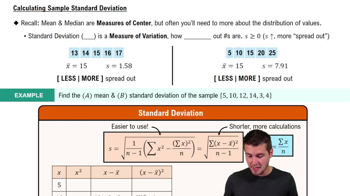
Calculating Standard Deviation

Mean

The mean, or average, is a measure of central tendency that is calculated by summing all the values in a data set and dividing by the number of values. It provides a single value that represents the center of the data distribution. In the context of the coefficient of variation, the mean serves as the baseline against which the standard deviation is compared, allowing for a relative assessment of variability.
Recommended video:
Guided course
04:52
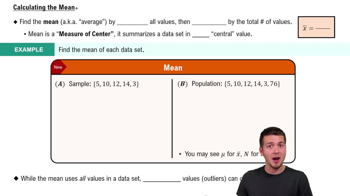
Calculating the Mean
Related Practice
Textbook Question

Grades In Exercise 46, one of the student’s B grades gets changed to an A. What is the student’s new grade point average?

133
views

Textbook Question

Putting Graphs in Context In Exercises 5–8, match the plot with the description of the sample.

a. Times (in minutes) it takes a sample of employees to drive to work

b. Grade point averages of a sample of students with finance majors

c. Top speeds (in miles per hour) of a sample of high-performance sports cars

d. Ages (in years) of a sample of residents of a retirement home


" style="" width="385">

91
views
Textbook Question

Constructing Data Sets In Exercises 25–28, construct a data set that has the given statistics.


N = 6

μ = 5

σ ≈ 2

109
views
Textbook Question

Construct a frequency distribution and a frequency histogram for the data set using the indicated number of classes. Describe any patterns.

Reaction Times

Number of classes: 8

Data set: Reaction times (in milliseconds) of 30 adult females to an auditory stimulus 507 389 305 291 336 310 514 442 373 428 387 454 323 441 388 426 411 382 320 450 309 416 359 388 307 337 469 351 422 413

81
views
Textbook Question

Extending Concepts


A Misleading Graph? A misleading graph is not drawn appropriately, which can misrepresent data and lead to false conclusions. In Exercises 37–40, (a) explain why the graph is misleading, and (b) redraw the graph so that it is not misleading.


166
views
Textbook Question

use the given information about the data set and the number of classes to find the class width, the lower class limits, and the upper class limits.

min=17, range=118, 8 classes

189
views