
Ch. 3 - Probability
Larson - Elementary Statistics: Picturing the World 8th Edition
Larson8th EditionElementary Statistics: Picturing the WorldISBN: 9780137493470Not the one you use?Change textbook
Chapter 3, Problem 3.1.19

Finding the Probability of the Complement of an Event In Exercises 17-20, the probability that an event will happen is given. Find the probability that the event will not happen.
19. P(E)=0.03

Verified step by step guidance
1
Step 1: Understand the concept of the complement of an event. The complement of an event E, denoted as E', represents all outcomes in the sample space that are not part of event E. The sum of the probabilities of an event and its complement is always equal to 1.
Step 2: Recall the formula for the probability of the complement of an event: \( P(E') = 1 - P(E) \). This formula is derived from the fact that \( P(E) + P(E') = 1 \).
Step 3: Identify the given probability of the event \( P(E) \). In this problem, \( P(E) = 0.03 \).
Step 4: Substitute the given value of \( P(E) \) into the formula for \( P(E') \): \( P(E') = 1 - 0.03 \).
Step 5: Simplify the expression to find \( P(E') \). This will give you the probability that the event will not happen.

Verified video answer for a similar problem:

This video solution was recommended by our tutors as helpful for the problem above.
Video duration:
1m
Was this helpful?

Key Concepts

Here are the essential concepts you must grasp in order to answer the question correctly.

Probability of an Event

Probability quantifies the likelihood of an event occurring, expressed as a number between 0 and 1. A probability of 0 indicates impossibility, while a probability of 1 indicates certainty. In this case, P(E) = 0.03 means there is a 3% chance that event E will occur.
Recommended video:
05:54
Probability of Multiple Independent Events

Complement of an Event

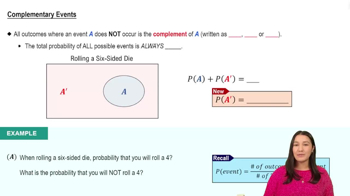
The complement of an event refers to all outcomes in which the event does not occur. It is denoted as P(E') and can be calculated using the formula P(E') = 1 - P(E). This concept is essential for determining the probability of an event not happening based on the probability of it happening.
Recommended video:
4:23
Complementary Events

Calculating Complement Probability

To find the probability of the complement of an event, subtract the probability of the event from 1. For example, if P(E) = 0.03, then P(E') = 1 - 0.03 = 0.97. This means there is a 97% chance that event E will not occur, illustrating how to effectively use the complement rule in probability.
Recommended video:
Guided course
07:09
Probability From Given Z-Scores - TI-84 (CE) Calculator
Related Practice
Textbook Question

Recognizing Mutually Exclusive Events In Exercises 9–12, determine whether the events are mutually exclusive. Explain your reasoning.

10. Event A: Randomly select a student with a birthday in April.

Event B: Randomly select a student with a birthday in May.

144
views
Textbook Question

Classifying Types of Probability In Exercises 53-58, classify the statement as an example of classical probability, empirical probability, or subjective probability. Explain your reasoning.

55. An analyst feels that the probability of a team winning an upcoming game is 60%.

114
views
Textbook Question

Finding the Probability of the Complement of an Event The age distribution of the residents of Ithaca, New York, is shown at the left. In Exercises 59-62, find the probability of the event. (Source: U.S. Census Bureau)

61. Event C: A randomly chosen resident of Ithaca is not less than 18 years old.

128
views
Textbook Question

Finding the Probability of an Event In Exercises 21-24, the probability that an event will not happen is given. Find the probability that the event will happen. 

21. P(E') =0.95

198
views
Textbook Question

"Classifying Events as Independent or Dependent In Exercises 9-14, determine whether the events are independent or dependent. Explain your reasoning.

9. Selecting a king from a standard deck of 52 playing cards, replacing it, and then selecting a queen from the deck"

66
views
Textbook Question

Writing In Exercises 89 and 90, write a statement that represents the complement of the probability.

90. The probability of randomly choosing a car with more than one cause for showing its "CHECK ENGINE" light from the population of vehicles showing "CHECK ENGINE" lights.

103
views