Back

Describing Data Numerically Using a Graphing Calculator definitions

Control buttons has been changed to "navigation" mode.
1/15
  • TI-84 Calculator

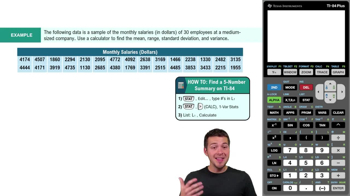
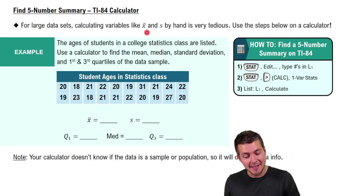
    A handheld device used to quickly compute descriptive statistics and summarize data for large datasets.
  • Descriptive Statistics

    Numerical measures that summarize and describe features of a dataset, aiding interpretation and analysis.
  • Mean

    A value representing the average of all data points, calculated by summing values and dividing by their count.
  • Standard Deviation

    A measure indicating how spread out data values are from the average, reflecting variability within the dataset.
  • Median

    A value separating the higher half from the lower half of a dataset, providing a central tendency indicator.
  • Quartile

    A value dividing a dataset into four equal parts, helping identify data distribution and spread.
  • First Quartile

    A cutoff point below which 25% of the data values lie, marking the lower quarter of the dataset.
  • Third Quartile

    A cutoff point below which 75% of the data values lie, marking the upper quarter of the dataset.
  • Five-Number Summary

    A collection of five values—minimum, Q1, median, Q3, and maximum—offering a concise overview of data distribution.
  • Minimum

    The smallest value in a dataset, indicating the lower boundary of the data range.
  • Maximum

    The largest value in a dataset, indicating the upper boundary of the data range.
  • Data Distribution

    The arrangement of values within a dataset, revealing patterns, spread, and central tendency.
  • Central Tendency

    A characteristic describing the center or typical value of a dataset, often summarized by mean or median.
  • Variability

    A feature reflecting how much data values differ from each other, often measured by standard deviation.
  • Sample

    A subset of a population used for statistical analysis, often requiring specific calculations for measures like standard deviation.