Back

Frequency Polygons definitions

Control buttons has been changed to "navigation" mode.
1/15
  • Frequency Polygon

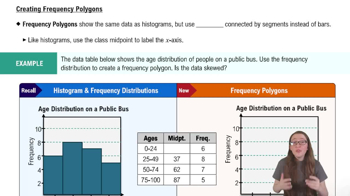
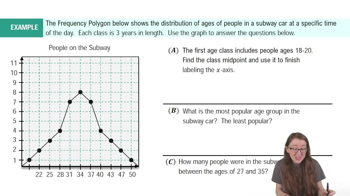
    A graph displaying frequency distribution using points at class midpoints connected by segments, offering a visual alternative to histograms.
  • Histogram

    A bar graph representing frequency distribution, where bar heights correspond to class frequencies and bars touch each other.
  • Frequency Distribution

    A summary showing how data values are grouped into classes and the number of occurrences in each class.
  • Class Midpoint

    A value calculated as the average of a class's lower and upper limits, used for plotting points in frequency polygons.
  • Class Limit

    The smallest and largest values that define the boundaries of a class interval in a frequency distribution.
  • Segment

    A straight line connecting two plotted points in a frequency polygon, forming the shape of the graph.
  • Y-Axis

    The vertical axis on a graph representing frequencies, identical in both histograms and frequency polygons.
  • X-Axis

    The horizontal axis on a graph labeled with class midpoints, used for both histograms and frequency polygons.
  • Skew

    A characteristic of a distribution indicating asymmetry, determined by the direction and length of the tails relative to the peak.
  • Peak

    The highest point on a frequency polygon or histogram, representing the class with the greatest frequency.
  • Tail

    The extended portion of a frequency polygon or histogram, used to assess skewness by its length and direction.
  • Scale

    A system of marks on axes that ensures consistent measurement and comparison of frequencies across graphs.
  • Line Graph

    A graph type often confused with frequency polygons, but differs by plotting individual data points rather than class frequencies.
  • Data Interpretation

    The process of analyzing graphical representations to extract meaningful information about frequency and distribution.
  • Visualization

    The use of graphical tools like histograms and frequency polygons to represent and understand statistical data.