Back

Frequency Polygons quiz

Control buttons has been changed to "navigation" mode.
1/15
  • What is a frequency polygon and how does it differ from a histogram?

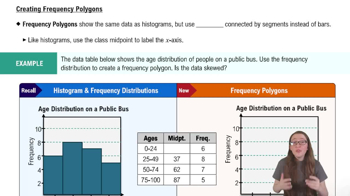
    A frequency polygon is a graph that displays frequency distributions using points connected by segments instead of bars, unlike a histogram which uses bars.
  • How are the points plotted on a frequency polygon determined?

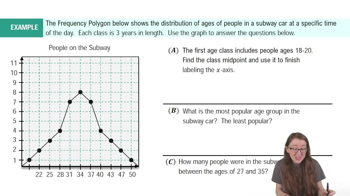
    Points are plotted at the class midpoints on the x-axis, with their y-coordinates representing the frequencies of each class.
  • What does the y-axis represent in a frequency polygon?

    The y-axis represents the frequencies of the classes, just like in a histogram.
  • How do you calculate a class midpoint for a frequency polygon?

    Add the lower and upper limits of the class and divide by two to find the class midpoint.
  • How do you connect the points in a frequency polygon?

    Connect the plotted points with straight line segments, and also connect the first and last points to the x-axis.
  • Why do we connect the first and last points of a frequency polygon to the x-axis?

    This closes the polygon and visually represents the start and end of the data distribution.
  • How is the x-axis labeled in a frequency polygon?

    The x-axis is labeled with the class midpoints for each class interval.
  • How do you interpret a point on a frequency polygon?

    A point's x-coordinate is the class midpoint and its y-coordinate is the frequency for that class interval.
  • What is the main similarity between histograms and frequency polygons?

    Both display the same frequency distribution data and use the same axes and scales.
  • How can you use a frequency polygon to analyze skewness in data?

    Look for the peak of the polygon and check if the tails extend further to the left or right to determine skewness.
  • What does it mean if a frequency polygon has a peak with tails extending equally on both sides?

    It means the data is not skewed and is roughly symmetric.
  • How is a frequency polygon different from a line graph?

    A frequency polygon shows frequencies for class intervals, not exact values, while a line graph typically shows trends for specific data points.
  • If a frequency polygon has a long tail to the right, what type of skew does the data have?

    The data is right-skewed.
  • What does a point at (37, 8) on a frequency polygon indicate?

    It indicates that the class with midpoint 37 has a frequency of 8.
  • Why is understanding frequency polygons important in statistics?

    They enhance data interpretation and visualization skills by providing an alternative way to display and analyze frequency distributions.