Back

Histograms definitions

Control buttons has been changed to "navigation" mode.
1/15
  • Histogram

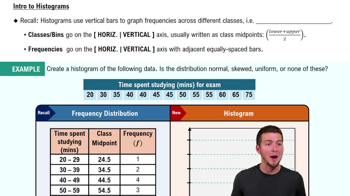
    Graphical display of quantitative data using vertical bars with touching edges to show frequency across classes.
  • Frequency Distribution

    Table organizing data into classes and showing how often each class occurs within a dataset.
  • Class Midpoint

    Value calculated by averaging the upper and lower class limits, used for labeling the x-axis in histograms.
  • Class Width

    Numerical difference between consecutive lower class limits, determining the span of each bar in a histogram.
  • Vertical Axis

    Axis representing frequencies in a histogram, indicating the height of each bar.
  • Horizontal Axis

    Axis displaying class midpoints or bins in a histogram, showing the range of data values.
  • Normal Distribution

    Symmetrical bell-shaped pattern where frequencies peak in the middle and taper at both ends.
  • Right-Skewed Distribution

    Pattern where data peaks left and tails off to the right, often seen in income or similar datasets.
  • Left-Skewed Distribution

    Pattern where data peaks right and tails off to the left, commonly observed in life expectancy data.
  • Uniform Distribution

    Pattern where all classes have equal or nearly equal frequencies, such as outcomes of dice rolls.
  • Stat Plot

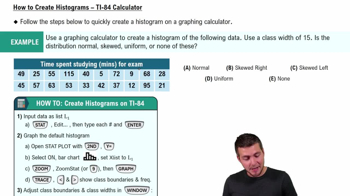
    Calculator feature enabling graphical representation of data, including histograms, by selecting plot type.
  • Window Settings

    Calculator adjustments controlling axis ranges and scales, crucial for fitting histogram bars to data.
  • Trace Function

    Calculator tool allowing navigation through histogram bars to view class boundaries and frequencies.
  • Bin

    Interval grouping data values in a histogram, each represented by a bar showing its frequency.
  • TI-84 Calculator

    Graphing device streamlining histogram creation and analysis by automating data input and visualization.