Ch. 1 - Introduction to Statistics
Larson - Elementary Statistics: Picturing the World 8th Edition
Larson8th EditionElementary Statistics: Picturing the WorldISBN: 9780137493470Not the one you use?Change textbook
Chapter 1, Problem 1.3.13

Determine whether the study is an observational study or an experiment. Explain.
A study used periodic blood pressure readings and brain MRIs of adults to find that adults with long periods of high blood pressure were more likely to develop cerebral small blood vessel disease. (Source: American Heart Association)

Verified step by step guidance
1
Identify the key characteristics of an observational study: In an observational study, researchers observe and measure variables without manipulating or controlling them. Participants are not assigned to specific groups or treatments by the researchers.
Identify the key characteristics of an experiment: In an experiment, researchers actively manipulate one or more variables (independent variables) to observe the effect on other variables (dependent variables). Participants are often randomly assigned to groups or treatments.
Analyze the details of the study: The study involves periodic blood pressure readings and brain MRIs of adults. The researchers did not assign participants to have high blood pressure or manipulate their blood pressure levels; they simply observed the participants' natural conditions over time.
Determine whether there is any intervention: Since the researchers did not intervene or assign treatments (e.g., controlling blood pressure levels), this indicates that the study is observational rather than experimental.
Conclude: Based on the lack of manipulation or intervention, the study is an observational study. The researchers observed the relationship between high blood pressure and cerebral small blood vessel disease without influencing the participants' conditions.

Verified video answer for a similar problem:

This video solution was recommended by our tutors as helpful for the problem above.
Video duration:
2m
Was this helpful?

Key Concepts

Here are the essential concepts you must grasp in order to answer the question correctly.

Observational Study

An observational study is a type of research where the investigator observes subjects without manipulating any variables. In this design, researchers collect data on participants' behaviors or conditions as they naturally occur, allowing for the identification of correlations or associations. However, because there is no intervention, causation cannot be established.
Recommended video:
Guided course
04:39
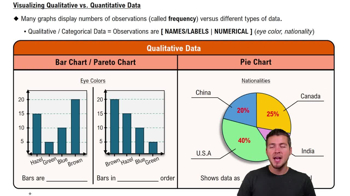
Visualizing Qualitative vs. Quantitative Data

Experiment

An experiment involves the manipulation of one or more independent variables to observe the effect on a dependent variable, allowing researchers to establish cause-and-effect relationships. Participants are typically assigned to different groups, such as treatment and control groups, to assess the impact of the intervention. This design is essential for testing hypotheses in a controlled environment.
Recommended video:
Guided course
06:00
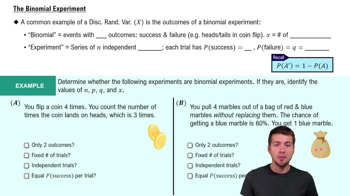
The Binomial Experiment

Causal Inference

Causal inference refers to the process of drawing conclusions about causal relationships based on the data collected. In the context of studies, it is crucial to differentiate between correlation and causation. While observational studies can suggest associations, only experiments can provide stronger evidence for causal claims due to their controlled nature and manipulation of variables.
Recommended video:
Guided course
07:19
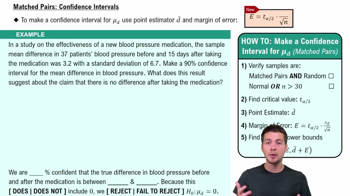
Matched Pairs: Confidence Intervals