
Ch. 2 - Descriptive Statistics
Larson - Elementary Statistics: Picturing the World 8th Edition
Larson8th EditionElementary Statistics: Picturing the WorldISBN: 9780137493470Not the one you use?Change textbook
Chapter 2, Problem 2.4.6

Building Basic Skills and Vocabulary


Given a data set, how do you know whether to calculate σ or s?

Verified step by step guidance
1
Understand the difference between σ (population standard deviation) and s (sample standard deviation). σ is used when you have data for the entire population, while s is used when you have data for a sample of the population.
Determine whether the data set represents the entire population or just a sample. If the data includes every member of the population, you calculate σ. If the data is a subset of the population, you calculate s.
Check the problem statement or context for keywords. For example, terms like 'population' or 'all' suggest you are working with the entire population, while terms like 'sample' or 'subset' indicate you are working with a sample.
Recall the formulas: For σ (population standard deviation), the formula is √(Σ(xᵢ - μ)² / N), where μ is the population mean and N is the population size. For s (sample standard deviation), the formula is √(Σ(xᵢ - x̄)² / (n - 1)), where x̄ is the sample mean and n is the sample size.
Apply the appropriate formula based on your determination in step 2. Use σ if the data represents the population and s if the data represents a sample.

Verified video answer for a similar problem:

This video solution was recommended by our tutors as helpful for the problem above.
Video duration:
1m
Was this helpful?

Key Concepts

Here are the essential concepts you must grasp in order to answer the question correctly.

Population vs. Sample

In statistics, a population refers to the entire group of individuals or observations that you want to draw conclusions about, while a sample is a subset of that population. When analyzing data, it's crucial to determine whether you are working with a complete population or just a sample, as this influences the choice of statistical methods and formulas.
Recommended video:
05:11
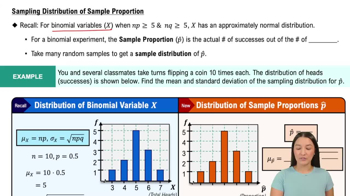
Sampling Distribution of Sample Proportion

Standard Deviation (σ vs. s)

Standard deviation is a measure of the amount of variation or dispersion in a set of values. The symbol σ (sigma) represents the population standard deviation, used when the data set includes the entire population. In contrast, s represents the sample standard deviation, which is used when the data set is a sample from a larger population, accounting for the additional uncertainty in estimates.
Recommended video:
Guided course
08:45
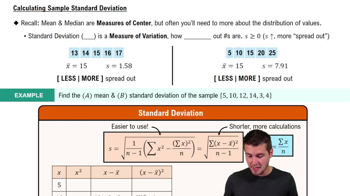
Calculating Standard Deviation

Statistical Inference

Statistical inference involves using data from a sample to make generalizations or predictions about a population. Understanding whether to use σ or s is essential for accurate inference, as using the wrong standard deviation can lead to incorrect conclusions about the population's characteristics based on the sample data.
Recommended video:
Guided course
05:53
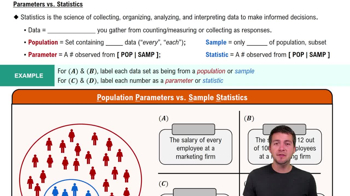
Parameters vs. Statistics
Related Practice
Textbook Question

Graphing Data Sets In Exercises 17–32, organize the data using the indicated type of graph. Describe any patterns.


Nursing Use a stem-and-leaf plot to display the data, which represent the number of hours 24 nurses work per week. 

40 40 35 48 38 40 36 50 32 36 40 35

30 24 40 36 40 36 40 39 33 40 32 38

151
views
Textbook Question

Constructing a Frequency Distribution and a Relative Frequency Histogram In Exercises 37–40, construct a frequency distribution and a relative frequency histogram for the data set using five classes. Which class has the greatest relative frequency and which has the least relative frequency?

Taste Test

Data set: Ratings from 1 (lowest) to 10 (highest) provided by 36 people after taste-testing a new flavor of protein bar 2 6 9 2 9 9 6 10 5 8 7 6 5 10 1 4 9 3 4 5 3 6 5 2 4 9 2 9 3 3 6 5 1 9 4 2

260
views
Textbook Question

Finding z-Scores The distribution of the ages of the winners of the Tour de France from 1903 to 2020 is approximately bell-shaped. The mean age is 27.9 years, with a standard deviation of 3.4 years. In Exercises 43–48, use the corresponding z-score to determine whether the age is unusual. Explain your reasoning. (Source: Le Tour de France)

100
views
Textbook Question

Building Basic Skills and Vocabulary


Explain how to find the range of a data set. What is an advantage of using the range as a measure of variation? What is a disadvantage?

123
views
Textbook Question

use the frequency polygon to identify the class with the greatest, and the class with the least, frequency.

82
views
Textbook Question

In Exercises 37– 40, without performing any calculations, determine which measure of central tendency best represents the graphed data. Explain your reasoning.

135
views