Ch. 2 - Descriptive Statistics
Larson - Elementary Statistics: Picturing the World 8th Edition
Larson8th EditionElementary Statistics: Picturing the WorldISBN: 9780137493470Not the one you use?Change textbook
Chapter 2, Problem 2.4.23

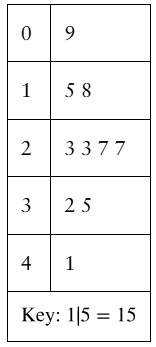
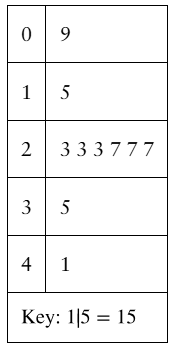
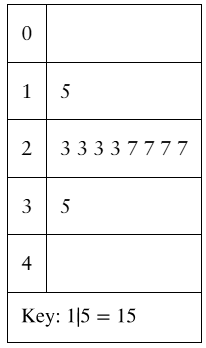
Graphical Analysis In Exercises 21–24, you are asked to compare three data sets.


(c) Estimate the sample standard deviations. Then determine how close each of your estimates is by finding the sample standard deviations.


i. ii. iii.

Verified step by step guidance
1
Step 1: Extract the data points from each stem-and-leaf plot. For example, in the first plot, the data points are 9, 15, 18, 23, 23, 27, 32, 35, and 41. Repeat this process for the other two plots.
Step 2: Calculate the mean (average) for each data set. Use the formula: μ=xn, where x represents each data point and n is the total number of data points.
Step 3: Compute the deviations from the mean for each data point in each data set. Subtract the mean from each data point to find the deviation.
Step 4: Square each deviation and calculate the average of these squared deviations. This is the variance, calculated using the formula: σ²=x-μ2n.
Step 5: Take the square root of the variance to find the sample standard deviation for each data set. Use the formula: σ=x-μ2n.

Verified video answer for a similar problem:

This video solution was recommended by our tutors as helpful for the problem above.
Video duration:
11m
Was this helpful?

Key Concepts

Here are the essential concepts you must grasp in order to answer the question correctly.

Sample Standard Deviation

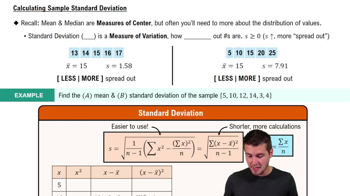
The sample standard deviation is a measure of the amount of variation or dispersion in a set of values. It quantifies how much the individual data points deviate from the sample mean. A low standard deviation indicates that the data points tend to be close to the mean, while a high standard deviation indicates a wider spread of values.
Recommended video:
Guided course
08:45
Calculating Standard Deviation

Estimating Standard Deviation

Estimating the sample standard deviation involves using visual data representations, such as graphs, to gauge the spread of data points. This can be done by observing the range and clustering of values in the data set. While estimates provide a quick insight, they should be verified with actual calculations for accuracy.
Recommended video:
Guided course
08:45
Calculating Standard Deviation

Data Set Comparison

Comparing data sets involves analyzing their statistical properties, such as means, medians, and standard deviations, to understand their differences and similarities. This comparison can reveal trends, patterns, or anomalies within the data, aiding in decision-making or hypothesis testing in research.
Recommended video:
4:01
Introduction to Collecting Data
Related Practice
Textbook Question

Graphing Data Sets In Exercises 17–32, organize the data using the indicated type of graph. Describe any patterns.


Highest-Paid Athletes Use a stem-and-leaf plot that has two rows for each stem to display the data, which represent the incomes (in millions) of the top 30 highest-paid athletes. (Source: Forbes Media LLC)

39 42 41 45 48 48 106 45 88 54 61 37 62 74 40

47 56 57 105 96 37 48 41 64 52 47 45 59 49 104

118
views
Textbook Question

Estimating the Sample Mean and Standard Deviation for Grouped Data In Exercises 41–44, make a frequency distribution for the data. Then use the table to estimate the sample mean and the sample standard deviation of the data set.

Weekly Study Hours The distribution of the number of hours that a random sample of college students study per week is shown in the pie chart. Use 32 as the midpoint for “30+ hours.”

107
views
Textbook Question

Graphical Analysis In Exercises 9–12, use the stem-and-leaf plot or dot plot to list the actual data entries. What is the maximum data entry? What is the minimum data entry?


" style="" width="385">

255
views
Textbook Question

Salary Offers You are applying for jobs at two companies. Company C offers starting salaries with μ = \$59,000 and σ = \$1500. Company D offers starting salaries with μ = \$59,000 and σ = \$1000. From which company are you more likely to get an offer of \$62,000 or more? Explain your reasoning.

124
views
Textbook Question

Constructing Data Sets In Exercises 25–28, construct a data set that has the given statistics.


n = 6

x̄ = 7

s ≈ 2

74
views
Textbook Question

Matching In Exercises 13–16, match the distribution with one of the graphs in Exercises 9–12. Justify your decision.

The frequency distribution of mileages of service vehicles at a business where a few vehicles have much higher mileages than the majority of vehicles

97
views