
Ch. 2 - Descriptive Statistics
Larson - Elementary Statistics: Picturing the World 8th Edition
Larson8th EditionElementary Statistics: Picturing the WorldISBN: 9780137493470Not the one you use?Change textbook
Chapter 2, Problem 2.2.31

Graphing Data Sets In Exercises 17–32, organize the data using the indicated type of graph. Describe any patterns.


Engineering Degrees Use a time series chart to display the data shown in the table. The data represent the number of bachelor’s degrees in engineering (in thousands) conferred in the U.S. (Source: U.S. Deapartment of Education)
Time-series graph showing the number of engineering bachelor's degrees conferred in the U.S. from 2011 to 2019.

Verified step by step guidance
1
Step 1: Understand the problem. You are tasked with creating a time series chart to display the data provided in the table. A time series chart is a graph that shows data points at successive time intervals, typically with time on the x-axis and the variable of interest on the y-axis.
Step 2: Identify the variables. In this case, the x-axis will represent the years (2011 to 2019), and the y-axis will represent the number of engineering degrees conferred (in thousands). The data points are: (2011, 93.1), (2012, 98.7), (2013, 103.0), (2014, 109.0), (2015, 115.1), (2016, 123.9), (2017, 133.8), (2018, 140.7), (2019, 146.3).
Step 3: Plot the data points. On graph paper or using software, mark the years on the x-axis and the number of degrees on the y-axis. Ensure the scale is appropriate to fit all data points clearly. For example, the x-axis could range from 2011 to 2019, and the y-axis could range from 90 to 150 (in thousands).
Step 4: Connect the data points. Use a line to connect the points sequentially from 2011 to 2019. This will create the time series chart, showing the trend in the number of engineering degrees conferred over time.
Step 5: Analyze the pattern. Observe the graph for trends. In this case, the number of engineering degrees conferred appears to increase steadily over the years, indicating a positive trend in the data.

Verified video answer for a similar problem:

This video solution was recommended by our tutors as helpful for the problem above.
Video duration:
4m
Was this helpful?

Key Concepts

Here are the essential concepts you must grasp in order to answer the question correctly.

Time Series Data

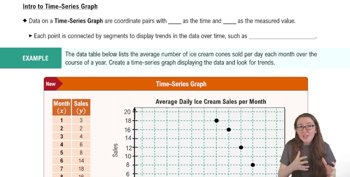
Time series data is a sequence of data points collected or recorded at successive points in time, often at uniform intervals. In this context, the data represents the number of engineering degrees conferred annually from 2011 to 2019. Analyzing time series data helps identify trends, seasonal patterns, and fluctuations over time.
Recommended video:
04:13
Creating Time-Series Graphs

Graphing Techniques

Graphing techniques involve visual representations of data to facilitate understanding and analysis. A time series chart, specifically, displays data points over time, allowing for easy identification of trends and patterns. Proper graphing techniques enhance clarity and can reveal insights that raw data may not immediately show.
Recommended video:
04:13
Creating Time-Series Graphs

Trend Analysis

Trend analysis is the practice of collecting information and attempting to spot a pattern or trend in the data over time. In the context of the engineering degrees data, trend analysis would involve examining the increase in degrees conferred from 2011 to 2019, helping to understand the growth in engineering education and its implications for the workforce.
Recommended video:
04:13
Creating Time-Series Graphs
Related Practice
Textbook Question

Construct a cumulative frequency distribution and an ogive for the data set using six classes. Then describe the location of the greatest increase in frequency.

Retirement Ages

Data set: Retirement ages of 35 English professors 72 62 55 61 53 62 65 66 69 55 66 63 67 69 55 65 67 57 67 68 73 75 65 54 71 57 52 58 58 71 72 67 63 65 61

182
views
Textbook Question

Identifying the Shape of a Distribution In Exercises 53–56, construct a frequency distribution and a frequency histogram for the data set using the indicated number of classes. Describe the shape of the histogram as symmetric, uniform, negatively skewed, positively skewed, or none of these.


Heights of Males

Number of classes: 5

Data set: The heights (to the nearest inch) of 30 males

67 76 69 68 72 68 65 63 75 69

66 72 67 66 69 73 64 62 71 73

68 72 71 65 69 66 74 72 68 69

265
views
Textbook Question

Interpreting Percentiles In Exercises 29–32, use the ogive, which represents the cumulative frequency distribution for quantitative reasoning scores on the Graduate Record Examination in a recent range of years. (Adapted from Educational Testing Service)

What percentile is a score of 170? How should you interpret this?

266
views
Textbook Question

Extending Concepts


Midquartile Another measure of position is called the midquartile. You can find the midquartile of a data set by using the formula below.

Midquartile = (Q₁ + Q₃) / 2

In Exercises 55 and 56, find the midquartile of the data set.


5 7 1 2 3 10 8 7 5 3

121
views
Textbook Question

The mean annual salary for a sample of electrical engineers is \$86,500, with a standard deviation of \(1500. The data set has a bell-shaped distribution.


b. The salaries of three randomly selected electrical engineers are \)93,500, \$85,600, and \$82,750. Find the z-score that corresponds to each salary. Determine whether any of these salaries are unusual.

78
views
Textbook Question

Tail lengths (in feet) for a sample of American alligators are listed.

6.5 3.4 4.2 7.1 5.4 6.8 7.5 3.9 4.6


a. Find the mean, median, and mode of the tail lengths. Which best describes a typical American alligator tail length? Explain your reasoning.

83
views