Ch. 4 - Discrete Probability Distributions
Larson - Elementary Statistics: Picturing the World 8th Edition
Larson8th EditionElementary Statistics: Picturing the WorldISBN: 9780137493470Not the one you use?Change textbook
Chapter 4, Problem 4.1.26

Determining a Missing Probability In Exercises 25 and 26, determine the missing probability for the probability distribution.

Verified step by step guidance
1
Step 1: Recall that for a probability distribution, the sum of all probabilities must equal 1. This is a fundamental property of probability distributions.
Step 2: Write the equation for the sum of probabilities: P(0) + P(1) + P(2) + P(3) + P(4) + P(5) + P(6) = 1.
Step 3: Substitute the known probabilities into the equation: 0.05 + P(1) + 0.23 + 0.21 + 0.17 + 0.11 + 0.08 = 1.
Step 4: Combine all the known probabilities: 0.05 + 0.23 + 0.21 + 0.17 + 0.11 + 0.08 = 0.85.
Step 5: Solve for the missing probability P(1) by subtracting the sum of the known probabilities from 1: P(1) = 1 - 0.85.

Verified video answer for a similar problem:

This video solution was recommended by our tutors as helpful for the problem above.
Video duration:
2m
Was this helpful?

Key Concepts

Here are the essential concepts you must grasp in order to answer the question correctly.

Probability Distribution

A probability distribution describes how the probabilities are distributed over the values of a random variable. It provides a complete description of the likelihood of each possible outcome. In this case, the distribution is discrete, as it lists specific values of x and their corresponding probabilities.
Recommended video:
Guided course
06:39
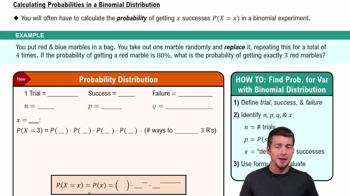
Calculating Probabilities in a Binomial Distribution

Sum of Probabilities

In any probability distribution, the sum of all probabilities must equal 1. This principle is fundamental in determining missing probabilities, as it allows us to calculate the unknown value by subtracting the sum of known probabilities from 1. This ensures that the distribution is valid and adheres to the rules of probability.
Recommended video:
5:37
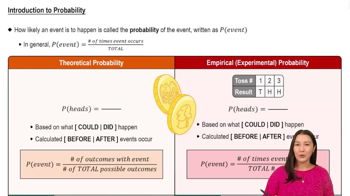
Introduction to Probability

Missing Probability Calculation

To find a missing probability in a distribution, you can use the equation derived from the sum of probabilities. By adding the known probabilities and subtracting this sum from 1, you can isolate and determine the unknown probability. This method is essential for completing the probability distribution accurately.
Recommended video:
Guided course
07:09
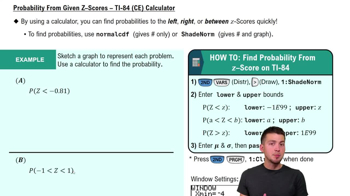
Probability From Given Z-Scores - TI-84 (CE) Calculator
Related Practice
Textbook Question

Identifying Probability Distributions In Exercises 27 and 28, determine whether the distribution is a probability distribution. If it is not a probability distribution, explain why.

195
views

Textbook Question

Using a Distribution to Find Probabilities In Exercises 11–26, find the indicated probabilities using the geometric distribution, the Poisson distribution, or the binomial distribution. Then determine whether the events are unusual. If convenient, use a table or technology to find the probabilities.


Pass Completions NFL player Aaron Rodgers completes a pass 65.1% of the time. Find the probability that (a) the first pass he completes is the second pass, (b) the first pass he completes is the first or second pass, and (c) he does not complete his first two passes. (Source: National Football League)

108
views
Textbook Question

Finding the Mean, Variance, and Standard Deviation In Exercises 29–34, (a) find the mean, variance, and standard deviation of the probability distribution, and (b) interpret the results.

Dogs The number of dogs per household in a neighborhood

251
views
Textbook Question

Discrete Variables and Continuous Variables In Exercises 13–18, determine whether the random variable x is discrete or continuous. Explain.


Let x represent the populations of the 50 U.S. states.

144
views
Textbook Question

Graphical Analysis In Exercises 3–5, the histogram represents a binomial distribution with five trials. Match the histogram with the appropriate probability of success p. Explain your reasoning.

a. p = 0.25

b. p = 0.50

c. p = 0.75


81
views
Textbook Question

"Using a Distribution to Find Probabilities In Exercises 11–26, find the indicated probabilities using the geometric distribution, the Poisson distribution, or the binomial distribution. Then determine whether the events are unusual. If convenient, use a table or technology to find the probabilities.


Hurricanes The mean number of hurricanes to strike the U.S. mainland per year from 1851 through 2020 was about 1.8. Find the probability that the number of hurricanes striking the U.S. mainland in any given year from 1851 through 2020 is (a) exactly one, (b) at most one, and (c) more than one. (Source: National Oceanic & Atmospheric Administration)"

83
views