Ch. 4 - Discrete Probability Distributions
Larson - Elementary Statistics: Picturing the World 8th Edition
Larson8th EditionElementary Statistics: Picturing the WorldISBN: 9780137493470Not the one you use?Change textbook
Chapter 4, Problem 4.2.3

Graphical Analysis In Exercises 3–5, the histogram represents a binomial distribution with five trials. Match the histogram with the appropriate probability of success p. Explain your reasoning.
a. p = 0.25
b. p = 0.50
c. p = 0.75
Histogram displaying a binomial distribution with five trials, showing probabilities for values 0 to 5 on the x-axis.

Verified step by step guidance
1
Step 1: Understand the problem. The histogram represents a binomial distribution with five trials, and we need to match it with the correct probability of success (p). The options are p = 0.25, p = 0.50, and p = 0.75.
Step 2: Recall the properties of a binomial distribution. The binomial distribution is defined by two parameters: the number of trials (n) and the probability of success (p). The shape of the distribution depends on the value of p. For p = 0.25, the distribution is skewed to the right; for p = 0.50, it is symmetric; and for p = 0.75, it is skewed to the left.
Step 3: Analyze the histogram. The histogram shows that the probabilities are concentrated around higher values of x (3, 4, and 5). This indicates that the probability of success (p) is relatively high, as more successes are observed.
Step 4: Match the histogram with the correct value of p. Since the distribution is skewed to the left and the probabilities are concentrated around higher values of x, the appropriate probability of success is p = 0.75.
Step 5: Explain the reasoning. When p = 0.75, the likelihood of success in each trial is high, leading to more occurrences of higher values of x in the binomial distribution. This matches the shape of the histogram provided.

Verified video answer for a similar problem:

This video solution was recommended by our tutors as helpful for the problem above.
Video duration:
3m
Was this helpful?

Key Concepts

Here are the essential concepts you must grasp in order to answer the question correctly.

Binomial Distribution

A binomial distribution models the number of successes in a fixed number of independent Bernoulli trials, each with the same probability of success. It is characterized by two parameters: the number of trials (n) and the probability of success (p). The distribution is discrete, meaning it only takes on integer values from 0 to n, and is often represented graphically using histograms.
Recommended video:
Guided course
03:28
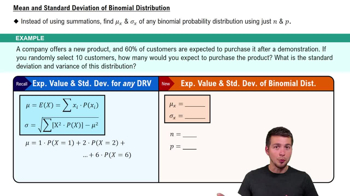
Mean & Standard Deviation of Binomial Distribution

Probability of Success (p)

The probability of success (p) in a binomial distribution indicates the likelihood of achieving a success in a single trial. It ranges from 0 to 1, where 0 means no chance of success and 1 means certainty of success. Different values of p affect the shape of the distribution; for example, p = 0.5 typically results in a symmetric distribution, while values closer to 0 or 1 create skewed distributions.
Recommended video:
5:37
Introduction to Probability

Histogram Interpretation

A histogram visually represents the frequency distribution of a dataset, in this case, the probabilities of different outcomes in a binomial distribution. Each bar corresponds to the probability of achieving a specific number of successes (x) in the trials. By analyzing the heights of the bars, one can infer the most likely outcomes and how they relate to the probability of success, aiding in matching the histogram to the correct value of p.
Recommended video:
Guided course
05:54
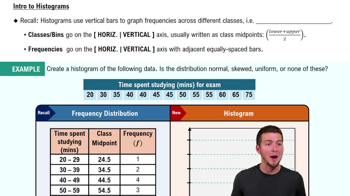
Intro to Histograms
Related Practice
Textbook Question

In your own words, describe the difference between the value of x in a binomial distribution and in the Poisson distribution.

143
views
Textbook Question

Identifying Probability Distributions In Exercises 27 and 28, determine whether the distribution is a probability distribution. If it is not a probability distribution, explain why.

195
views
Textbook Question

Discrete Variables and Continuous Variables In Exercises 13–18, determine whether the random variable x is discrete or continuous. Explain.


Let x represent the populations of the 50 U.S. states.

144
views
Textbook Question

Determining a Missing Probability In Exercises 25 and 26, determine the missing probability for the probability distribution.

162
views
Textbook Question

Finding an Expected Value In Exercises 37 and 38, find the expected value E(x) to the player for one play of the game. If x is the gain to a player in a game of chance, then E(x) is usually negative. This value gives the average amount per game the player can expect to lose.


In American roulette, the wheel has the 38 numbers, 00, 0, 1, 2, . . ., 34, 35, and 36, marked on equally spaced slots. If a player bets \$1 on a number and wins, then the player keeps the dollar and receives an additional \$35. Otherwise, the dollar is lost.

112
views
Textbook Question

"Using a Distribution to Find Probabilities In Exercises 11–26, find the indicated probabilities using the geometric distribution, the Poisson distribution, or the binomial distribution. Then determine whether the events are unusual. If convenient, use a table or technology to find the probabilities.


Hurricanes The mean number of hurricanes to strike the U.S. mainland per year from 1851 through 2020 was about 1.8. Find the probability that the number of hurricanes striking the U.S. mainland in any given year from 1851 through 2020 is (a) exactly one, (b) at most one, and (c) more than one. (Source: National Oceanic & Atmospheric Administration)"

83
views