
Ch. 3 - Describing, Exploring, and Comparing Data
Triola - Elementary Statistics 14th Edition
Triola14th EditionElementary StatisticsISBN: 9780137366446Not the one you use?Change textbook
Chapter 3, Problem 3.2.19

In Exercises 5–20, find the range, variance, and standard deviation for the given sample data. Include appropriate units (such as “minutes”) in your results. (The same data were used in Section 3-1, where we found measures of center. Here we find measures of variation.) Then answer the given questions.


California Smokers In the California Health Interview Survey, randomly selected adults are interviewed. One of the questions asks how many cigarettes are smoked per day, and results are listed below for 50 randomly selected respondents. How well do the results reflect the smoking behavior of California adults?


[IMAGE]

Verified step by step guidance
1
Step 1: Identify the data set provided in the problem. The data represents the number of cigarettes smoked per day by 50 randomly selected respondents. Ensure you have the full data set to proceed with calculations.
Step 2: Calculate the range of the data. The range is the difference between the maximum and minimum values in the data set. Use the formula: Range=Max-Min.
Step 3: Compute the variance for the sample data. First, find the mean (average) of the data using the formula: Mean=xn. Then, calculate the squared differences between each data point and the mean, sum them up, and divide by n-1 (since this is a sample). The formula for sample variance is: s2=(x-Mean)2n-1.
Step 4: Calculate the standard deviation. The standard deviation is the square root of the variance. Use the formula: s=s2. This provides a measure of how spread out the data is around the mean.
Step 5: Interpret the results. Compare the range, variance, and standard deviation to assess the variability in the data. Discuss how well the sample data reflects the smoking behavior of California adults, considering the sample size and randomness of the selection process.

Verified video answer for a similar problem:

This video solution was recommended by our tutors as helpful for the problem above.
Video duration:
7m
Was this helpful?

Key Concepts

Here are the essential concepts you must grasp in order to answer the question correctly.

Range

The range is a measure of variation that indicates the difference between the highest and lowest values in a data set. It provides a simple way to understand the spread of the data, showing how much variability exists. For example, if the highest number of cigarettes smoked per day is 20 and the lowest is 0, the range would be 20 - 0 = 20 cigarettes.
Recommended video:
Guided course
05:45
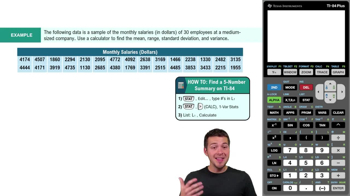
Find 5-Number Summary - TI-84 Calculator Example 1

Variance

Variance quantifies the degree to which data points differ from the mean of the data set. It is calculated by averaging the squared differences between each data point and the mean. A higher variance indicates greater dispersion among the data points, which can be crucial for understanding the consistency of smoking behavior among respondents.
Recommended video:
Guided course
04:48
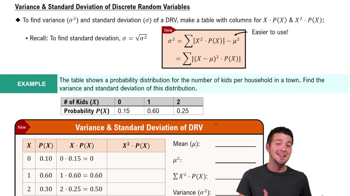
Variance & Standard Deviation of Discrete Random Variables

Standard Deviation

Standard deviation is the square root of the variance and provides a measure of the average distance of each data point from the mean. It is expressed in the same units as the original data, making it more interpretable. A smaller standard deviation suggests that the data points are closer to the mean, while a larger standard deviation indicates more variability in smoking habits among the surveyed individuals.
Recommended video:
Guided course
08:45
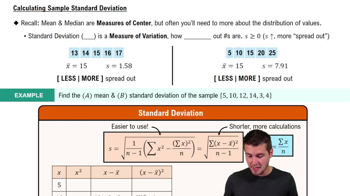
Calculating Standard Deviation
Related Practice
Textbook Question

Boxplots. In Exercises 29–32, use the given data to construct a boxplot and identify the 5-number summary.


Taxis Listed below are times (minutes) of a sample of taxi rides in New York City. The data are from the New York City Taxi and Limousine Commission.

15123131133624

138
views
Textbook Question

In Exercises 21–24, find the mean and median for each of the two samples, then compare the two sets of results.


Blood Pressure A sample of blood pressure measurements is taken from Data Set 1 “Body Data” in Appendix B, and those values (mm Hg) are listed below. The values are matched so that 10 subjects each have systolic and diastolic measurements. (Systolic is a measure of the force of blood being pushed through arteries, but diastolic is a measure of blood pressure when the heart is at rest between beats.) Are the measures of center the best statistics to use with these data? What else might be better?

Systolic: 118 128 158 96 156 122 116 136 126 120

Diastolic: 80  76  74  52  90  88  58   64  72  82

186
views
Textbook Question

Estimating Standard Deviation with the Range Rule of Thumb. In Exercises 29–32, refer to the data in the indicated exercise. After finding the range of the data, use the range rule of thumb to estimate the value of the standard deviation. Compare the result to the standard deviation computed using all of the data.


Body Temperatures Refer to Data Set 5 “Body Temperatures” in Appendix B and use the body temperatures for 12:00 AM on day 2.

320
views
Textbook Question

Large Data Sets from Appendix B. In Exercises 25–28, refer to the indicated data set in Appendix B. Use software or a calculator to find the range, variance, and standard deviation. Express answers using appropriate units, such as “minutes.”


Earthquakes Use the magnitudes (Richter scale) of the 600 earthquakes listed in Data Set 24 “Earthquakes” in Appendix B. In 1989, the San Francisco Bay Area was struck with an earthquake that measured 7.0 on the Richter scale. If we add that value of 7.0 to those listed in the data set, do the measures of variation change much?

149
views
Textbook Question

Large Data Sets from Appendix B. In Exercises 25–28, refer to the indicated data set in Appendix B. Use software or a calculator to find the means and medians.


Weights Use the weights of the males listed in Data Set 2 “ANSUR I 1988,” which were measured in 1988 and use the weights of the males listed in Data Set 3 “ANSUR II 2012,” which were measured in 2012. Does it appear that males have become heavier?

160
views
Textbook Question

Weighted Mean A student of the author earned grades of 63, 91, 88, 84, and 79 on her five regular statistics tests. She earned grades of 86 on the final exam and 90 on her class projects. Her combined homework grade was 70. The five regular tests count for 60% of the final grade, the final exam counts for 10%, the project counts for 15%, and homework counts for 15%. What is her weighted mean grade? What letter grade did she earn (A, B, C, D, or F)? Assume that a mean of 90 or above is an A, a mean of 80 to 89 is a B, and so on.

209
views