Ch. 3 - Describing, Exploring, and Comparing Data
Triola - Elementary Statistics 14th Edition
Triola14th EditionElementary StatisticsISBN: 9780137366446Not the one you use?Change textbook
Chapter 3, Problem 3.CRE.7

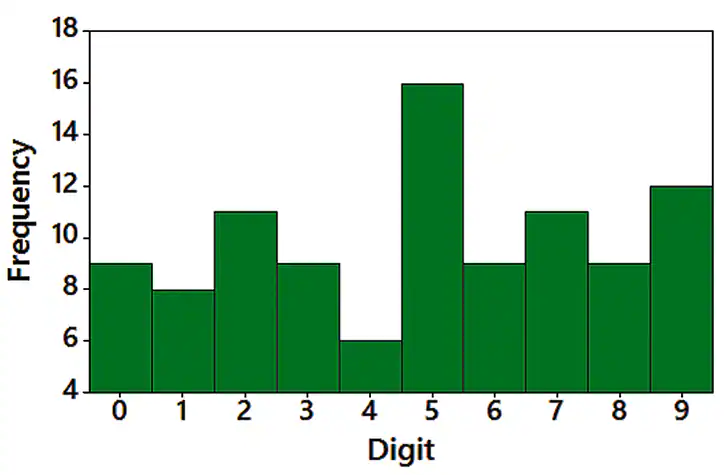
Normal Distribution Examine the distribution shown in the histogram from Exercise 6. Does it appear that the sample data are from a population with a normal distribution? Why or why not?
Histogram showing frequency of digits 0-9. Peaks at digit 5, with uneven distribution across other digits.

Verified step by step guidance
1
Step 1: Observe the histogram provided. A normal distribution typically has a bell-shaped curve, where the frequencies are highest at the center and taper off symmetrically towards the tails. In this histogram, the frequencies do not follow this pattern.
Step 2: Note the peaks and troughs in the histogram. For a normal distribution, the frequencies should gradually decrease as you move away from the center. However, the histogram shows irregular peaks, such as the high frequency at digit 5 and lower frequencies at digits 3 and 4.
Step 3: Assess the symmetry of the distribution. A normal distribution is symmetric around its mean. In this histogram, the frequencies are not symmetric; for example, the frequencies for digits 0, 1, and 2 differ significantly from those for digits 7, 8, and 9.
Step 4: Consider the spread of the data. A normal distribution has a smooth, continuous spread. The histogram here shows a jagged pattern with abrupt changes in frequency, which is inconsistent with a normal distribution.
Step 5: Conclude based on the observations. The irregular shape, lack of symmetry, and uneven spread of frequencies suggest that the sample data are not from a population with a normal distribution.

Verified video answer for a similar problem:

This video solution was recommended by our tutors as helpful for the problem above.
Video duration:
3m
Was this helpful?

Key Concepts

Here are the essential concepts you must grasp in order to answer the question correctly.

Normal Distribution

Normal distribution is a probability distribution that is symmetric about the mean, showing that data near the mean are more frequent in occurrence than data far from the mean. It is characterized by its bell-shaped curve, where the mean, median, and mode are all equal. In a normal distribution, approximately 68% of the data falls within one standard deviation of the mean, which is crucial for understanding the spread and central tendency of the data.
Recommended video:
Guided course
03:17
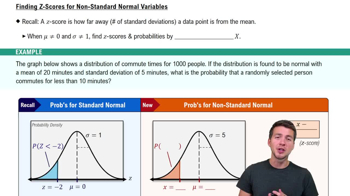
Finding Z-Scores for Non-Standard Normal Variables

Histogram

A histogram is a graphical representation of the distribution of numerical data, where the data is divided into bins or intervals. The height of each bar represents the frequency of data points within that interval. Histograms are useful for visualizing the shape of the data distribution, identifying patterns, and detecting outliers, which can help in assessing whether the data follows a normal distribution.
Recommended video:
Guided course
05:54
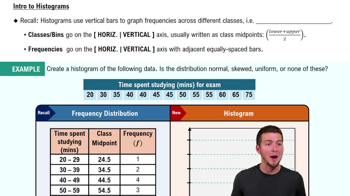
Intro to Histograms

Skewness

Skewness refers to the asymmetry of the distribution of values in a dataset. A distribution is said to be positively skewed if it has a longer tail on the right side, while a negatively skewed distribution has a longer tail on the left. Assessing skewness is important when determining if a dataset approximates a normal distribution, as significant skewness indicates deviations from normality, which can affect statistical analyses.
Recommended video:
04:41
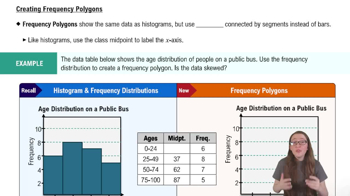
Creating Frequency Polygons
Related Practice
Textbook Question

Mean of Roller Coaster Speeds Listed below are maximum speeds (km/h) of randomly selected roller coasters in the United States. Find the mean.

7076978157151194651176545105

168
views

Textbook Question

Sugar Listed below are measured weights (mg) of sugar in Domino packets labelled as containing 3500 mg (or 3.5 g).


[IMAGE]


d. Given that the weights are from Domino sugar packets selected from a much larger population, are the weights a sample or a population?

221
views
Textbook Question

Roller Coaster Speed Outlier Identify any outliers among the data listed for Exercise 1.

137
views
Textbook Question

Boxplot Using the same differences from Exercise 1, construct a boxplot and include the values of the 5-number summary.

191
views
Textbook Question

In Exercises 5–20, find the range, variance, and standard deviation for the given sample data. Include appropriate units (such as “minutes”) in your results. (The same data were used in Section 3-1, where we found measures of center. Here we find measures of variation.) Then answer the given questions.


Smart Thermostats Listed below are selling prices (dollars) of smart thermostats tested by Consumer Reports magazine. Are any of the resulting statistics helpful in selecting a smart thermostat for purchase?


250 170 225 100 250 250 130 200 150 250 170 200 180 250

163
views
Textbook Question

Correlation Between Magnitudes and Depths Using the paired magnitude/depth data, construct the graph that is helpful in determining whether there is a correlation between earthquake magnitudes and depths. Based on the result, does there appear to be a correlation?

167
views