Ch. 3 - Describing, Exploring, and Comparing Data
Triola - Elementary Statistics 14th Edition
Triola14th EditionElementary StatisticsISBN: 9780137366446Not the one you use?Change textbook
Chapter 3, Problem 3.2.41

The Empirical Rule Based on Data Set 1 “Body Data” in Appendix B, blood platelet counts of women have a bell-shaped distribution with a mean of 255.1 and a standard deviation of 65.4. (All units are 1000 cells/) Using the empirical rule, what is the approximate percentage of women with platelet counts


a. within 2 standard deviations of the mean, or between 124.3 and 385.9?

Verified step by step guidance
1
Step 1: Recall the Empirical Rule, which states that for a bell-shaped (normal) distribution: approximately 68% of the data falls within 1 standard deviation of the mean, 95% within 2 standard deviations, and 99.7% within 3 standard deviations.
Step 2: Identify the given values from the problem. The mean (μ) is 255.1, and the standard deviation (σ) is 65.4. The range of interest is within 2 standard deviations of the mean, which corresponds to the interval [μ - 2σ, μ + 2σ].
Step 3: Calculate the lower bound of the interval by subtracting 2 standard deviations from the mean: μ - 2σ = 255.1 - 2(65.4).
Step 4: Calculate the upper bound of the interval by adding 2 standard deviations to the mean: μ + 2σ = 255.1 + 2(65.4).
Step 5: Using the Empirical Rule, conclude that approximately 95% of the data falls within 2 standard deviations of the mean. Therefore, the percentage of women with platelet counts between the calculated lower and upper bounds is approximately 95%.

Verified video answer for a similar problem:

This video solution was recommended by our tutors as helpful for the problem above.
Video duration:
2m
Was this helpful?

Key Concepts

Here are the essential concepts you must grasp in order to answer the question correctly.

Empirical Rule

The Empirical Rule, also known as the 68-95-99.7 rule, states that for a normal distribution, approximately 68% of the data falls within one standard deviation of the mean, about 95% falls within two standard deviations, and around 99.7% falls within three standard deviations. This rule helps in understanding the spread of data in a bell-shaped distribution.
Recommended video:
5:14
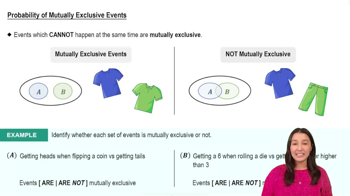
Probability of Mutually Exclusive Events

Standard Deviation

Standard deviation is a measure of the amount of variation or dispersion in a set of values. A low standard deviation indicates that the values tend to be close to the mean, while a high standard deviation indicates that the values are spread out over a wider range. In this context, it helps quantify how platelet counts vary among women.
Recommended video:
Guided course
08:45
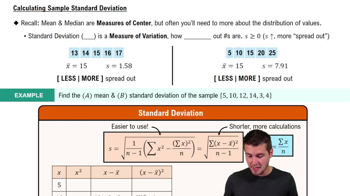
Calculating Standard Deviation

Normal Distribution

A normal distribution is a probability distribution that is symmetric about the mean, showing that data near the mean are more frequent in occurrence than data far from the mean. It is characterized by its bell-shaped curve, where the mean, median, and mode are all equal. Understanding this concept is crucial for applying the Empirical Rule effectively.
Recommended video:
Guided course
09:47
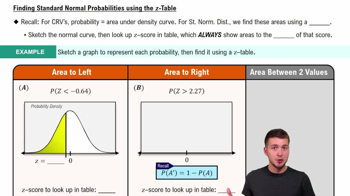
Finding Standard Normal Probabilities using z-Table
Related Practice
Textbook Question

Mean of Roller Coaster Speeds Listed below are maximum speeds (km/h) of randomly selected roller coasters in the United States. Find the mean.

7076978157151194651176545105

168
views
Textbook Question

Percentiles. In Exercises 17–20, use the following radiation levels (in W/kg) for 50 different cell phones. Find the percentile corresponding to the given radiation level.


0.48 W/kg

222
views
Textbook Question

Geometric Mean The geometric mean is often used in business and economics for finding average rates of change, average rates of growth, or average ratios. To find the geometric mean of n values (all of which are positive), first multiply the values, then find the nth root of the product. For a 6-year period, money deposited in annual certificates of deposit had annual interest rates of 0.58%, 0.29%, 0.13%, 0.14%, 0.15%, and 0.19%. Identify the single percentage growth rate that is the same as the six consecutive growth rates by computing the geometric mean of 1.0058, 1.0029, 1.0013, 1.0014, 1.0015, and 1.0019.

401
views
Textbook Question

Identifying Significant Values with the Range Rule of Thumb. In Exercises 33–36, use the range rule of thumb to identify the limits separating values that are significantly low or significantly high.


U.S. Presidents Based on Data Set 22 “Presidents” in Appendix B, at the time of their first inauguration, presidents have a mean age of 55.2 years and a standard deviation of 6.9 years. Is the minimum required 35-year age for a president significantly low?

463
views
Textbook Question

Roller Coaster Speed Outlier Identify any outliers among the data listed for Exercise 1.

137
views
Textbook Question

In Exercises 5–20, find the range, variance, and standard deviation for the given sample data. Include appropriate units (such as “minutes”) in your results. (The same data were used in Section 3-1, where we found measures of center. Here we find measures of variation.) Then answer the given questions.


Smart Thermostats Listed below are selling prices (dollars) of smart thermostats tested by Consumer Reports magazine. Are any of the resulting statistics helpful in selecting a smart thermostat for purchase?


250 170 225 100 250 250 130 200 150 250 170 200 180 250

163
views