
Ch. 6 - Normal Probability Distributions
Triola - Elementary Statistics 14th Edition
Triola14th EditionElementary StatisticsISBN: 9780137366446Not the one you use?Change textbook
Chapter 6, Problem 6.1.37

Finding Bone Density Scores. In Exercises 37–40 assume that a randomly selected subject is given a bone density test. Bone density test scores are normally distributed with a mean of 0 and a standard deviation of 1. In each case, draw a graph, then find the bone density test score corresponding to the given information. Round results to two decimal places.


Find P99, the 99th percentile. This is the bone density score separating the bottom 99% from the top 1%.

Verified step by step guidance
1
Step 1: Understand the problem. The goal is to find the bone density test score corresponding to the 99th percentile (P99) in a standard normal distribution. This means we are looking for the z-score that separates the bottom 99% of the distribution from the top 1%.
Step 2: Recall that the standard normal distribution has a mean (μ) of 0 and a standard deviation (σ) of 1. The z-score corresponding to a given percentile can be found using a z-table, statistical software, or a calculator with inverse cumulative distribution function capabilities.
Step 3: Use the cumulative probability value of 0.99 (since 99% of the data lies below this point) to find the z-score. This involves finding the z-score such that the cumulative area under the standard normal curve to the left of this z-score is 0.99.
Step 4: Once the z-score is identified, interpret it as the bone density test score corresponding to the 99th percentile. This z-score represents the value separating the bottom 99% of the distribution from the top 1%.
Step 5: Round the z-score to two decimal places as instructed in the problem. This rounded value is the final answer for the bone density test score at the 99th percentile.

Verified video answer for a similar problem:

This video solution was recommended by our tutors as helpful for the problem above.
Video duration:
2m
Was this helpful?

Key Concepts

Here are the essential concepts you must grasp in order to answer the question correctly.

Normal Distribution

Normal distribution is a probability distribution that is symmetric about the mean, showing that data near the mean are more frequent in occurrence than data far from the mean. It is characterized by its bell-shaped curve, defined by its mean and standard deviation. In this context, the bone density scores are normally distributed with a mean of 0 and a standard deviation of 1, which allows for the application of statistical methods to find percentiles.
Recommended video:
Guided course
09:47
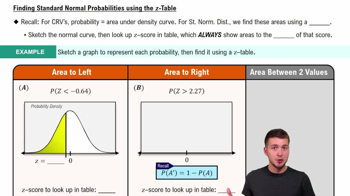
Finding Standard Normal Probabilities using z-Table

Percentiles

A percentile is a measure used in statistics indicating the value below which a given percentage of observations fall. For example, the 99th percentile (P99) is the score below which 99% of the data points lie. Understanding percentiles is crucial for interpreting the results of the bone density test, as it helps to identify how a specific score compares to the overall distribution of scores.

Z-scores

A Z-score is a statistical measurement that describes a value's relationship to the mean of a group of values, expressed in terms of standard deviations. In a standard normal distribution, a Z-score of 0 indicates the mean, while positive and negative values indicate how many standard deviations a score is above or below the mean. To find P99 in this scenario, one would typically look up the Z-score that corresponds to the 99th percentile in the standard normal distribution table.
Recommended video:
Guided course
06:31
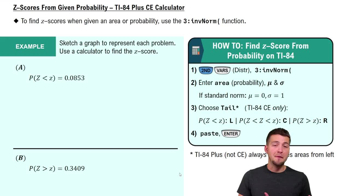
Z-Scores From Given Probability - TI-84 (CE) Calculator
Related Practice
Textbook Question

Car Colors

In Exercises 9–12, assume that 100 cars are randomly selected. Refer to the accompanying graph, which shows the top car colors and the percentages of cars with those colors (based on PPG Industries).


Black Cars Find the probability that at least 25 cars are black. Is 25 a significantly high number of black cars?

125
views
Textbook Question

Outliers For the purposes of constructing modified boxplots as described in Section 3-3, outliers are defined as data values that are above Q3 by an amount greater than 1.5 x IQR or below Q1 by an amount greater than 1.5 x IQR, where IQR is the interquartile range. Using this definition of outliers, find the probability that when a value is randomly selected from a normal distribution, it is an outlier.

209
views
Textbook Question

Determining Normality. In Exercises 9–12, refer to the indicated sample data and determine whether they appear to be from a population with a normal distribution. Assume that this requirement is loose in the sense that the population distribution need not be exactly normal, but it must be a distribution that is roughly bell-shaped.


Taxi Trips The distances (miles) traveled by New York City taxis transporting customers, as listed in Data Set 32 “Taxis” in Appendix B

163
views
Textbook Question

Distributions In a continuous uniform distribution,


" style="" width="290">


a. Find the mean and standard deviation for the distribution of the waiting times represented in Figure 6-2, which accompanies Exercises 5–8.

246
views
Textbook Question

Standard Normal Distribution. In Exercises 17–36, assume that a randomly selected subject is given a bone density test. Those test scores are normally distributed with a mean of 0 and a standard deviation of 1. In each case, draw a graph, then find the probability of the given bone density test scores. If using technology instead of Table A-2, round answers to four decimal places.


Between 1.50 and 2.00

185
views
Textbook Question

Constructing Normal Quantile Plots. In Exercises 17–20, use the given data values to identify the corresponding z scores that are used for a normal quantile plot, then identify the coordinates of each point in the normal quantile plot. Construct the normal quantile plot, then determine whether the data appear to be from a population with a normal distribution.


Earthquake Depths A sample of depths (km) of earthquakes is obtained from Data Set 24 “Earthquakes” in Appendix B: 17.3, 7.0, 7.0, 7.0, 8.1, 6.8.

139
views