
Ch. 6 - Normal Probability Distributions
Triola - Elementary Statistics 14th Edition
Triola14th EditionElementary StatisticsISBN: 9780137366446Not the one you use?Change textbook
Chapter 6, Problem 6.4.18

Hypothesis Testing. In Exercises 17–19, apply the central limit theorem to test the given claim. (Hint: See Example 3.)


Adult Sleep Times (hours) of sleep for randomly selected adult subjects included in the National Health and Nutrition Examination Study are listed below. Here are the statistics for this sample: n = 12, x_bar = 6.8 hours, s = 20 hours. The times appear to be from a normally distributed population. A common recommendation is that adults should sleep between 7 hours and 9 hours each night. Assuming that the mean sleep time is 7 hours, find the probability of getting a sample of 12 adults with a mean of 6.8 hours or less. What does the result suggest about a claim that “the mean sleep time is less than 7 hours”?


4 8 4 4 8 6 9 7 7 10 7 8

Verified step by step guidance
1
Step 1: Identify the null hypothesis (H₀) and the alternative hypothesis (H₁). The null hypothesis is H₀: μ = 7 hours (the mean sleep time is 7 hours). The alternative hypothesis is H₁: μ < 7 hours (the mean sleep time is less than 7 hours).
Step 2: Calculate the standard error of the mean (SE). The formula for the standard error is SE = s / √n, where s is the sample standard deviation and n is the sample size. Substitute the given values: s = 20 and n = 12.
Step 3: Compute the test statistic (z-score). The formula for the z-score is z = (x̄ - μ) / SE, where x̄ is the sample mean, μ is the population mean, and SE is the standard error. Substitute the given values: x̄ = 6.8, μ = 7, and the SE calculated in Step 2.
Step 4: Find the p-value corresponding to the calculated z-score. Use a standard normal distribution table or statistical software to determine the probability of observing a z-score less than the calculated value.
Step 5: Compare the p-value to the significance level (commonly α = 0.05). If the p-value is less than α, reject the null hypothesis. Interpret the result in the context of the problem: Does the evidence suggest that the mean sleep time is less than 7 hours?

Verified video answer for a similar problem:

This video solution was recommended by our tutors as helpful for the problem above.
Video duration:
6m
Was this helpful?

Key Concepts

Here are the essential concepts you must grasp in order to answer the question correctly.

Central Limit Theorem

The Central Limit Theorem (CLT) states that the sampling distribution of the sample mean will approach a normal distribution as the sample size increases, regardless of the population's distribution, provided the samples are independent and identically distributed. This theorem is crucial for hypothesis testing, as it allows us to make inferences about population parameters based on sample statistics, especially when dealing with small sample sizes.
Recommended video:
Guided course
04:52
Calculating the Mean

Hypothesis Testing

Hypothesis testing is a statistical method used to make decisions about a population based on sample data. It involves formulating a null hypothesis (H0) and an alternative hypothesis (H1), then using sample data to determine whether to reject H0 in favor of H1. In this context, the null hypothesis would state that the mean sleep time is 7 hours, while the alternative would suggest it is less than 7 hours.
Recommended video:
Guided course
06:21
Step 1: Write Hypotheses

P-value

The P-value is a measure that helps determine the strength of the evidence against the null hypothesis in hypothesis testing. It represents the probability of obtaining a sample mean as extreme as, or more extreme than, the observed sample mean, assuming the null hypothesis is true. A low P-value (typically less than 0.05) indicates strong evidence against the null hypothesis, suggesting that the mean sleep time may indeed be less than 7 hours.
Recommended video:
Guided course
06:50
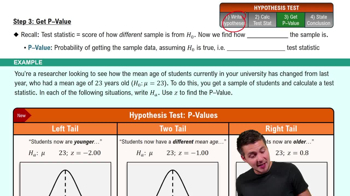
Step 3: Get P-Value
Related Practice
Textbook Question

Determining Normality. In Exercises 9–12, refer to the indicated sample data and determine whether they appear to be from a population with a normal distribution. Assume that this requirement is loose in the sense that the population distribution need not be exactly normal, but it must be a distribution that is roughly bell-shaped.


Dunkin’ Donuts The drive-through service times (seconds) of Dunkin’ Donuts lunch customers, as listed in Data Set 36 “Fast Food” in Appendix B

116
views
Textbook Question

Notation Common tests such as the SAT, ACT, LSAT, and MCAT tests use multiple choice test questions, each with possible answers of a, b, c, d, e, and each question has only one correct answer. For people who make random guesses for answers to a block of 100 questions, identify the values of p, q, μ, and σ. What do μ and σ measure?

173
views
Textbook Question

Continuous Uniform Distribution. In Exercises 5–8, refer to the continuous uniform distribution depicted in Figure 6-2 and described in Example 1. Assume that a passenger is randomly selected, and find the probability that the waiting time is within the given range.


Between 2 minutes and 3 minutes

167
views
Textbook Question

Standard Normal Distribution. In Exercises 9–12, find the area of the shaded region. The graph depicts the standard normal distribution of bone density scores with mean 0 and standard deviation 1.


432
views
Textbook Question

Continuous Uniform Distribution. In Exercises 5–8, refer to the continuous uniform distribution depicted in Figure 6-2 and described in Example 1. Assume that a passenger is randomly selected, and find the probability that the waiting time is within the given range.

Less than 4.00 minutes

227
views
Textbook Question

Births: Sampling Distribution of Sample Proportion When two births are randomly selected, the sample space for genders is bb, bg, gb, and gg (where and Assume that those four outcomes are equally likely. Construct a table that describes the sampling distribution of the sample proportion of girls from two births. Does the mean of the sample proportions equal the proportion of girls in two births? Does the result suggest that a sample proportion is an unbiased estimator of a population proportion?

178
views