
Ch. 6 - Normal Probability Distributions
Triola - Elementary Statistics 14th Edition
Triola14th EditionElementary StatisticsISBN: 9780137366446Not the one you use?Change textbook
Chapter 6, Problem 6.6.3

Notation Common tests such as the SAT, ACT, LSAT, and MCAT tests use multiple choice test questions, each with possible answers of a, b, c, d, e, and each question has only one correct answer. For people who make random guesses for answers to a block of 100 questions, identify the values of p, q, μ, and σ. What do μ and σ measure?

Verified step by step guidance
1
Step 1: Define the probability of success (p) and failure (q). Since each question has one correct answer out of five choices (a, b, c, d, e), the probability of guessing correctly (success) is p = 1/5 = 0.2. The probability of guessing incorrectly (failure) is q = 1 - p = 1 - 0.2 = 0.8.
Step 2: Identify the number of trials (n). In this case, the number of trials corresponds to the total number of questions, which is n = 100.
Step 3: Calculate the mean (μ). The mean of a binomial distribution is given by the formula μ = n * p. Substituting the values, μ = 100 * 0.2.
Step 4: Calculate the standard deviation (σ). The standard deviation of a binomial distribution is given by the formula σ = √(n * p * q). Substituting the values, σ = √(100 * 0.2 * 0.8).
Step 5: Explain the meaning of μ and σ. The mean (μ) represents the expected number of correct answers when guessing randomly. The standard deviation (σ) measures the spread or variability of the number of correct answers around the mean.

Verified video answer for a similar problem:

This video solution was recommended by our tutors as helpful for the problem above.
Video duration:
4m
Was this helpful?

Key Concepts

Here are the essential concepts you must grasp in order to answer the question correctly.

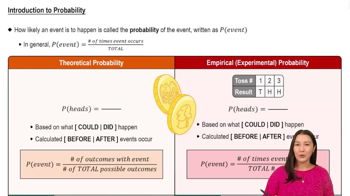
Probability (p and q)

In the context of multiple-choice questions, 'p' represents the probability of selecting the correct answer, while 'q' represents the probability of selecting an incorrect answer. For a question with one correct answer out of five options, p is 1/5 (0.2) and q is 4/5 (0.8). Understanding these probabilities is essential for calculating expected outcomes in random guessing scenarios.
Recommended video:
5:37
Introduction to Probability

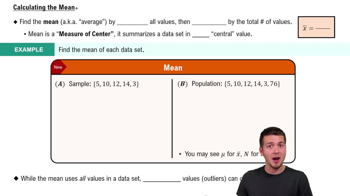
Mean (μ)

The mean, denoted as μ, is the average number of correct answers expected when guessing on a set of questions. It is calculated by multiplying the total number of questions by the probability of answering correctly (p). In this case, for 100 questions, μ would be 100 * (1/5) = 20, indicating that a random guesser is expected to answer 20 questions correctly.
Recommended video:
Guided course
04:52
Calculating the Mean

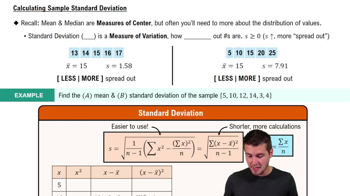
Standard Deviation (σ)

The standard deviation, represented as σ, measures the amount of variation or dispersion in the number of correct answers from the mean. It is calculated using the formula σ = √(n * p * q), where n is the total number of questions. For 100 questions, this results in σ = √(100 * (1/5) * (4/5)), which quantifies how much the number of correct answers is likely to fluctuate around the mean.
Recommended video:
Guided course
08:45
Calculating Standard Deviation
Related Practice
Textbook Question

Good Sample? An economist is investigating the incomes of college students. Because she lives in Maine, she obtains sample data from that state. Is the resulting mean income of college students a good estimator of the mean income of college students in the United States? Why or why not?

111
views
Textbook Question

Overbooking a Boeing 767-300 A Boeing 767-300 aircraft has 213 seats. When someone buys a ticket for a flight, there is a 0.0995 probability that the person will not show up for the flight (based on data from an IBM research paper by Lawrence, Hong, and Cherrier). How many reservations could be accepted for a Boeing 767-300 for there to be at least a 0.95 probability that all reservation holders who show will be accommodated?

182
views
Textbook Question

Determining Normality. In Exercises 9–12, refer to the indicated sample data and determine whether they appear to be from a population with a normal distribution. Assume that this requirement is loose in the sense that the population distribution need not be exactly normal, but it must be a distribution that is roughly bell-shaped.


Dunkin’ Donuts The drive-through service times (seconds) of Dunkin’ Donuts lunch customers, as listed in Data Set 36 “Fast Food” in Appendix B

116
views
Textbook Question

Continuous Uniform Distribution. In Exercises 5–8, refer to the continuous uniform distribution depicted in Figure 6-2 and described in Example 1. Assume that a passenger is randomly selected, and find the probability that the waiting time is within the given range.


Between 2 minutes and 3 minutes

167
views
Textbook Question

Hypothesis Testing. In Exercises 17–19, apply the central limit theorem to test the given claim. (Hint: See Example 3.)


Adult Sleep Times (hours) of sleep for randomly selected adult subjects included in the National Health and Nutrition Examination Study are listed below. Here are the statistics for this sample: n = 12, x_bar = 6.8 hours, s = 20 hours. The times appear to be from a normally distributed population. A common recommendation is that adults should sleep between 7 hours and 9 hours each night. Assuming that the mean sleep time is 7 hours, find the probability of getting a sample of 12 adults with a mean of 6.8 hours or less. What does the result suggest about a claim that “the mean sleep time is less than 7 hours”?


4 8 4 4 8 6 9 7 7 10 7 8

169
views
Textbook Question

Standard Normal Distribution. In Exercises 9–12, find the area of the shaded region. The graph depicts the standard normal distribution of bone density scores with mean 0 and standard deviation 1.


432
views