Ch. 8 - Hypothesis Testing
Triola - Elementary Statistics 14th Edition
Triola14th EditionElementary StatisticsISBN: 9780137366446Not the one you use?Change textbook
Chapter 8, Problem 29

Large Sample and a Small Difference It has been said that with really large samples, even very small differences between the sample mean and the claimed population mean can appear to be significant, but in reality they are not significant. Test this statement using the claim that the mean IQ score of adults is 100, given the following sample data: n = 1,000,000, x_bar = 100.05, s = 15 . Based on this sample, is the difference between x_bar = 100.05 and the claimed mean of 100 statistically significant? Does that difference have practical significance?

Verified step by step guidance
1
Step 1: Formulate the null hypothesis (H₀) and the alternative hypothesis (H₁). The null hypothesis is H₀: μ = 100 (the population mean is 100), and the alternative hypothesis is H₁: μ ≠ 100 (the population mean is not 100).
Step 2: Calculate the test statistic using the formula for the z-test for a single sample mean: z = (x̄ - μ) / (s / √n), where x̄ is the sample mean, μ is the population mean, s is the sample standard deviation, and n is the sample size. Substitute the given values: x̄ = 100.05, μ = 100, s = 15, and n = 1,000,000.
Step 3: Determine the critical z-value(s) for the chosen significance level (commonly α = 0.05 for a two-tailed test). Use a z-table or statistical software to find the critical values corresponding to α/2 in each tail.
Step 4: Compare the calculated z-value from Step 2 to the critical z-value(s) from Step 3. If the calculated z-value falls outside the range defined by the critical z-values, reject the null hypothesis; otherwise, fail to reject the null hypothesis.
Step 5: Assess practical significance. Even if the null hypothesis is rejected (indicating statistical significance), consider whether the observed difference (x̄ - μ = 0.05) is meaningful in a real-world context. Given the large sample size, very small differences can appear statistically significant but may lack practical importance.

Verified video answer for a similar problem:

This video solution was recommended by our tutors as helpful for the problem above.
Video duration:
5m
Was this helpful?

Key Concepts

Here are the essential concepts you must grasp in order to answer the question correctly.

Statistical Significance

Statistical significance refers to the likelihood that a relationship between variables in a sample is not due to random chance. It is typically assessed using a p-value, which indicates the probability of observing the data if the null hypothesis is true. A common threshold for significance is p < 0.05, meaning there is less than a 5% chance that the observed difference is due to random variation.
Recommended video:
Guided course
05:53
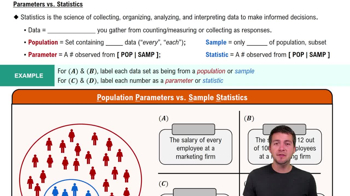
Parameters vs. Statistics

Practical Significance

Practical significance assesses whether a statistically significant result has real-world relevance or meaningful impact. While a result may be statistically significant, it does not necessarily imply that the difference is large enough to be of practical importance. For example, a small difference in means may be statistically significant in a large sample but may not have any meaningful implications in practice.
Recommended video:
Guided course
04:46
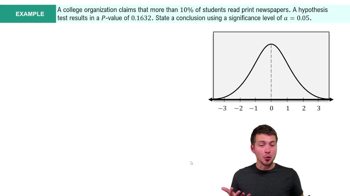
Step 4: State Conclusion Example 4

Central Limit Theorem

The Central Limit Theorem states that the distribution of sample means will approach a normal distribution as the sample size increases, regardless of the population's distribution. This theorem is crucial when working with large samples, as it allows for the use of normal distribution properties to make inferences about population parameters, even when the underlying data may not be normally distributed.
Recommended video:
Guided course
04:52
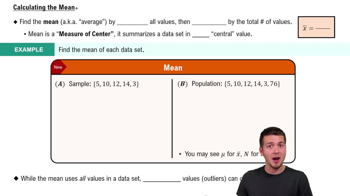
Calculating the Mean
Related Practice
Textbook Question

Hypothesis Test with Known σ


a. How do the results from Example 1 in this section change if σ is known to be 1.99240984 g? Does the knowledge of σ have much of an effect on the results of this hypothesis test?

239
views

Textbook Question

Large Data Sets from Appendix B

In Exercises 25–28, use the data set from Appendix B to test the given claim. Use the P-value method unless your instructor specifies otherwise.


Los Angeles Commute Time Use the 1000 Los Angeles Commute times listed in Data Set 31 “Commute Times” to test the claim that the mean Los Angeles commute time is less than 35 minutes. Use a 0.01 significance level. Compare the sample mean to the claimed mean of 35 minutes. Is the difference between those two values statistically significant? Does the difference between those two values appear to have practical significance?

127
views
Textbook Question

Testing Hypotheses

In Exercises 13–24, assume that a simple random sample has been selected and test the given claim. Unless specified by your instructor, use either the P-value method or the critical value method for testing hypotheses. Identify the null and alternative hypotheses, test statistic, P-value (or range of P-values), or critical value(s), and state the final conclusion that addresses the original claim.


Got a Minute? Students of the author estimated the length of one minute without reference to a watch or clock, and the times (seconds) are listed below. Use a 0.05 significance level to test the claim that these times are from a population with a mean equal to 60 seconds. Does it appear that students are reasonably good at estimating one minute?


69 81 39 65 42 21 60 63 66 48 64 70 96 91 95

89
views
Textbook Question

Testing Hypotheses

In Exercises 13–24, assume that a simple random sample has been selected and test the given claim. Unless specified by your instructor, use either the P-value method or the critical value method for testing hypotheses. Identify the null and alternative hypotheses, test statistic, P-value (or range of P-values), or critical value(s), and state the final conclusion that addresses the original claim.


Lead in Medicine Listed below are the lead concentrations (in ) measured in different Ayurveda medicines. Ayurveda is a traditional medical system commonly used in India. The lead concentrations listed here are from medicines manufactured in the United States (based on data from “Lead, Mercury, and Arsenic in US and Indian Manufactured Ayurvedic Medicines Sold via the Internet,” by Saper et al., Journal of the American Medical Association, Vol. 300, No. 8). Use a 0.05 significance level to test the claim that the mean lead concentration for all such medicines is less than 14 μg/g.


3.0 6.5 6.0 5.5 20.5 7.5 12 20.5 11.5 17.5

91
views