Ch. 9 - Inferences from Two Samples
Triola - Elementary Statistics 14th Edition
Triola14th EditionElementary StatisticsISBN: 9780137366446Not the one you use?Change textbook
Chapter 9, Problem 9.5.5

In Exercises 5–8, use (a) randomization and (b) bootstrapping for the indicated exercise from Section 9-1. Compare the results to those obtained in the original exercise.


Exercise 7 in Section 9-1 “Buttered Toast Drop”

Verified step by step guidance
1
Step 1: Understand the problem. The exercise involves using randomization and bootstrapping methods to analyze the 'Buttered Toast Drop' experiment. Randomization involves reshuffling the data to simulate outcomes, while bootstrapping involves resampling with replacement to estimate variability.
Step 2: Randomization method: Begin by identifying the original dataset from the 'Buttered Toast Drop' experiment. Shuffle the data randomly multiple times (e.g., 1000 iterations) to simulate the outcomes. For each iteration, calculate the statistic of interest (e.g., proportion of buttered side landing down).
Step 3: Bootstrapping method: Use the original dataset to create multiple bootstrap samples by resampling with replacement. For each bootstrap sample, calculate the statistic of interest (e.g., proportion of buttered side landing down). Repeat this process for a large number of iterations (e.g., 1000).
Step 4: Compare results: Analyze the distribution of the statistics obtained from both randomization and bootstrapping methods. Compare these results to the original exercise's findings to assess consistency and variability.
Step 5: Interpret findings: Discuss the implications of the randomization and bootstrapping results. Highlight how these methods provide insights into the variability and reliability of the original experiment's conclusions.

Verified video answer for a similar problem:

This video solution was recommended by our tutors as helpful for the problem above.
Video duration:
4m
Was this helpful?

Key Concepts

Here are the essential concepts you must grasp in order to answer the question correctly.

Randomization

Randomization is a statistical technique used to eliminate bias by randomly assigning subjects to different groups or treatments. This process ensures that each participant has an equal chance of being placed in any group, which helps to create comparable groups and allows for valid inferences about the effects of treatments. In the context of the 'Buttered Toast Drop' exercise, randomization can help assess the impact of different conditions on the outcome.
Recommended video:
Guided course
07:09
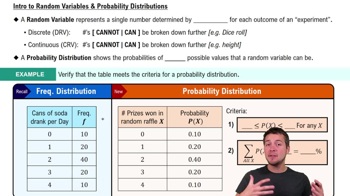
Intro to Random Variables & Probability Distributions

Bootstrapping

Bootstrapping is a resampling method that involves repeatedly drawing samples from a dataset with replacement to estimate the distribution of a statistic. This technique allows for the estimation of confidence intervals and standard errors without relying on traditional parametric assumptions. In the context of the exercise, bootstrapping can provide insights into the variability of the results obtained from the original data.

Comparative Analysis

Comparative analysis involves evaluating the differences and similarities between two or more sets of results or methods. In this case, it refers to comparing the outcomes obtained from randomization and bootstrapping with those from the original exercise. This analysis helps to understand the robustness of the findings and whether the alternative methods yield consistent results.
Recommended video:
Guided course
04:48
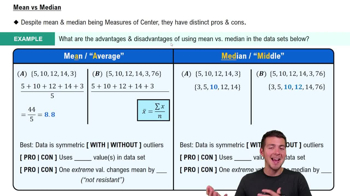
Comparing Mean vs. Median
Related Practice
Textbook Question

Equivalence of Hypothesis Test and Confidence Interval Two different simple random samples are drawn from two different populations. The first sample consists of 20 people with 10 having a common attribute. The second sample consists of 2000 people with 1404 of them having the same common attribute. Compare the results from a hypothesis test of p1=p2 (with a 0.05 significance level) and a 95% confidence interval estimate of p1-p2

184
views
Textbook Question

Bootstrapping and Randomization When resampling data from two independent samples, what is the fundamental difference between bootstrapping and randomization?

165
views
Textbook Question

In Exercises 1–10, based on the nature of the given data, do the following:


a. Pose a key question that is relevant to the given data.

b. Identify a procedure or tool from this chapter or the preceding chapters to address the key question from part (a).

c. Analyze the data and state a conclusion.


Video Games In a survey of subjects aged 18–29, subjects were asked if they play video games often or sometimes. Among 1017 males, 72% answered “yes.” Among 984 females, 49% answered “yes” (based on data from a Pew Research Center survey).

139
views
Textbook Question

In Exercises 1–10, based on the nature of the given data, do the following:


a. Pose a key question that is relevant to the given data.

b. Identify a procedure or tool from this chapter or the preceding chapters to address the key question from part (a).

c. Analyze the data and state a conclusion.


Video Games In a survey of subjects aged 18–29, subjects were asked if they play video games often or sometimes. Among 984 females, 49% answered “yes” (based on data from a Pew Research Center survey).

133
views
Textbook Question

Color and Creativity Researchers from the University of British Columbia conducted trials to investigate the effects of color on creativity. Subjects with a red background were asked to think of creative uses for a brick; other subjects with a blue background were given the same task. Responses were scored by a panel of judges and results from scores of creativity are given below. Use a 0.05 significance level to test the claim that creative task scores have the same variation with a red background and a blue background.

[Image]

137
views
Textbook Question

Sampling Methods A student obtains a sample of responses to the question “Do you plan to take or have you taken a statistics course?” A second student obtains a sample of responses to the same question. The first student surveys only males at the same college, and the second student surveys only females at the same college. What is wrong with the samples? Can randomization be used to overcome the flaws of those samples?

145
views