Ch. 9 - Inferences from Two Samples
Triola - Elementary Statistics 14th Edition
Triola14th EditionElementary StatisticsISBN: 9780137366446Not the one you use?Change textbook
Chapter 9, Problem 9.5.2

Sampling Methods A student obtains a sample of responses to the question “Do you plan to take or have you taken a statistics course?” A second student obtains a sample of responses to the same question. The first student surveys only males at the same college, and the second student surveys only females at the same college. What is wrong with the samples? Can randomization be used to overcome the flaws of those samples?

Verified step by step guidance
1
Step 1: Identify the issue with the sampling method. The samples are biased because they are not representative of the entire population. The first student surveys only males, and the second student surveys only females, which excludes other groups and does not account for diversity in responses.
Step 2: Understand the concept of randomization. Randomization involves selecting individuals from the population in a way that each individual has an equal chance of being chosen. This helps ensure that the sample is representative of the population and reduces bias.
Step 3: Explain how randomization can address the flaws. By using randomization, the students can create a sample that includes both males and females, as well as other demographic groups, ensuring that the sample reflects the population more accurately.
Step 4: Suggest a better sampling method. The students could use a simple random sampling technique, where they randomly select individuals from the entire college population, regardless of gender, to answer the question.
Step 5: Highlight the importance of representative samples. A representative sample is crucial for making valid inferences about the population. By addressing the bias in the original samples and using randomization, the students can improve the reliability and validity of their results.

Verified video answer for a similar problem:

This video solution was recommended by our tutors as helpful for the problem above.
Video duration:
2m
Was this helpful?

Key Concepts

Here are the essential concepts you must grasp in order to answer the question correctly.

Sampling Bias

Sampling bias occurs when certain members of a population are systematically more likely to be selected for a sample than others. In this scenario, the first student only surveys males and the second only surveys females, which means neither sample represents the entire population of the college. This can lead to skewed results that do not accurately reflect the views of all students.
Recommended video:
05:11
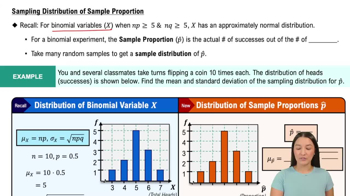
Sampling Distribution of Sample Proportion

Random Sampling

Random sampling is a technique where each member of a population has an equal chance of being selected for the sample. This method helps to minimize bias and ensures that the sample is representative of the population. In the context of the question, using random sampling could help include both males and females, thus providing a more accurate reflection of the overall student body’s opinions on taking a statistics course.
Recommended video:
05:11
Sampling Distribution of Sample Proportion

Generalizability

Generalizability refers to the extent to which findings from a sample can be applied to the larger population. If a sample is biased, as in the case of the two students surveying only one gender, the results may not be generalizable to the entire college population. Ensuring a representative sample through randomization enhances the ability to generalize the results to the broader group.
Related Practice
Textbook Question

Equivalence of Hypothesis Test and Confidence Interval Two different simple random samples are drawn from two different populations. The first sample consists of 20 people with 10 having a common attribute. The second sample consists of 2000 people with 1404 of them having the same common attribute. Compare the results from a hypothesis test of p1=p2 (with a 0.05 significance level) and a 95% confidence interval estimate of p1-p2

184
views
Textbook Question

Bootstrapping and Randomization When resampling data from two independent samples, what is the fundamental difference between bootstrapping and randomization?

165
views
Textbook Question

In Exercises 5–8, use (a) randomization and (b) bootstrapping for the indicated exercise from Section 9-1. Compare the results to those obtained in the original exercise.


Exercise 7 in Section 9-1 “Buttered Toast Drop”

106
views
Textbook Question

In Exercises 1–10, based on the nature of the given data, do the following:


a. Pose a key question that is relevant to the given data.

b. Identify a procedure or tool from this chapter or the preceding chapters to address the key question from part (a).

c. Analyze the data and state a conclusion.


Video Games In a survey of subjects aged 18–29, subjects were asked if they play video games often or sometimes. Among 1017 males, 72% answered “yes.” Among 984 females, 49% answered “yes” (based on data from a Pew Research Center survey).

139
views
Textbook Question

In Exercises 1–10, based on the nature of the given data, do the following:


a. Pose a key question that is relevant to the given data.

b. Identify a procedure or tool from this chapter or the preceding chapters to address the key question from part (a).

c. Analyze the data and state a conclusion.


Video Games In a survey of subjects aged 18–29, subjects were asked if they play video games often or sometimes. Among 984 females, 49% answered “yes” (based on data from a Pew Research Center survey).

133
views
Textbook Question

In Exercises 1–10, based on the nature of the given data, do the following:


a. Pose a key question that is relevant to the given data.

b. Identify a procedure or tool from this chapter or the preceding chapters to address the key question from part (a).

c. Analyze the data and state a conclusion.


IQ Scores of Twins Listed below are IQ scores of twins listed in Data Set 12 “IQ and Brain Size” in Appendix B. The data are pairs of IQ scores from ten different families.


164
views