Ch. 5 - Complex Numbers, Polar Coordinates and Parametric Equations
Blitzer - Trigonometry 3rd Edition
Blitzer3rd EditionTrigonometryISBN: 9780137316601Not the one you use?Change textbook
Chapter 5, Problem 5.5.53

In Exercises 53–56, find two different sets of parametric equations for each rectangular equation. y = 4x − 3

Verified step by step guidance
1
Recognize that the given rectangular equation is a linear equation: \(y = 4x - 3\). Our goal is to express both \(x\) and \(y\) in terms of a parameter \(t\) to form parametric equations.
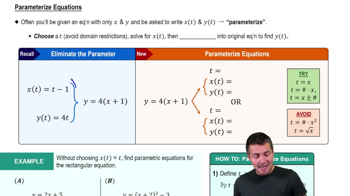
For the first set of parametric equations, let the parameter \(t\) represent \(x\). So, set \(x = t\). Then, substitute \(x = t\) into the original equation to find \(y\): \(y = 4t - 3\). Thus, the first set is \(x = t\), \(y = 4t - 3\).
For the second set of parametric equations, choose a different parameterization. For example, let \(y = t\). Then solve the original equation for \(x\) in terms of \(y\): \(y = 4x - 3 \implies 4x = y + 3 \implies x = \frac{y + 3}{4}\). Substitute \(y = t\) to get \(x = \frac{t + 3}{4}\). So, the second set is \(x = \frac{t + 3}{4}\), \(y = t\).
Verify that both sets of parametric equations satisfy the original rectangular equation by substituting back and confirming the equality holds for all values of \(t\).
Note that parametric equations are not unique; you can choose different parameters or expressions for \(x\) and \(y\) as long as they satisfy the original equation.

Verified video answer for a similar problem:

This video solution was recommended by our tutors as helpful for the problem above.
Video duration:
1m
Was this helpful?

Key Concepts

Here are the essential concepts you must grasp in order to answer the question correctly.

Rectangular and Parametric Equations

A rectangular equation relates x and y directly, like y = 4x - 3. Parametric equations express both x and y in terms of a third variable, usually t, allowing the representation of curves as a set of coordinate pairs (x(t), y(t)). Understanding how to convert between these forms is essential.
Recommended video:
08:02
Parameterizing Equations

Parametrization of Lines

To parametrize a line given by y = mx + b, one can assign x = t and then express y in terms of t using the line equation. Alternatively, different parameter choices can produce distinct parametric forms, such as setting y = t and solving for x, illustrating multiple valid parametrizations.
Recommended video:
08:02
Parameterizing Equations

Slope-Intercept Form and Its Role in Parametrization

The slope-intercept form y = mx + b provides the slope (m) and y-intercept (b), which guide the relationship between x and y. This slope helps determine how y changes with x, crucial for defining parametric equations that maintain the line's direction and position.
Recommended video:
06:03
Equations of Circles & Ellipses