Skip to main content
Trigonometry
My Course
Learn
Exam Prep
AI Tutor
Study Guides
Textbook Solutions
Flashcards
Explore
Try the app
My Course
Learn
Exam Prep
AI Tutor
Study Guides
Textbook Solutions
Flashcards
Explore
Try the app
Back
Complementary and Supplementary Angles definitions
You can tap to flip the card.
Complementary Angles
You can tap to flip the card.
👆
Complementary Angles
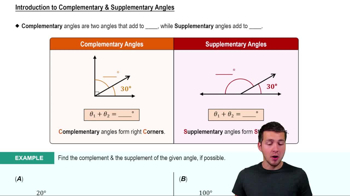
Pair whose measures total 90 degrees; often found as the two non-right angles in a right triangle.
Track progress
Control buttons has been changed to "navigation" mode.
1/14
Related flashcards
Related practice
Recommended videos
Complementary and Supplementary Angles quiz #1
Complementary and Supplementary Angles
19 Terms
Complementary and Supplementary Angles
1. Measuring Angles
5 problems
Topic
Patrick
Radians
1. Measuring Angles
6 problems
Topic
Patrick
1. Measuring Angles
4 topics
11 problems
Chapter
Patrick
Guided course
2:28
Solving Problems with Complementary & Supplementary Angles
1391
views
35
rank
Guided course
3:35
Intro to Complementary & Supplementary Angles
1777
views
29
rank
Guided course
3:04
Example 1
1293
views
40
rank
Terms in this set (14)
Hide definitions
Complementary Angles
Pair whose measures total 90 degrees; often found as the two non-right angles in a right triangle.
Supplementary Angles
Pair whose measures total 180 degrees; together they form a straight line.
Right Triangle
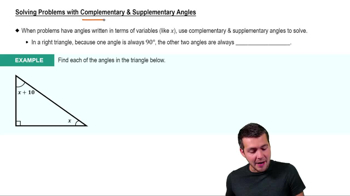
Shape with one angle fixed at 90 degrees, making the other two angles complementary.
Corner
Mnemonic for complementary angles, representing the meeting point of two lines forming 90 degrees.
Straight Line
Mnemonic for supplementary angles, representing the alignment of two angles totaling 180 degrees.
Variable Expression
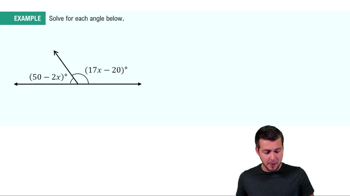
Algebraic form used to represent unknown angle measures in problems involving complementary or supplementary relationships.
Equation
Mathematical statement set up to solve for unknown angles, based on their sum being 90 or 180 degrees.
Sum of Angles
Total measure of angles in a triangle, always 180 degrees, used to solve for unknowns.
Complement
Angle that, when added to a given angle, results in a total of 90 degrees.
Supplement
Angle that, when added to a given angle, results in a total of 180 degrees.
Linear Equation
Type of equation used to solve for unknown angles when their measures are expressed with variables.
Triangle
Shape with three angles whose measures always sum to 180 degrees.
Degree
Unit of measurement for angles, commonly used to express complementary and supplementary relationships.
Mnemonic
Memory aid, such as 'complementary corners' or 'supplementary straight,' to recall angle relationships.
 BackBack
 2:28
2:28