Skip to main content
Trigonometry
My Course
Learn
Exam Prep
AI Tutor
Study Guides
Textbook Solutions
Flashcards
Explore
Try the app
My Course
Learn
Exam Prep
AI Tutor
Study Guides
Textbook Solutions
Flashcards
Explore
Try the app
Back
Dot Product definitions
You can tap to flip the card.
Dot Product
You can tap to flip the card.
👆
Dot Product
A scalar result from multiplying corresponding vector components and summing, indicating directional alignment.
Track progress
Control buttons has been changed to "navigation" mode.
1/15
Related flashcards
Related practice
Recommended videos
Dot Product quiz #1
Dot Product
10 Terms
Dot Product
8. Vectors
6 problems
Topic
Patrick
Cross Product
8. Vectors
3 problems
Topic
8. Vectors
5 topics
11 problems
Chapter
Patrick
Guided course
05:40
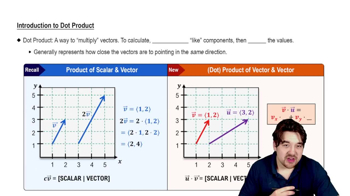
Introduction to Dot Product
1088
views
4
rank
Guided course
04:33
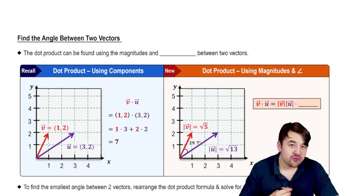
Find the Angle Between Vectors
832
views
3
rank
Terms in this set (15)
Hide definitions
Dot Product
A scalar result from multiplying corresponding vector components and summing, indicating directional alignment.
Vector
A mathematical object with both magnitude and direction, often represented by components along axes.
Scalar
A single numerical value resulting from the dot product, representing the degree of vector alignment.
Component
Individual parts of a vector along each axis, used in calculations like the dot product.
Magnitude
The length or size of a vector, used in alternate dot product calculations involving angles.
Cosine
A trigonometric function used in the dot product formula to relate vector magnitudes and their angle.
Angle
The measure between two vectors, crucial for determining their relationship via the dot product.
Perpendicular
A relationship where vectors meet at a right angle, resulting in a dot product of zero.
Alignment
The degree to which vectors point in the same direction, reflected by the sign and value of the dot product.
Inverse Cosine
A function used to find the angle between vectors when the dot product and magnitudes are known.
Positive Result
A dot product outcome indicating vectors are pointing in similar directions.
Negative Result
A dot product outcome showing vectors are pointing in opposite directions.
Zero Result
A dot product outcome signifying vectors are perpendicular and have no directional alignment.
Unit Circle
A tool for determining trigonometric values, useful in finding angles from dot product calculations.
Degree Mode
A calculator setting required for accurate angle calculations in dot product problems.
 BackBack
 05:40
05:40