Back

Linear Trigonometric Equations definitions

Control buttons has been changed to "navigation" mode.
1/15
  • Trigonometric Equation

    A mathematical statement involving a trigonometric function set equal to a value, often yielding multiple angle solutions.
  • Unit Circle

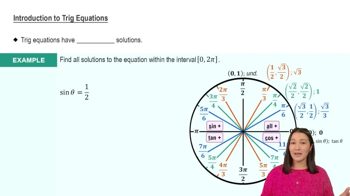
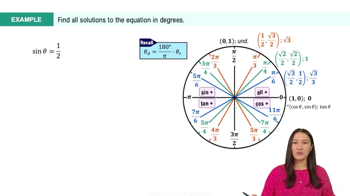
    A circle with radius one centered at the origin, used to determine angle values for trigonometric functions.
  • Interval

    A specified range of angle values, such as 0 to 2π, within which solutions are considered.
  • Quadrant

    One of four sections of the unit circle, each affecting the sign and value of trigonometric functions.
  • Rotation

    A complete turn around the unit circle, corresponding to an angle of 2π radians.
  • Integer

    A whole number used to represent repeated rotations or cycles in trigonometric solutions.
  • Domain

    The set of allowable input values, often restricted to a specific interval for trigonometric equations.
  • Cosine

    A trigonometric function representing the horizontal coordinate of a point on the unit circle.
  • Sine

    A trigonometric function representing the vertical coordinate of a point on the unit circle.
  • Linear Trigonometric Equation

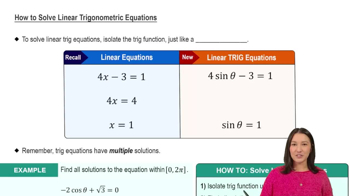
    An equation where a trigonometric function appears in a linear form, allowing algebraic isolation.
  • Algebraic Operation

    A mathematical process such as addition, subtraction, or division used to manipulate equations.
  • Solution

    An angle value that satisfies a trigonometric equation, often found using the unit circle.
  • Restriction

    A limitation placed on the domain, narrowing the set of possible solutions to a trigonometric equation.
  • Argument

    The angle input for a trigonometric function, such as θ in sine or cosine.
  • Basic Trigonometric Equation

    A simplified form of a trigonometric equation, typically solved using the unit circle.