Back

Pythagorean Theorem & Basics of Triangles definitions

Control buttons has been changed to "navigation" mode.
1/15
  • Triangle

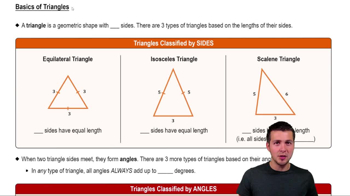
    A geometric figure with three sides and three angles, forming a closed shape.
  • Equilateral Triangle

    A three-sided shape where all sides have equal length, indicated by identical tick marks.
  • Isosceles Triangle

    A triangle with exactly two sides of equal length, often marked with two identical tick marks.
  • Scalene Triangle

    A triangle where all three sides have different lengths, with no tick marks indicating equality.
  • Acute Triangle

    A triangle in which all three angles are less than 90 degrees.
  • Obtuse Triangle

    A triangle with one angle greater than 90 degrees and the other two less than 90 degrees.
  • Right Triangle

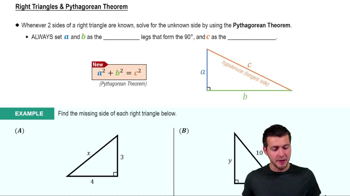
    A triangle containing one angle exactly equal to 90 degrees, forming a corner.
  • Hypotenuse

    The longest side of a right triangle, usually diagonal, opposite the 90-degree angle.
  • Leg

    One of the two shorter sides of a right triangle that form the 90-degree angle.
  • Degree

    A unit for measuring angles, commonly used to express triangle angles.
  • Tick Mark

    A diagram symbol indicating equal side lengths in triangles.
  • Arc Symbol

    A curved mark in diagrams used to represent angles at triangle vertices.
  • Pythagorean Theorem

    A formula relating the three sides of a right triangle: sum of squares of legs equals square of hypotenuse.
  • Square Root

    A mathematical operation used to find the original value from its squared result, crucial in solving for triangle sides.
  • Angle Sum Property

    A rule stating that the total of all angles in any triangle is always 180 degrees.