Back
Back
Problem 44
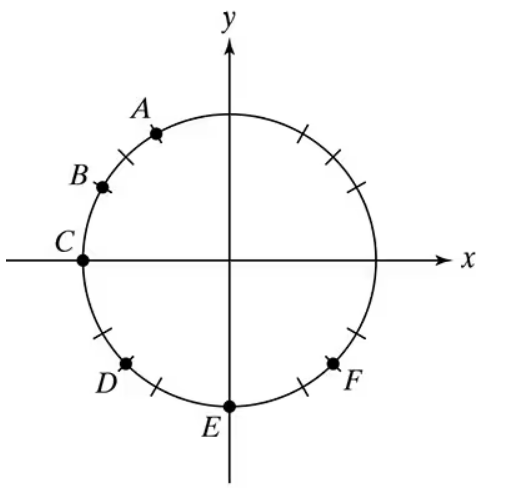
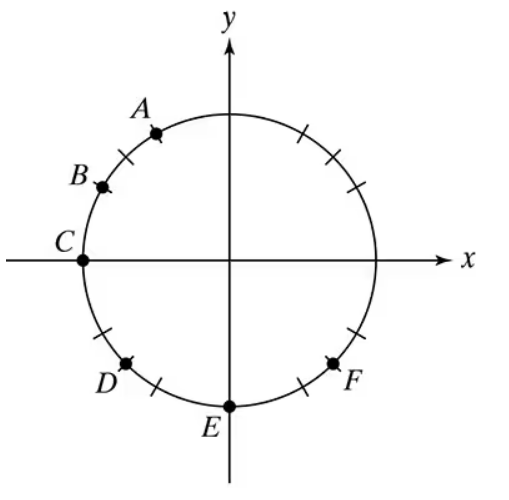
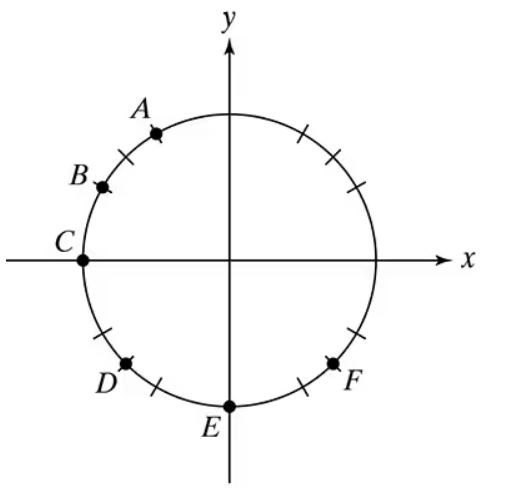
In Exercises 41–56, use the circle shown in the rectangular coordinate system to draw each angle in standard position. State the quadrant in which the angle lies. When an angle's measure is given in radians, work the exercise without converting to degrees.

7𝜋/4
Problem 45
In Exercises 41–56, use the circle shown in the rectangular coordinate system to draw each angle in standard position. State the quadrant in which the angle lies. When an angle's measure is given in radians, work the exercise without converting to degrees.
-2𝜋/3
Problem 46
In Exercises 41–56, use the circle shown in the rectangular coordinate system to draw each angle in standard position. State the quadrant in which the angle lies. When an angle's measure is given in radians, work the exercise without converting to degrees.
-5𝜋/6
Problem 47
In Exercises 41–56, use the circle shown in the rectangular coordinate system to draw each angle in standard position. State the quadrant in which the angle lies. When an angle's measure is given in radians, work the exercise without converting to degrees.
-5𝜋/4
Problem 48
In Exercises 41–56, use the circle shown in the rectangular coordinate system to draw each angle in standard position. State the quadrant in which the angle lies. When an angle's measure is given in radians, work the exercise without converting to degrees.
-7𝜋/4
Problem 49
In Exercises 41–56, use the circle shown in the rectangular coordinate system to draw each angle in standard position. State the quadrant in which the angle lies. When an angle's measure is given in radians, work the exercise without converting to degrees.
16𝜋/3
Problem 79
Express each angular speed in radians per second. 6 revolutions per second
Problem 81
Use the circle shown in the rectangular coordinate system to solve Exercises 81–86. Find two angles, in radians, between -2𝜋 and 2𝜋 such that each angle's terminal side passes through the origin and the given point.
A
Problem 83
Use the circle shown in the rectangular coordinate system to solve Exercises 81–86. Find two angles, in radians, between -2𝜋 and 2𝜋 such that each angle's terminal side passes through the origin and the given point.
D
Problem 85
Use the circle shown in the rectangular coordinate system to solve Exercises 81–86. Find two angles, in radians, between -2𝜋 and 2𝜋 such that each angle's terminal side passes through the origin and the given point.
E
Problem 87
Find the absolute value of the radian measure of the angle that the second hand of a clock moves through in the given time. 55 seconds
Problem 89
Find the absolute value of the radian measure of the angle that the second hand of a clock moves through in the given time. 3 minutes and 40 seconds
Problem 91
Find the measure of the central angle on a circle of radius r that forms a sector with the given area.
Radius, r: 10 feet Area of the Sector, A: 25 square feet
Problem 1.2.72
If θ is an acute angle and cos θ = 1/3, find csc (𝜋/2 - θ).
Problem 1.2.61
In Exercises 59–62, use a calculator to find the value of the acute angle θ in radians, rounded to three decimal places. tan θ = 0.4169
Problem 1.2.59
In Exercises 59–62, use a calculator to find the value of the acute angle θ in radians, rounded to three decimal places. cos θ = 0.4112
Problem 1.2.69
In Exercises 69–70, express the exact value of each function as a single fraction. Do not use a calculator. If f(θ) = 2 cos θ - cos 2θ, find f(𝜋/6).
Problem 1
In Exercises 1–8, use the Pythagorean Theorem to find the length of the missing side of each right triangle. Then find the value of each of the six trigonometric functions of θ.

Problem 1.2.65
In Exercises 63–68, find the exact value of each expression. Do not use a calculator. 1 + sin² 40° + sin² 50°
Problem 1.2.57
In Exercises 55–58, use a calculator to find the value of the acute angle θ to the nearest degree. tan θ = 4.6252
Problem 1.2.63
In Exercises 63–68, find the exact value of each expression. Do not use a calculator. tan(𝜋/3)/2 - 1/sec(𝜋/6)
Problem 1.2.55
In Exercises 55–58, use a calculator to find the value of the acute angle θ to the nearest degree. sin θ = 0.2974
Problem 1.2.68
In Exercises 63–68, find the exact value of each expression. Do not use a calculator. cos 12° sin 78° + cos 78° sin 12°
Problem 1.2.67
In Exercises 63–68, find the exact value of each expression. Do not use a calculator. csc 37° sec 53° - tan 53° cot 37°
Problem 3
In Exercises 1–8, use the Pythagorean Theorem to find the length of the missing side of each right triangle. Then find the value of each of the six trigonometric functions of θ.

Problem 5
In Exercises 1–8, use the Pythagorean Theorem to find the length of the missing side of each right triangle. Then find the value of each of the six trigonometric functions of θ.

Problem 9
In Exercises 9–16, use the given triangles to evaluate each expression. If necessary, express the value without a square root in the denominator by rationalizing the denominator.

cos 30°
Problem 10
In Exercises 9–16, use the given triangles to evaluate each expression. If necessary, express the value without a square root in the denominator by rationalizing the denominator.

tan 30°
Problem 11
Use the given triangles to evaluate each expression. If necessary, express the value without a square root in the denominator by rationalizing the denominator.
<IMAGE>
sec 45°
Problem 12
Use the given triangles to evaluate each expression. If necessary, express the value without a square root in the denominator by rationalizing the denominator.
<IMAGE>
csc 45°