Pearson+ LogoPearson+ Logo
Ch. 1 - Trigonometric Functions
Lial - Trigonometry 12th Edition
Lial12th EditionTrigonometryISBN: 9780136552161Not the one you use?Change textbook
Chapter 2, Problem 3.7

Convert each degree measure to radians. Leave answers as multiples of π.


175°

Verified step by step guidance
1
Understand that to convert degrees to radians, you use the conversion factor \( \frac{\pi}{180} \).
Multiply the given degree measure by the conversion factor: \( 175^\circ \times \frac{\pi}{180} \).
Simplify the expression by multiplying the numbers: \( 175 \times \frac{\pi}{180} \).
Factor out any common factors from the numerator and the denominator to simplify the fraction.
Express the simplified fraction as a multiple of \( \pi \).

Verified video answer for a similar problem:

This video solution was recommended by our tutors as helpful for the problem above.
Was this helpful?

Key Concepts

Here are the essential concepts you must grasp in order to answer the question correctly.

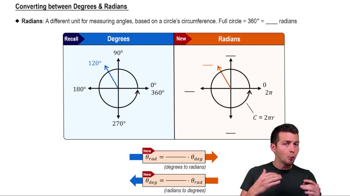
Degree to Radian Conversion

To convert degrees to radians, use the conversion factor π radians = 180 degrees. This means that to convert a degree measure, you multiply the degree value by π and then divide by 180. For example, to convert 175°, you would calculate (175 × π) / 180.
Recommended video:
5:04
Converting between Degrees & Radians

Simplifying Fractions

When converting degrees to radians, the resulting fraction can often be simplified. This involves finding the greatest common divisor (GCD) of the numerator and denominator and dividing both by this value. Simplifying helps express the angle in its simplest form, making it easier to understand and use in further calculations.
Recommended video:
4:02
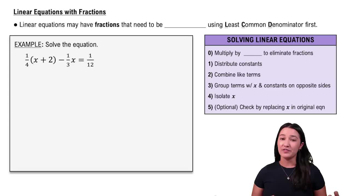
Solving Linear Equations with Fractions

Understanding π in Trigonometry

In trigonometry, π (pi) is a fundamental constant representing the ratio of a circle's circumference to its diameter. It is approximately equal to 3.14, but in trigonometric contexts, it is often left in terms of π to maintain exactness. Understanding how π relates to angles is crucial for working with radians, as it helps in visualizing and calculating circular motion and periodic functions.
Recommended video:
5:32
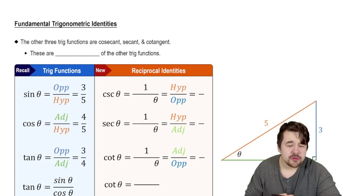
Fundamental Trigonometric Identities