

Beyond the textbook: Preparing students for real-life problem solving
by
What does it take to prepare today’s learners for tomorrow’s unknown challenges? Beyond memorising facts or acing exams, education must equip students with the mindset to innovate, adapt, and solve problems that impact communities worldwide. This is where Pearson Edexcel’s curriculum shines, bridging theory with real-world application to nurture the next generation of problem solvers.
At the secondary level, where students lay the foundation for university and beyond, the emphasis shifts to critical thinking and adaptability. A strong curriculum must do more than deliver subject knowledge; it should train learners to analyse, apply, and problem-solve in ways that mirror real-world demands.
This approach is evident at MAZ International School in Petaling Jaya, Malaysia, where the Pearson Edexcel International GCSE Computer Science curriculum has become a springboard for innovation.
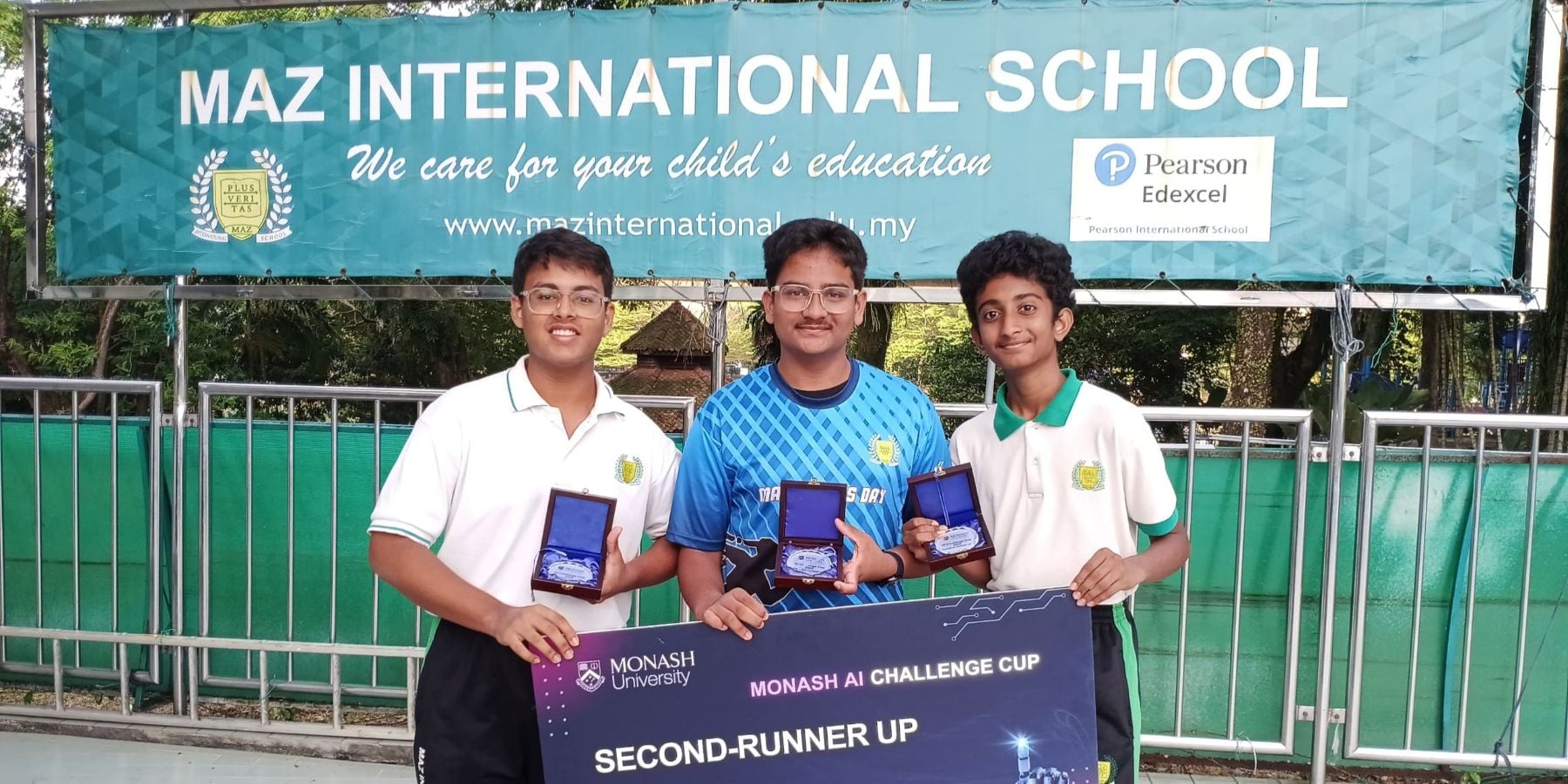
In July 2025, 14 students from the school shone at two national-level AI competitions, securing one second runner-up achievement and four finalist placings. Their success demonstrates how a curriculum rooted in practical application equips learners to tackle global challenges with creativity and confidence.
Bringing real-world scenarios to life
The Computer Science curriculum’s foundational theories supported by real-world scenarios was crucial in helping the students link theory to reality.
For year 11 student, Sadikshya Dhakal, whose team built an app and AI chatbot to tackle national health issues related to anti-microbial resistance, the exposure to data privacy laws and regulations was essential.
“When building the app, we learned that collecting user information comes with limits. You need to protect data, store it responsibly, and safeguard your users’ trust.” she said.
“Furthermore, we noticed that Pearson textbooks don’t just give us the theory, but also real life examples on how we can implement the theories. For example, there was a topic about the conscious, ethical use of AI. Based on this, we ensured that we collected and securely stored only the relevant user data we needed for our AI chatbot.” Sadikshya continued.
Her perspective demonstrated how textbook examples became guiding principles in designing solutions that were not only functional but also ethical.
These learnings reflect the heart of Pearson’s approach: scenarios are drawn broad real-world applications from healthcare, business, science and technology, and relevant issues like data protection.
As observed by her schoolmate, Yashwardhan Verma, a year 10 student who was part of another team participating in the AI challenge, “The Pearson syllabus is very proactive. You’re not studying outdated problems - you're engaging with challenges that appear every day.”


Best Ephraim from MAZ International School entered the Monash AI Challenge 2025 as a solo contender with an AI-powered chip to solve the recurring Malaysian flood issues.
A curriculum that builds depth
Beyond broad principles, students benefited from in-depth technical modules in the Computer Science curriculum.
Year 10 student, Mohamed Rayyan Mridha, credited the unit on sub programs in Python for helping him break large codes into smaller, manageable parts. “Facing a problem step by step instead of head-on made it easier to achieve the outcome we wanted.” he explained
Another student, Best Ephraim from year 10, found that studying Python’s diff functions introduced a new way of thinking to him. “It gave me an analytical mindset. Instead of creating a massive code, I broke it into components and each had its own purpose and process.” he said.
Avighna Visveswaran from Year 11 highlighted Unit Six in the curriculum which taught them about AI, and Units One and Two which taught the students how to decode and approach unfamiliar problems. “Our lessons taught me to look at problems from different angles and effectively find solutions.” she noted.
By applying these modules directly into their AI competition prototypes, students moved beyond exam preparation into true computational thinking.
A focus on applied learning
The Pearson curriculum also cultivates and supports project-based learning that mirrors workplace problem-solving. The AI projects fielded by the students for the competitions became their real life experiments in applying code, debugging, and refining presentations.
These projects demanded teamwork and perseverance, skills nurtured in the classroom through project-based learning.
Reflecting on the journey, Mohamed Rayyan shared, “Joining competitions has given me exposure to new knowledge and experience. It teaches you to adapt to new environments and gives you the hunger to keep improving.”
Computer Science teacher at MAZ International School, Ms Anjali Maniyangatt praised Pearson’s assessment approach for going beyond traditional examinations. Students are placed in real-world scenarios - taking on the role of an employee or leader within an organisation - where they must apply their knowledge to solve practical challenges. This method not only evaluates technical ability but also cultivates analytical thinking and creative problem-solving, encouraging learners to discover workable solutions for complex issues.

Students were challenged to test their knowledge by applying the computer science topics in class projects.


“What impressed me most was the three-hour practical assessment for Years 10 and 11,” said Ms. Anjali. “Rather than focusing solely on the final output or a technically perfect code, the assessment challenges students to think like real-world problem solvers - balancing multiple factors, weighing scenarios, and arriving at the most effective solution. This approach develops critical thinking and logical reasoning, ensuring that when students face real-life obstacles, they can work through them step by step to find answers.”
Classroom learning, in other words, was not siloed knowledge but a launchpad for tackling authentic, open-ended challenges.

Students participating in an interactive computer science assessment in online quiz format, sparking excitement and fun engagement in the learning process.
The role of mentorship
Behind the success of every student is the invaluable guidance of a dedicated teacher, playing the role of educator, gentle critic, motivational leader and cheerleader.
The students’ strong performance was a result of their Computer Science teacher, Ms Anjali Maniyangatt, who went above and beyond in guiding the students to competition.
Students described her mentorship as “immensely crucial” and “impossible to do without.” She rehearsed presentations with every team, asked tough questions to prepare them for judges, and even joined late-night calls to troubleshoot technical errors.
Franciya Elizabeth Antony (year 11) recalled, “She motivated us, clarified our doubts, and even joined us on Google Meet until midnight to fix errors.”
Mohamed Rayyan added, “When our program crashed, she encouraged us to rebuild it. The version we presented was better than the original.”
For Yashwardhan Verma, her foresight was invaluable, “She knew questions would matter as much as presentations. Training us to answer tough questions gave us the edge.”
Such mentorship highlights the synergy between a robust curriculum and dedicated educators. The Pearson Edexcel curriculum, when delivered and supported by a dedicated educator, empowers students to connect theory with the world beyond the classroom.

MAZ International School IT and computer science teacher, Ms Anjali Maniyangatt, was instrumental in mentoring the students to win placings in AI and coding competitions.
Shaping futures beyond school
Perhaps the greatest testament to Pearson’s impact is how it influenced students’ aspirations. Several expressed interest in pursuing technology-related fields, from software engineering to bioengineering with AI applications.
“Seeing the role of technology today makes me want to contribute to it in the future.” said Avighna.
The competitions weren’t just about winning prizes. They also built confidence, resilience, and vision. As Franciya put it, “This experience showed us that with encouragement and facilities, students can create ideas that positively impact the world.”

Avighna Visveswaran and Franciya Elizabeth Anthony, along with their teammate Gadhe Jeremiah Caleb, impressed judges with their AI powered solution to handle the rising plastic pollution in the Klang River.

Mohamed Rayyan (left) and his teammates from team 'Sparks_AI' confidently presenting an AI-powered tracking system for illegal waste dumping through smart surveillance.

Team AIVengers was selected as a top ten finalist in the National AI Competition organised by a local university.
MAZ International School understands that learning that stays within the textbook risks becoming obsolete. Pearson Edexcel International GCSE Computer Science curriculum prepares students for life by equipping them with logical reasoning, ethical awareness, and the ability to design innovative solutions.
At MAZ International School, these skills propelled 14 students into national competitions, where they proved that real-world challenges can be met with creativity, collaboration, and determination.
Their stories affirm that when curriculum meets application, and when students are guided by inspired teachers, the classroom becomes a launchpad for shaping the innovators of tomorrow.
Article banner image: Team GPT Who? from MAZ International School, who were awarded the second runner-up in the Monash AI Challenge Cup 2025