

From classroom code to real-world impact, Pearson Edexcel empowers students to success
by
In July 2025, students from MAZ International School, Malaysia demonstrated how a strong curriculum and dedicated mentorship can nurture students’ potential. Competing against thousands of peers nationwide, five teams of young innovators won judges over with their creativity and technical skills in two prestigious artificial intelligence (AI) competitions hosted by Sunway University and Monash University in Malaysia.
Their achievements not only highlighted individual talent but also reflected the formative impact of Pearson Edexcel International GCSE Computer Science.
Computer Science at MAZ International School
Although Computer Science was introduced for Year 10 and Year 11 students only last year, MAZ International School had already been preparing its learners through Pearson’s Computing and ICT syllabus up to Year 9. This early exposure gave students a solid grounding in digital literacy and basic programming before advancing into the more rigorous International GCSE Computer Science curriculum.
Building on this foundation, the school fielded 15 teams across the two competitions, with five teams (14 students) ultimately securing recognition. Four students received higher education bursaries worth RM5,000, another three earned RM1,000 cash awards, and the rest achieved finalist placements.
Their projects addressed pressing global challenges - from antimicrobial resistance and mental health to plastic pollution and urban flooding - in alignment with the United Nations Sustainable Development Goals (SDGs) that the competitions chose to address.
This success speaks volumes about how quickly students adapted to computational thinking, problem-solving, and AI application, building on the foundation provided by the Pearson Edexcel International GCSE Computer Science curriculum.

Bursaries worth RM5,000 each were awarded to Team AIVengers, one of the Top 10 finalists at the National AI Competition 2025 hosted by Sunway University.
Success at Sunway University's AI competition
At the National AI Competition 2025, co-organised by Sunway University and Hyperbyte AI and the largest of its kind in Malaysia, Team AIVengers, comprising Ardhra Sreejith (Year 9), Shreeyansh Krishna Shrestha (Year 9), Sadikshya Dhakal (Year 11) and Jo Eui Chan (Year 9), emerged as a top 10 finalist among 600 submissions from more than 2,500 secondary and pre-university students.
Their project, MedAIAssist, tackled the urgent issue of antimicrobial resistance. The mobile app, capable of functioning in low-bandwidth areas, uses AI chatbots and a medical database sourced from the WHO, FDA, and Malaysia’s Ministry of Health to guide users on antibiotic use.
In addition to the final presentation, the team was required to present their project in a booth, which they set up as an interactive learning space. Visitors were invited to play flashcard games to test their knowledge of antimicrobial resistance, pledge their support on a promise wall, and take home eco-friendly badges as reminders of the cause.
“We went through 39 failed attempts before we managed to get our final prototype out.” said Year 11 student Sadikshya Dhakal from Team AIVengers. Despite having their persistence tested repeatedly, the team’s resilience carried them to the finals, where they also educated the public through games and awareness activities.

Team AIVengers from MAZ International School impressed judges with their AI chatbot and mobile app designed to reduce antimicrobial resistance. Ardhra Sreejith from Team AIVengers later visited Google’s headquarters as part of the perks offered to finalists of the competition.
Accolades at the Monash AI Challenge Cup
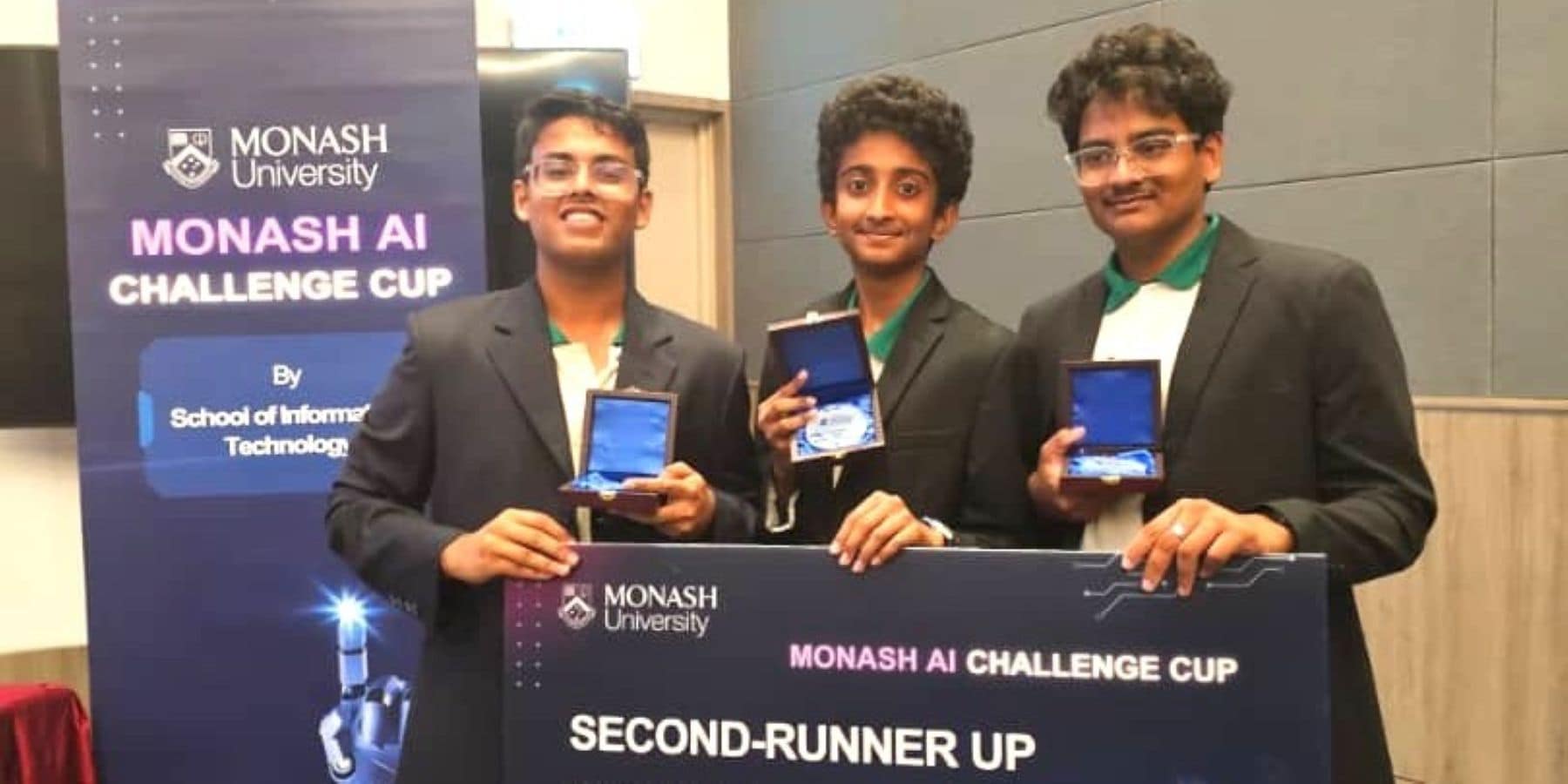
At the Monash AI Challenge Cup (MAICC), four MAZ teams reached the final round, with one team securing second runner-up and three teams recognised as top 10 finalists. This competition was distinctive for its 'surprise criteria', where teams had just 90 minutes to integrate an unexpected element into their projects.
Guided by mentors from Monash’s School of Information Technology, students showcased adaptability alongside their technical proficiency.
Earning a second runner-up placing was team GPT Who?, comprising Year 10 students, Yashwardhan Verma, Vaishnav Harish and Aakash Garikapati, with their mental health AI tool to detect early signs of depression and anxiety in teenagers. By incorporating a chatbot trained in Gen-Z slang, the app helped destigmatise mental health support. When challenged to add a surprise gender equality feature, the team innovated further by creating women-only forums for safe discussions.

Team GPT Who? presenting their project, Mindspace AI – For teens by teens, to the panel of judges at the Monash AI Challenge Cup.
Demonstrating their technical prowess, three other teams earned finalist placements with AI-powered solutions addressing urgent environmental challenges.
Year 11 seniors Franciya Elizabeth Antony, Gadhe Jeremiah Caleb and Avighna Visveswaran of team AIScapers created Aqua Sweep, an AI-powered net and plastic pollution alert system designed for the Klang River. For the additional surprise challenge on gender equality, they linked the river pollution data to fertility concerns, creating a platform for women to share experiences and support.
Team Sparks_AI, comprising Year 10 students, Mohamed Rayyan Mridha, Joel okojie Ehigie and Mohamed Hanif addressed illegal waste dumping with a drone-based smart water surveillance system. With the additional challenge of reducing income inequality, the team developed a community rewards scheme that encourages public reporting.
Solo contender and Year 10 student, Best Ephraim impressed judges with an AI-powered modular flap system to mitigate urban flooding, aligning with SDG 11 on sustainable cities.

A plastic pollution alert and net system powered by AI, Aqua Sweep, is the brainchild of the three Year 11 students comprising team AIScapers.

The Year 10 students in Team Sparks_AI, presenting their AI-powered smart water surveillance system that improves the sustainability of cities.

“I chose to compete alone because I love pushing myself to the limit. Watching my idea come to life was the proudest moment.” Best Ephraim, Year 10
Skills that are central to International GCSE Computer Science curriculum
These projects illustrate not only technical ingenuity but also the capacity to engage with complex societal issues.
As shared by Shreeyansh Krishna Shrestha from Team AIVengers, “We gained valuable insights into using AI not just as a tool, but as an online collaborative partner. With the power of AI’s analytical skills, we could now tackle future challenges with deeper intelligence, speed and creativity.”
Importantly, the competitions demanded that students move beyond theoretical knowledge into real-world application. Through the process of designing prototypes, pitching to judges, and refining their solutions under time pressure, the students demonstrated skills that are central to the Pearson Edexcel International GCSE Computer Science curriculum: algorithmic thinking, data analysis, systems design, and collaborative problem-solving.
The fact that first-year learners in the subject could compete at this level and secure national recognition highlights the strength of the programme in preparing students for future challenges.
A strong curriculum foundation
The Pearson Edexcel International GCSE Computer Science curriculum provided MAZ students with a strong foundation that went far beyond coding exercises.
Each concept was connected to real-world applications, whether it was in healthcare, business intelligence, or environmental monitoring. Through such examples, the students learned to view programming not as an abstract skill but as a tool for solving tangible problems.
More importantly, the three-hour practical assessments emphasised the learning process over final output. By training students to think logically, troubleshoot effectively, and innovate under pressure, it gave students the confidence to transform classroom knowledge into ready solutions to address global issues.
Inspiring teaching
The key behind the students’ success was the dedication of their teacher, Ms. Anjali, who guided them through months of preparation.
As the sole Computer Science teacher for Forms 1 to 5, she not only supervised projects but also stayed late with students to refine their prototypes, balancing competition deadlines with term exams.
Drawing on her background as a software engineer and her decade of corporate experience, she encouraged students to see coding as more than assignments. In the classroom, she constantly shared illustrations and examples of how their work could produce real-world impact. Her mentorship nurtured both resilience and excitement in the students, and gave them the confidence to thrive during the competition.
“The curriculum excites students because every concept links to real-world use. They are not just learning programming, they are learning to solve problems.” she says.
Developing future changemakers
The achievements of MAZ International School students stand as proof that when education is tied to real-world application, young people can become changemakers.
Guided by Pearson Edexcel International GCSE Computer Science curriculum and supported by dedicated mentorship, these students successfully translated classroom lessons into purposeful innovations addressing health, environment, and community wellbeing.
Their competition journey is proof that learning is not just about consuming knowledge but also producing it; applying creativity, empathy, and perseverance to solve pressing challenges.
With every project, they remind us that the future of education lies in equipping students to imagine, innovate, and impact society meaningfully.