

Effective classroom management routines for very young learners

Jeanne Perrett
Jeanne Perrett
A teacher with young students sitting at a table looking at flashcards
Reading time: 4 minutes

For very young learners, children aged 3-6, being in a classroom might be a completely new experience. Most of them won’t know any English words at all and might have very little idea of what English is or why they are learning it. Some of them may not yet be completely fluent in their mother tongue. 

At the beginning of the school year, some of them may find it distressing to be separated from their parents and they also have to learn to get along with their new classmates. 

If we want to keep them comfortable and safe and provide a friendly and welcoming environment, we need to establish routines. 

7 ways you can build routines into your classes

Here are some areas where you can easily incorporate classroom management routines into your English language class.

1. Think about your target language

Our target language for each lesson may be one or two short phrases or a few new words. We should always keep the presentation and practice of this simple and clear. 

However, we can use English for all our greetings, praise, instructions and explanations. After a few days, the children will begin to expect it and they will gradually understand what you are saying. 

2. Coming into the class

Take time to greet each child by name when they enter the classroom and encourage them to learn and use each other’s names too. This will change how they perceive themselves and each other and encourage friendly communication. 

Notice the small things about each child. They might have a new T-shirt on or have done their hair specially. They may not tell you that they have made an effort to look nice for their lesson, but they will be pleased when you notice and will feel encouraged to continue. 

3. Circle time

Make circle time the start of every lesson. It gets the children sitting down together and this helps them to get to know each other and feel part of a comfortable group. 

It’s the time where you present the target language for the day. Use a puppet to help you do this. Make the puppet part of the routine by keeping it in a certain place and bringing it out from there every day. The children can call its name. 

The puppet can greet the children by name and the children can answer back. First, use picture cards or objects to present the language to the puppet. Then, the puppet can show that it understands or ask for repetition. 

Let the children call out responses as a group. As they build their confidence in English they will want to speak by themselves. 

Always accept approximations of words and phrases. Rather than correcting the children, continue to model the words and gradually the students will self-correct. Pass this tip on to parents too. 

4. Book time

Give students time to discover pages and images they like in the books they are using. Always leave time to help each child find the correct page and then help them to focus their attention on that page. 

In Circle time you have introduced the language and presented it with flashcards or objects. In Book time, children can look at these images – the content will be familiar and they will start to feel ownership of what they are learning. 

5. Songs, games and miming

Singing, playing games and miming are the main ways in which the students will start to freely use and show they understand the target language. 

In My Disney Stars and Friends each stage of every game is detailed, along with the language you and the students can use. Students might become so involved in the action of the game that they forget to speak in English! That’s okay – continue using the language and eventually they will start to use it too. 

When a game or a song involves physical activity, have drinks of water ready and let them rest and relax afterwards. Always have a ‘sitting down’ activity ready for them to move on to so that they do not become overexcited or tired.

6. Craft and stickers

For any craft work there are four stages: preparation, production, playing with the completed craft work and tidying up. If you're using My Disney Stars and Friends, there is a special Tidy Up song and all the craft projects are press-outs so there is no need for scissors. 

Children of 3 or 4 years old will need to learn how to unpeel and then re-stick a sticker. Allow time for this and encourage them to learn from each other once some of them have mastered this fine motor skill. 

7. Leaving the class

Time your lessons so that the students don’t have to leave in a rush. It takes them a while to collect up their things and find their bags and coats. 

If you want the parents to know something, make sure that the children know where they have put the note. One notebook for such messages is a simple way of doing this, and you can tell parents to check it after every lesson. 

Just as you greeted each child by name when they came in, say goodbye to them individually as they leave. 

Incorporating effective classroom management routines makes young learners feel more comfortable as they know what to expect from their language classes. Familiarity is welcome for children, so exploit these times for more language learning opportunities. 

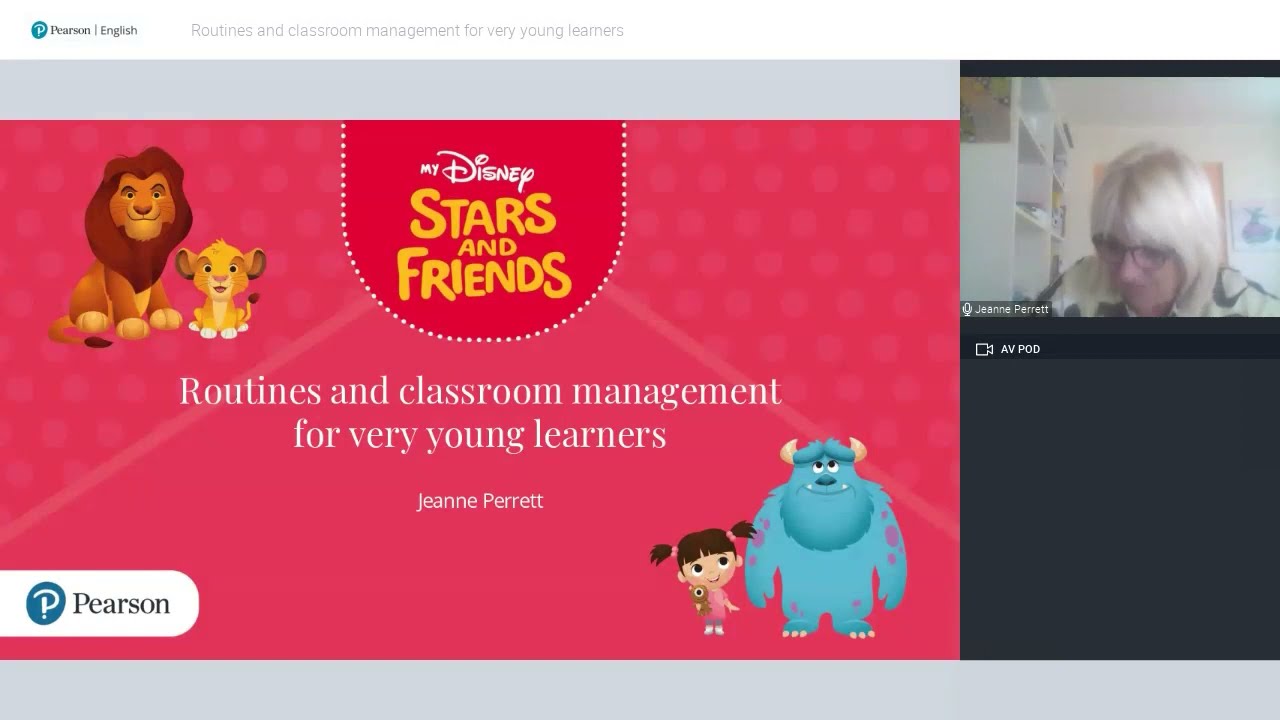
Find more ideas on effective classroom management routines in Jeanne Perrett’s webinar, where she focuses on practical ideas and teaching tips for how we can organise and manage a class of young learners.

Routines and classroom management for very young learners I Pearson English Disney Day
Play
Privacy and cookies

By watching, you agree Pearson can share your viewership data for marketing and analytics for one year, revocable by deleting your cookies.

Want to learn more about teaching young learners? Read our post 'Young learners of English deserve more'.

More blogs from Pearson

  • Children stood around a laptop with a teacher smiling
    Educator wrapped 2025
    By Charlotte Guest
    Reading time: 4 minutes

    If 2025 taught us anything, it’s that educators who lead with heart, ingenuity and resilience help students thrive. Your creativity drove the momentum. Your learners set the direction. Our role at Pearson was to support your journey with tools that save time, create impact and open more opportunities for your students.

    Here’s your Educator Wrapped for 2025.

  • University students sat in a lecture hall, one has his hand raised
    Supporting student success beyond admissions
    By Alice Bazzi
    Reading time: 2 minutes

    In international education, admissions are just the beginning. While securing a place at a university is a massive milestone for a student, measuring success continues for them from the moment they arrive on campus. Institutions know that academic performance, engagement and retention are shaped long before the first lecture begins, and one of those critical factors is English language proficiency. 

    Students who begin their studies with the right level of English are better equipped to participate fully in academic life. They understand course material, contribute to discussions and complete assignments with confidence. This foundation does not support individual achievement; it also strengthens the entire learning environment. 

    That is why reliable proficiency testing is more than an admissions tool. It is a strategic investment in student success. 

    The link between proficiency and performance 

    Universities have long understood the connection between language readiness and academic outcomes. When students are placed correctly, they are more likely to thrive. Misplacement, on the other hand, can lead to frustration, disengagement and even dropout. 

    Reliable testing helps institutions avoid such pitfalls. It ensures that students are matched to the right level of study, reducing the need for remedial support and improving retention rates. For universities, this translates into stronger performance metrics and a cohesive student experience overall. 

    Pearson English Express Test: A foundation for success

    The Pearson English Express Test is designed to support this journey before day one. With fast, secure and trusted results, it gives both students and institutions the clarity they need to move forward with confidence. 

    It delivers certified scores within 48 hours, allowing universities to make timely decisions and students to begin their academic journey without delay. It is AI-powered scoring and alignment with CEFR and GSE frameworks ensures accuracy, while remote proctoring and identity verfication protect the integrity of the results. 

    This combination of speed, precision and security makes the Pearson English Express Test more than just a test but a strategic tool for long-term success 

    Institutional value that goes beyond admissions 

    For universities, adopting the Pearson English Express Test is not just about streamlining admissions; it is about strengthening the entire student lifecycle. By ensuring that potential students are linguistically prepared, institutions can reduce academic risk, improve retention and enhance their reputation for supporting international learners. 

    The Pearson English Express Test helps universities to demonstrate a commitment to quality and care. It shows that they are not just admitting students, they are setting them up for success. 

    A smarter start for international students

    In a competitive global education market, institutions need solutions that go beyond the basics. The Pearson English Express Test offers a smarter, more strategically driven approach to language assessment. One that not only supports them getting into university, but also from application to graduation. 

    By choosing the Pearson English Express Test, universities are investing in outcomes that matter: academic success, student satisfaction and long-term institutional positive impact. 

  • Youung adults outside dressed up warm chatting together
    Celebrating global holidays: Inclusive festive activities for your English classroom
    By Charlotte Guest
    Reading time: 4 minutes

    Across classrooms, holidays show up as stories, songs, recipes, colors and customs. For English educators, they also offer language tasks that build communication, intercultural understanding and community. The key is to celebrate in a way that’s inclusive, academically rich, and respectful of diverse beliefs and backgrounds. Here are some activities you can do this festive season with minimal fluff and maximum impact, each tied to clear language objectives.

    Principles for inclusive festive learning

    • Student choice: Invite learners to showcase their traditions, for example, Diwali, Lunar New Year, Eid, Hanukkah, Christmas, Día de los Muertos, Nowruz or a seasonal theme without a religious focus.
    • Language-first design: Anchor activities in explicit objectives – for example, “Can describe customs and traditions,” “Can compare events,” “Can write instructions” – to ensure measurable progress.
    • Do-no-harm approach: Provide opt-in alternatives, avoid stereotyping and create space for students who do not celebrate holidays.
    • Representation: Use materials that reflect multiple regions and voices. Encourage translanguaging to deepen understanding and honor identity.
    • Accessibility: Scaffold with visuals, sentence frames and leveled texts so every learner can contribute meaningfully.