Pearson+ LogoPearson+ Logo
Ch. 26 Hormones and the Endocrine System
Taylor - Campbell Biology: Concepts & Connections 10th Edition
Taylor, Simon, Dickey, Hogan10th EditionCampbell Biology: Concepts & ConnectionsISBN: 9780136538783Not the one you use?Change textbook
Chapter 26, Problem 4

Explain how the hypothalamus controls body functions through its action on the pituitary gland. How does control of the anterior and posterior pituitary differ?

Verified step by step guidance
1
Understand the role of the hypothalamus: The hypothalamus is a small region at the base of the brain that serves as a crucial link between the nervous system and the endocrine system. It regulates many bodily functions such as temperature, hunger, and thirst by controlling hormone release.
Recognize the connection to the pituitary gland: The hypothalamus is directly connected to the pituitary gland, which is divided into two parts: the anterior pituitary and the posterior pituitary. The hypothalamus communicates with these two parts differently to control various body functions.
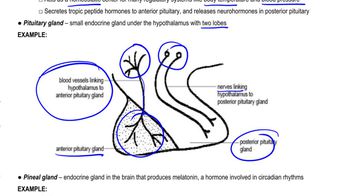
Explore the control over the posterior pituitary: The hypothalamus produces hormones that are directly transported to and stored in the posterior pituitary. When needed, these hormones (such as antidiuretic hormone and oxytocin) are released into the bloodstream directly from the posterior pituitary.
Investigate the control over the anterior pituitary: Unlike the posterior pituitary, the hypothalamus influences the anterior pituitary through a special blood vessel system called the hypothalamic-pituitary portal system. The hypothalamus secretes releasing and inhibiting hormones into this portal system, which then travel to the anterior pituitary to regulate the release of its hormones.
Examine the effects of anterior pituitary hormones: The hormones released by the anterior pituitary (such as growth hormone, thyroid-stimulating hormone, and adrenocorticotropic hormone) have wide-ranging effects on growth, metabolism, and stress response. The hypothalamus, through its releasing and inhibiting hormones, plays a critical role in controlling these functions.

Verified video answer for a similar problem:

This video solution was recommended by our tutors as helpful for the problem above.
Video duration:
1m
Was this helpful?

Key Concepts

Here are the essential concepts you must grasp in order to answer the question correctly.

Hypothalamus Function

The hypothalamus is a small but crucial brain region that regulates various bodily functions, including temperature, hunger, and thirst. It acts as a control center, receiving signals from the body and responding by releasing hormones that influence the pituitary gland, which in turn affects other endocrine glands throughout the body.
Recommended video:
Guided course
06:04
Functional Groups

Pituitary Gland Structure

The pituitary gland, often referred to as the 'master gland,' is divided into two main parts: the anterior and posterior pituitary. The anterior pituitary produces and secretes hormones that regulate growth, metabolism, and reproductive functions, while the posterior pituitary stores and releases hormones produced by the hypothalamus, such as oxytocin and vasopressin.
Recommended video:
Guided course
03:34
Hypothalamus and Pituitary

Hormonal Control Mechanisms

The control of the anterior and posterior pituitary differs in their hormonal regulation. The anterior pituitary is regulated by releasing and inhibiting hormones from the hypothalamus, which stimulate or suppress hormone production. In contrast, the posterior pituitary directly releases hormones into the bloodstream, acting as a storage site for hormones synthesized by the hypothalamus, thus providing a more immediate response to physiological changes.
Recommended video:
Guided course
08:18
Plant Hormones and Senescence