This chapter explains how the emergent properties of water contribute to the suitability of the environment for life. Until fairly recently, scientists assumed that other physical requirements for life included a moderate range of temperature, pH, and atmospheric pressure. That view has changed with the discovery of organisms known as extremophiles, which have been found flourishing in hot, acidic sulfur springs and around hydrothermal vents deep in the ocean. What does the existence of life in such environments say about the possibility of life on other planets?
Verified step by step guidance
1
Step 1: Begin by understanding the concept of extremophiles. Extremophiles are organisms that thrive in extreme environmental conditions, such as high temperatures, acidity, salinity, or pressure, which are typically inhospitable to most life forms.
Step 2: Reflect on the emergent properties of water that make it essential for life, such as its ability to moderate temperature, its solvent properties, and its role in maintaining pH balance. These properties contribute to the adaptability of life in diverse environments.
Step 3: Consider how the discovery of extremophiles challenges the traditional assumptions about the physical requirements for life. Their existence demonstrates that life can adapt to conditions far beyond the moderate ranges of temperature, pH, and pressure previously thought necessary.
Step 4: Explore the implications of extremophiles for astrobiology, the study of life on other planets. If life can exist in extreme environments on Earth, it suggests that life might also exist in extreme conditions on other planets or moons, such as Mars or Europa, where water and extreme conditions are present.
Step 5: Conclude by recognizing that the discovery of extremophiles expands the scope of environments considered potentially habitable for life, encouraging scientists to search for life in diverse and extreme extraterrestrial environments.
Verified video answer for a similar problem:
This video solution was recommended by our tutors as helpful for the problem above
Video duration:
1m
Play a video:
Was this helpful?
Key Concepts
Here are the essential concepts you must grasp in order to answer the question correctly.
Emergent Properties of Water
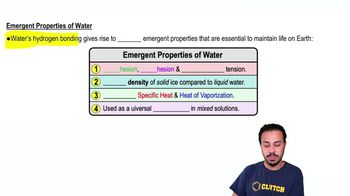
Emergent properties of water refer to unique characteristics that arise from the molecular structure and interactions of water molecules. These properties, such as cohesion, adhesion, high specific heat, and solvent capabilities, are crucial for supporting life. For instance, water's high heat capacity helps stabilize temperatures in environments, making them more suitable for living organisms.
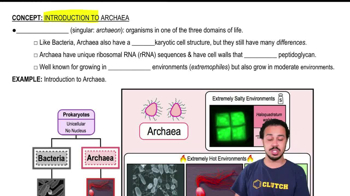
Extremophiles are organisms that thrive in extreme environmental conditions, such as high temperatures, acidity, or salinity, which would be inhospitable to most life forms. Their existence challenges traditional views of life's requirements and suggests that life can adapt to a wider range of conditions than previously thought. This adaptability raises intriguing possibilities about the potential for life on other planets with extreme environments.
Astrobiology is the study of the origin, evolution, distribution, and future of life in the universe. It encompasses the search for life beyond Earth, considering various environmental conditions that could support life. The discovery of extremophiles on Earth informs astrobiological research by expanding the criteria for habitability, suggesting that life may exist in diverse and extreme environments on other planets.