
Pearson+ LogoPearson+ Logo
Ch. 2 The Chemical Basis of Life
Taylor - Campbell Biology: Concepts & Connections 10th Edition
Taylor, Simon, Dickey, Hogan10th EditionCampbell Biology: Concepts & ConnectionsISBN: 9780136538783Not the one you use?Change textbook
Chapter 2, Problem 1

Fill in the blanks in this concept map to help you tie together the key concepts concerning elements, atoms, and molecules.
Concept map illustrating atoms, chemical bonds, and their properties for biology chapter 2.

Verified step by step guidance
1
Step 1: Analyze the concept map starting with atoms. Atoms can be positively charged (a), neutral (b), or negatively charged (c). Positively charged atoms are protons, and their number equals the atomic number of each element.
Step 2: Neutral atoms have neutrons, and their number may differ in (d), which refers to isotopes. Isotopes are variations of an element with different numbers of neutrons.
Step 3: Negatively charged atoms are electrons, and the number in the outer shell determines the formation of (c), which refers to chemical bonds. These bonds can be ionic or covalent.
Step 4: Chemical bonds are formed through electron transfer or sharing. Electron transfer creates ions, and attraction between ions creates (f), which refers to ionic bonds. Unequal sharing of electrons creates (g), which refers to polar covalent bonds.
Step 5: Equal sharing of electrons creates (e), which refers to nonpolar covalent bonds. Polar covalent bonds, such as in water, lead to (h), which refers to hydrogen bonds. These bonds give water its important qualities due to polarity.

Verified video answer for a similar problem:

This video solution was recommended by our tutors as helpful for the problem above.
Video duration:
38s
Was this helpful?

Key Concepts

Here are the essential concepts you must grasp in order to answer the question correctly.

Atoms

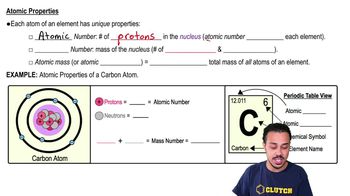
Atoms are the fundamental units of matter, consisting of protons, neutrons, and electrons. The atomic number, which is the number of protons in the nucleus, defines each element. Atoms can be positively charged (cations), negatively charged (anions), or neutral, depending on the balance of protons and electrons. Understanding the structure of atoms is crucial for grasping how they interact to form molecules.
Recommended video:
Guided course
07:43
Atomic Properties

Chemical Bonds

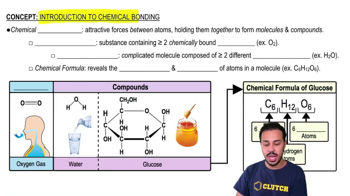
Chemical bonds are the forces that hold atoms together in molecules. There are primarily two types of bonds: ionic bonds, formed through the transfer of electrons between atoms, and covalent bonds, formed by the sharing of electrons. The nature of these bonds affects the properties of the resulting compounds, such as polarity and reactivity, which are essential for biological functions.
Recommended video:
Guided course
06:53
Introduction to Chemical Bonding

Polarity and Water

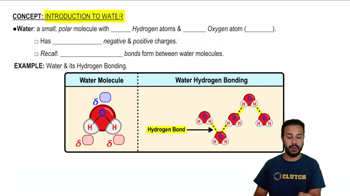
Polarity refers to the distribution of electrical charge over the atoms in a molecule. Water (H2O) is a polar molecule, meaning it has a partial positive charge on the hydrogen atoms and a partial negative charge on the oxygen atom. This polarity leads to unique properties of water, such as its solvent capabilities and high specific heat, which are vital for sustaining life and facilitating biochemical reactions.
Recommended video:
Guided course
01:54
Introduction to Water