Skip to main content
General Biology
My Course
Learn
Exam Prep
AI Tutor
Study Guides
Textbook Solutions
Flashcards
Explore
My Course
Learn
Exam Prep
AI Tutor
Study Guides
Textbook Solutions
Flashcards
Explore
Back
Introduction to DNA-Based Technology quiz #1
You can tap to flip the card.
Define:
What is the first step in DNA cloning?
You can tap to flip the card.
👆
What is the first step in DNA cloning?
The first step in DNA cloning is creating the recombinant DNA molecule using restriction enzymes to cut the DNA and ligation enzymes to paste it.
Track progress
Control buttons has been changed to "navigation" mode.
1/25
Related flashcards
Related practice
Recommended videos
Introduction to DNA-Based Technology definitions
Introduction to DNA-Based Technology
22 Terms
Introduction to DNA-Based Technology exam
Introduction to DNA-Based Technology
28 Terms
Introduction to DNA-Based Technology quiz #2
Introduction to DNA-Based Technology
31 Terms
Introduction to DNA-Based Technology
18. Biotechnology
5 problems
Topic
Jason
Introduction to DNA Cloning
18. Biotechnology
3 problems
Topic
Jason
18. Biotechnology - Part 1 of 2
5 topics
10 problems
Chapter
Jason
18. Biotechnology - Part 2 of 2
5 topics
9 problems
Chapter
Jason
Guided course
02:30
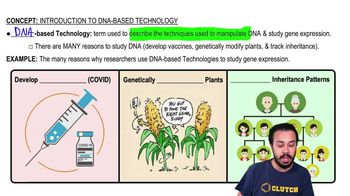
Introduction to DNA-Based Technology
Jason
6251
views
82
rank
Guided course
03:12
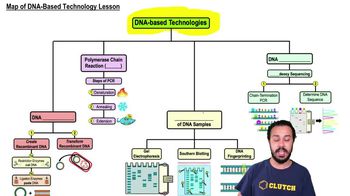
Map of DNA-Based Technology Lesson
Jason
5433
views
92
rank
Terms in this set (25)
Hide definitions
What is the first step in DNA cloning?
The first step in DNA cloning is creating the recombinant DNA molecule using restriction enzymes to cut the DNA and ligation enzymes to paste it.
What does PCR stand for in DNA-based technologies?
PCR stands for Polymerase Chain Reaction.
What are the three main steps of PCR?
The three main steps of PCR are denaturation, annealing, and extension.
What technique is used for the separation of DNA samples?
Gel electrophoresis is used for the separation of DNA samples.
What is the purpose of DNA sequencing in DNA-based technologies?
The purpose of DNA sequencing is to determine the exact sequence of nucleotides in a DNA molecule.
What is the role of restriction enzymes in DNA cloning?
Restriction enzymes act like molecular scissors to cut DNA at specific sequences.
What is the function of ligation enzymes in DNA cloning?
Ligation enzymes help paste the DNA fragments together to form recombinant DNA.
What is the final step in DNA cloning after creating recombinant DNA?
The final step is transforming the recombinant DNA into bacteria for replication.
What is the significance of dideoxy sequencing in DNA-based technologies?
Dideoxy sequencing, also known as Sanger sequencing, is used to determine the DNA sequence by chain termination PCR.
What is the main goal of DNA cloning?
The main goal of DNA cloning is to create many identical copies of a specific DNA sequence.
What is the role of E. coli in DNA cloning?
E. coli is used as a host cell to replicate and clone the specific DNA sequence of interest.
What is the purpose of using a map in the lesson on DNA-based technologies?
The map helps guide the lesson by showing the different branches and topics to be covered in DNA-based technologies.
What is the process of creating recombinant DNA called?
The process of creating recombinant DNA is called DNA cloning.
What is the significance of gel electrophoresis in DNA-based technologies?
Gel electrophoresis is significant for separating and analyzing DNA fragments based on their size.
What is the purpose of using chain termination PCR in DNA sequencing?
Chain termination PCR is used to terminate DNA synthesis at specific points, allowing the determination of the DNA sequence.
the unpaired nucleotides produced by the action of restriction enzymes are referred to as _____.
sticky ends
during which step in the pcr cycle are nucleotides used?
extension
how is mitochondrial dna (mtdna) typing used in forensic science?
mtDNA typing is used to analyze genetic material from mitochondria, which can help identify individuals, especially when nuclear DNA is not available.
can you correctly place the labels in this diagram that summarizes the process of dna profiling?
DNA profiling involves steps such as DNA extraction, PCR amplification, gel electrophoresis, and analysis of the resulting DNA patterns.
Which DNA molecules are cut with a restriction enzyme to create recombinant DNA?
Both the vector DNA and the DNA fragment of interest are cut with the same restriction enzyme.
why is bromophenol blue added to the individual dna samples?
Bromophenol blue is added to DNA samples to act as a tracking dye during gel electrophoresis, allowing visualization of the sample migration.
what is the end goal of pcr?
The end goal of PCR is to amplify a specific segment of DNA, generating millions of copies for analysis.
during which step in the pcr cycle do primers form bonds with a single-stranded template?
annealing
which technique would most likely be used by forensic scientists?
DNA profiling (or DNA fingerprinting)
what features of dna make it possible to make recombinant dna in the lab?
The complementary base pairing and the ability of restriction enzymes to cut DNA at specific sequences make it possible to create recombinant DNA.
 BackBack
 02:30
02:30