Pearson+ LogoPearson+ Logo
Ch. 34 The Biosphere: An Introduction to Earth's Diverse Environments
Taylor - Campbell Biology: Concepts & Connections 10th Edition
Taylor, Simon, Dickey, Hogan10th EditionCampbell Biology: Concepts & ConnectionsISBN: 9780136538783Not the one you use?Change textbook
Chapter 34, Problem 18

Aquatic biomes differ in levels of light, nutrients, oxygen, and water movement. These abiotic factors influence the productivity and diversity of freshwater ecosystems.
a. Productivity, roughly defined as photosynthetic output, is high in estuaries, coral reefs, and shallow ponds. Describe the abiotic factors that contribute to high productivity in these ecosystems.
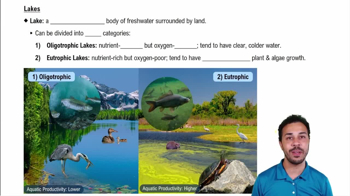
b. How does extra input of nitrogen and phosphorus (for instance, by fertilizer runoff) affect the productivity of lakes and ponds? Is this nutrient input beneficial for the ecosystem? Explain.

Verified step by step guidance
1
Step 1: Understand the concept of productivity in aquatic ecosystems. Productivity refers to the rate at which photosynthetic organisms, such as algae and aquatic plants, convert light energy into chemical energy (organic compounds). High productivity is often associated with favorable abiotic factors such as light availability, nutrient levels, and water movement.
Step 2: For part (a), identify the abiotic factors that contribute to high productivity in estuaries, coral reefs, and shallow ponds. These factors include: (1) High light availability due to shallow water depth, which allows sunlight to penetrate effectively. (2) Abundant nutrients, often due to nutrient-rich sediments or water mixing. (3) Moderate water movement, which prevents stagnation and ensures nutrient distribution without washing away organisms.
Step 3: For part (b), analyze the effects of extra nitrogen and phosphorus input on lakes and ponds. These nutrients are essential for plant and algae growth, so their addition can lead to an increase in productivity, a phenomenon known as eutrophication. However, excessive nutrient input can cause overgrowth of algae (algal blooms), which can block sunlight and reduce oxygen levels in the water as algae decompose.
Step 4: Evaluate whether the nutrient input is beneficial for the ecosystem. While moderate nutrient levels can enhance productivity, excessive input often leads to negative consequences such as hypoxia (low oxygen levels), fish kills, and loss of biodiversity. This process disrupts the balance of the ecosystem and is generally harmful.
Step 5: Summarize the key points. High productivity in estuaries, coral reefs, and shallow ponds is driven by light, nutrients, and water movement. Excessive nitrogen and phosphorus input in lakes and ponds initially increases productivity but often leads to harmful effects like eutrophication, making it detrimental to the ecosystem in the long term.

Verified video answer for a similar problem:

This video solution was recommended by our tutors as helpful for the problem above.
Video duration:
2m
Was this helpful?

Key Concepts

Here are the essential concepts you must grasp in order to answer the question correctly.

Abiotic Factors

Abiotic factors are the non-living components of an ecosystem that influence its environment and organisms. In aquatic biomes, key abiotic factors include light availability, nutrient levels, oxygen concentration, and water movement. These factors determine the types of organisms that can thrive in a given ecosystem and significantly affect overall productivity and biodiversity.
Recommended video:
Guided course
06:59
Biotic and Abiotic Factors

Nutrient Cycling

Nutrient cycling refers to the movement and exchange of organic and inorganic matter back into the production of living matter. In freshwater ecosystems, nitrogen and phosphorus are essential nutrients that support plant growth and productivity. However, their availability must be balanced; excessive inputs can lead to algal blooms, which disrupt the ecosystem and deplete oxygen levels, harming aquatic life.
Recommended video:
Guided course
03:25
Soil Nutrients

Eutrophication

Eutrophication is the process by which water bodies become overly enriched with nutrients, leading to excessive growth of algae and aquatic plants. This phenomenon often results from runoff containing fertilizers rich in nitrogen and phosphorus. While initial increases in productivity may seem beneficial, eutrophication can lead to oxygen depletion and the death of aquatic organisms, ultimately degrading the ecosystem's health.
Recommended video:
Related Practice
Textbook Question
Tropical rain forests are the most diverse biomes. What factors contribute to this diversity?
2308
views
Textbook Question
What biome do you live in? Describe your climate and the factors that have produced that climate. What plants and animals are typical of this biome? If you live in an urban or agricultural area, how have human interventions changed the natural biome?
1985
views
Textbook Question

Use Figures 34.5C and 34.18 to predict how global warming (rapid increase in Earth's average temperature; see Module 7.14) might affect the water cycle.

<IMAGE>

1147
views
Textbook Question

In the climograph below, biomes are plotted by their range of annual mean temperature and annual mean precipitation. Identify the following biomes:

Arctic tundra

Coniferous forest

Desert, grassland

Temperate forest,

Tropical forest.

Explain why there are areas in which biomes overlap on this graph.

3432
views
Textbook Question

The North American pronghorn looks and acts like the antelopes of Africa. But the pronghorn is the only survivor of a family of mammals restricted to North America. Propose a hypothesis to explain how these widely separated animals came to be so much alike.

837
views
Textbook Question

In 1954, workers at Michigan State University began spraying the elm trees on campus annually with DDT to kill disease-carrying bark beetles. In the spring of 1955, large numbers of dead robins were found on the campus. Observers thought perhaps the robins died after eating earthworms contaminated by DDT the previous spring. Suggest how scientists could have investigated the scientific validity of this idea.

848
views