
Pearson+ LogoPearson+ Logo
Ch. 34 The Biosphere: An Introduction to Earth's Diverse Environments
Taylor - Campbell Biology: Concepts & Connections 10th Edition
Taylor, Simon, Dickey, Hogan10th EditionCampbell Biology: Concepts & ConnectionsISBN: 9780136538783Not the one you use?Change textbook
Chapter 34, Problem 10

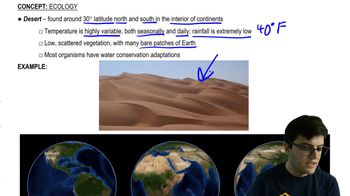
What makes the Gobi Desert of Asia a desert?
a. The growing season there is very short
b. It is hot
c. Temperatures vary little from summer to winter
d. It is dry

Verified step by step guidance
1
Understand the definition of a desert: A desert is typically defined by its low precipitation levels, not necessarily by temperature or other factors.
Analyze the options provided: Option (a) refers to the growing season, which is not a defining characteristic of a desert. Option (b) refers to heat, but not all deserts are hot (e.g., cold deserts like Antarctica). Option (c) refers to temperature variation, which is also not a defining factor of a desert. Option (d) refers to dryness, which aligns with the definition of a desert.
Recall that the Gobi Desert is classified as a cold desert, meaning it experiences significant temperature fluctuations and is not always hot, further ruling out options (b) and (c).
Focus on precipitation: The Gobi Desert receives very little rainfall annually, which is the primary reason it is classified as a desert.
Conclude that the correct answer is based on the defining characteristic of deserts, which is their dryness, making option (d) the most accurate choice.

Verified video answer for a similar problem:

This video solution was recommended by our tutors as helpful for the problem above.
Video duration:
1m
Was this helpful?

Key Concepts

Here are the essential concepts you must grasp in order to answer the question correctly.

Desert Definition

A desert is defined as a region that receives very little precipitation, typically less than 250 mm (10 inches) annually. This lack of moisture leads to arid conditions, which are a hallmark of desert ecosystems. Understanding this definition is crucial for identifying the characteristics that classify an area as a desert.
Recommended video:
Guided course
03:54
Desert and Savanna

Climate Factors

Climate factors such as temperature, humidity, and precipitation patterns play a significant role in determining the characteristics of a desert. In the case of the Gobi Desert, its dry climate, along with extreme temperature variations between summer and winter, contributes to its classification as a desert. Recognizing these climatic influences helps in understanding the environmental conditions of desert regions.
Recommended video:
Guided course
01:41
Weather vs. Climate

Growing Season

The growing season refers to the period during which conditions are suitable for plant growth, typically defined by temperature and moisture availability. In deserts like the Gobi, the growing season is often very short due to extreme temperatures and limited rainfall, which affects the types of vegetation that can thrive. This concept is important for understanding the ecological dynamics of desert environments.
Recommended video:
Guided course
03:57
Seasonal Turnover & Ocean Upwelling
Related Practice
Textbook Question

You have seen that Earth's terrestrial biomes reflect regional variations in climate. But what determines these climatic variations? Interpret the following diagrams in reference to how each represents effects on global patterns of temperature, rainfall, and winds.

a. Solar radiation and latitude

b. Earth's orbit around the sun

c. Global patterns of air circulation and rainfall

952
views
Textbook Question
Match each description on the left with the correct biome on the right. 2. The most complex and diverse biome 3. Ground permanently frozen 4. Deciduous trees such as ­hickory and birch 5. Limited to small coastal areas 6. Spruce, fir, pine, and hemlock trees 7. Home of ants, antelopes, and lions 8. North American plains a. chaparral b. savanna c. taiga d. temperate broadleaf forest e. temperate grassland f. tropical rain forest g. arctic tundra
1432
views
Textbook Question

Changes in the seasons are caused by

a. The tilt of Earth's axis toward or away from the sun

b. Annual cycles of temperature and rainfall

c. Variation in the distance between Earth and the sun

d. An annual cycle in the sun's energy output

1122
views
Textbook Question

Which of the following sea creatures might be described as a pelagic animal of the aphotic zone?

a. A coral reef fish

b. An intertidal snail

c. A deep-sea squid

d. A harbor seal

928
views
Textbook Question

Why do the tropics and the windward side of mountains receive more rainfall than areas around latitudes 30° north and south and the leeward side of mountains?

a. Rising warm, moist air cools and drops its moisture as rain.

b. Descending air condenses, creating clouds and rain.

c. There is more solar radiation in the tropics and on the windward side of mountains.

d. Earth's rotation creates seasonal differences in rainfall.

1259
views
Textbook Question

Phytoplankton are the major photosynthesizers in

a. The benthic realm of the ocean

b. The ocean photic zone

c. The intertidal zone

d. The aphotic zone of a lake

1750
views