
Pearson+ LogoPearson+ Logo
Ch. 34 The Biosphere: An Introduction to Earth's Diverse Environments
Taylor - Campbell Biology: Concepts & Connections 10th Edition
Taylor, Simon, Dickey, Hogan10th EditionCampbell Biology: Concepts & ConnectionsISBN: 9780136538783Not the one you use?Change textbook
Chapter 34, Problem 1

You have seen that Earth's terrestrial biomes reflect regional variations in climate. But what determines these climatic variations? Interpret the following diagrams in reference to how each represents effects on global patterns of temperature, rainfall, and winds.
a. Solar radiation and latitude
b. Earth's orbit around the sun
c. Global patterns of air circulation and rainfall
Diagram showing solar radiation and latitude effects on climate.

Verified step by step guidance
1
Solar radiation and latitude: The diagram shows that solar radiation is most intense at the equator (0° latitude) because sunlight strikes this region directly. As latitude increases toward the poles (30°N and 30°S), the angle of sunlight becomes more oblique, spreading the energy over a larger area and reducing its intensity. This explains why equatorial regions are warmer and polar regions are cooler.
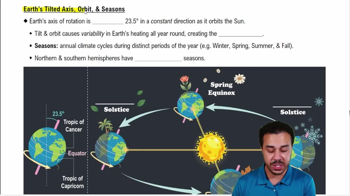
Earth's orbit around the sun: The diagram illustrates Earth's constant axial tilt of 23.5° and its orbit around the sun. This tilt causes seasonal variations in temperature and daylight. For example, during the June solstice, the Northern Hemisphere is tilted toward the sun, resulting in longer days and warmer temperatures, while the Southern Hemisphere experiences shorter days and cooler temperatures. The reverse occurs during the December solstice.
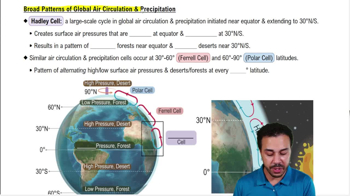
Global patterns of air circulation and rainfall: The diagram shows how warm air rises at the equator due to intense solar heating, creating low-pressure zones. As the air rises, it cools and condenses, leading to heavy rainfall in the tropics. The cooled air then moves toward the poles, descending at approximately 30°N and 30°S, creating high-pressure zones and dry conditions in these regions, such as deserts. This cycle is part of the Hadley cell circulation.
The combination of solar radiation, Earth's axial tilt, and global air circulation patterns explains the distribution of Earth's biomes. Tropical rainforests are found near the equator due to high rainfall, while deserts are located at 30° latitude due to descending dry air.
Understanding these diagrams helps explain how Earth's climate systems interact to create diverse biomes, each with unique temperature and precipitation patterns influenced by latitude, Earth's orbit, and atmospheric circulation.

Verified video answer for a similar problem:

This video solution was recommended by our tutors as helpful for the problem above.
Video duration:
2m
Was this helpful?

Key Concepts

Here are the essential concepts you must grasp in order to answer the question correctly.

Solar Radiation and Latitude

Solar radiation varies with latitude due to the curvature of the Earth. Areas near the equator receive more direct sunlight throughout the year, leading to warmer temperatures, while regions closer to the poles receive sunlight at a more oblique angle, resulting in cooler climates. This variation in solar energy is a fundamental factor influencing global climate patterns.
Recommended video:
05:24
Adaptive Radiation

Earth's Orbit Around the Sun

The Earth's orbit around the sun is elliptical and affects seasonal changes in climate. The tilt of the Earth's axis (approximately 23.5 degrees) causes variations in solar exposure throughout the year, leading to seasonal differences in temperature and daylight. This axial tilt is responsible for the changing seasons and influences climate zones across the globe.
Recommended video:
Guided course
02:17
Earth’s Tilted Axis, Orbit, & Seasons

Global Patterns of Air Circulation and Rainfall

Global air circulation patterns, driven by the uneven heating of the Earth's surface, play a crucial role in determining climate and rainfall distribution. Warm air rises at the equator, creating low-pressure zones, while cooler air descends at higher latitudes, forming high-pressure areas. These patterns lead to distinct climatic regions, influencing where rainfall occurs and shaping terrestrial biomes.
Recommended video:
Guided course
05:02
Broad Patterns of Global Air Circulation & Precipitation