
Pearson+ LogoPearson+ Logo
Ch. 34 The Biosphere: An Introduction to Earth's Diverse Environments
Taylor - Campbell Biology: Concepts & Connections 10th Edition
Taylor, Simon, Dickey, Hogan10th EditionCampbell Biology: Concepts & ConnectionsISBN: 9780136538783Not the one you use?Change textbook
Chapter 34, Problem 11

Which of the following sea creatures might be described as a pelagic animal of the aphotic zone?
a. A coral reef fish
b. An intertidal snail
c. A deep-sea squid
d. A harbor seal

Verified step by step guidance
1
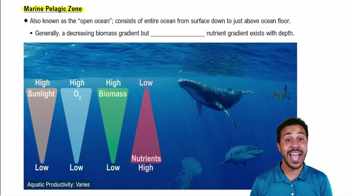
Understand the key terms in the question: 'pelagic,' 'aphotic zone,' and 'animal.' 'Pelagic' refers to organisms that live in the open ocean, away from the sea floor. The 'aphotic zone' is the part of the ocean where sunlight does not penetrate, typically below 200 meters. An 'animal' is a multicellular organism that is heterotrophic and motile at some stage of its life.
Analyze each option to determine if it fits the description of a pelagic animal in the aphotic zone. Start with option (a): A coral reef fish is not pelagic because it lives near coral reefs, which are typically in the photic zone (where sunlight penetrates).
Evaluate option (b): An intertidal snail is not pelagic because it lives in the intertidal zone, which is near the shore and exposed to sunlight. It is also not found in the aphotic zone.
Consider option (c): A deep-sea squid is pelagic because it lives in the open ocean and is found in the aphotic zone, where sunlight does not reach. This matches the description in the question.
Review option (d): A harbor seal is not pelagic because it spends time near the coast and on land. It is also not typically found in the aphotic zone. Therefore, the correct answer is the deep-sea squid.

Verified video answer for a similar problem:

This video solution was recommended by our tutors as helpful for the problem above.
Video duration:
2m
Was this helpful?

Key Concepts

Here are the essential concepts you must grasp in order to answer the question correctly.

Pelagic Zone

The pelagic zone refers to the open ocean environment, which is distinct from coastal or benthic areas. It encompasses various depths and is characterized by the absence of solid substrates. Organisms in this zone are often adapted to life in the water column, where they may encounter varying light levels and temperatures.
Recommended video:
Guided course
02:14
Marine Pelagic Zone

Aphotic Zone

The aphotic zone is the part of the ocean where sunlight does not penetrate, typically found below a depth of about 200 meters. In this zone, photosynthesis is not possible, leading to a unique ecosystem that relies on organic matter falling from above or chemosynthesis. Organisms here are adapted to darkness and often exhibit specialized feeding and survival strategies.
Recommended video:
04:38
Hybrid Zones

Deep-Sea Adaptations

Deep-sea organisms, such as the deep-sea squid, have evolved specific adaptations to survive in extreme conditions, including high pressure, low temperatures, and complete darkness. These adaptations may include bioluminescence for communication or predation, large eyes for detecting faint light, and unique metabolic processes to utilize scarce food resources.
Recommended video:
05:24
Adaptive Radiation
Related Practice
Textbook Question
Match each description on the left with the correct biome on the right. 2. The most complex and diverse biome 3. Ground permanently frozen 4. Deciduous trees such as ­hickory and birch 5. Limited to small coastal areas 6. Spruce, fir, pine, and hemlock trees 7. Home of ants, antelopes, and lions 8. North American plains a. chaparral b. savanna c. taiga d. temperate broadleaf forest e. temperate grassland f. tropical rain forest g. arctic tundra
1432
views
Textbook Question

Changes in the seasons are caused by

a. The tilt of Earth's axis toward or away from the sun

b. Annual cycles of temperature and rainfall

c. Variation in the distance between Earth and the sun

d. An annual cycle in the sun's energy output

1122
views
Textbook Question

What makes the Gobi Desert of Asia a desert?

a. The growing season there is very short

b. It is hot

c. Temperatures vary little from summer to winter

d. It is dry

1145
views
Textbook Question

Why do the tropics and the windward side of mountains receive more rainfall than areas around latitudes 30° north and south and the leeward side of mountains?

a. Rising warm, moist air cools and drops its moisture as rain.

b. Descending air condenses, creating clouds and rain.

c. There is more solar radiation in the tropics and on the windward side of mountains.

d. Earth's rotation creates seasonal differences in rainfall.

1259
views
Textbook Question

Phytoplankton are the major photosynthesizers in

a. The benthic realm of the ocean

b. The ocean photic zone

c. The intertidal zone

d. The aphotic zone of a lake

1750
views
Textbook Question
An ecologist monitoring the number of gorillas in a wildlife ­refuge over a five-year period is studying ecology at which level?a. organismb. populationc. communityd. ecosystem
651
views