Pearson+ LogoPearson+ Logo
Ch. 2 The Chemical Basis of Life
Taylor - Campbell Biology: Concepts & Connections 10th Edition
Taylor, Simon, Dickey, Hogan10th EditionCampbell Biology: Concepts & ConnectionsISBN: 9780136538783Not the one you use?Change textbook
Chapter 2, Problem 3

Changing the _________ would change it into an atom of a different element.
a. Number of electrons surrounding the nucleus of an atom
b. Number of protons in the nucleus of an atom
c. Electrical charge of an atom
d. Number of neutrons in the nucleus of an atom

Verified step by step guidance
1
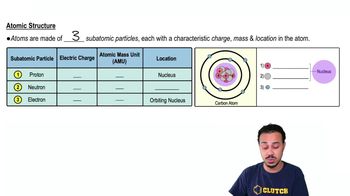
Understand the structure of an atom: An atom consists of protons, neutrons, and electrons. Protons and neutrons are located in the nucleus, while electrons orbit the nucleus.
Recall the defining characteristic of an element: The number of protons in the nucleus of an atom, known as the atomic number, determines the identity of the element.
Analyze the options: Changing the number of electrons affects the charge of the atom but does not change the element. Changing the number of neutrons creates isotopes of the same element. Changing the electrical charge alters the ionization state but not the element itself.
Focus on the correct option: Changing the number of protons in the nucleus changes the atomic number, which directly changes the element.
Conclude: The correct answer is the option that refers to the number of protons in the nucleus of an atom.

Verified video answer for a similar problem:

This video solution was recommended by our tutors as helpful for the problem above.
Video duration:
2m
Was this helpful?

Key Concepts

Here are the essential concepts you must grasp in order to answer the question correctly.

Atomic Structure

Atoms are the basic units of matter, consisting of a nucleus made up of protons and neutrons, surrounded by electrons. The number of protons in the nucleus defines the element, while neutrons contribute to the atomic mass. Electrons, which orbit the nucleus, determine the atom's chemical behavior but do not change its elemental identity.
Recommended video:
Guided course
04:48
Atomic Structure

Element Identity

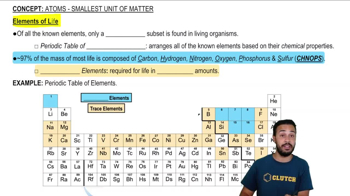
The identity of an element is determined by the number of protons in its nucleus, known as the atomic number. Changing the number of protons transforms the atom into a different element, as each element has a unique atomic number. For example, hydrogen has one proton, while helium has two, making them distinct elements.
Recommended video:
Guided course
03:36
Elements of Life

Isotopes

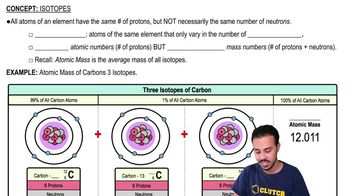
Isotopes are variants of a particular chemical element that have the same number of protons but different numbers of neutrons. This variation affects the atomic mass but not the elemental identity. For instance, carbon-12 and carbon-14 are both carbon isotopes, differing in neutron count but retaining the same chemical properties.
Recommended video: