Pearson+ LogoPearson+ Logo
Ch. 2 The Chemical Basis of Life
Taylor - Campbell Biology: Concepts & Connections 10th Edition
Taylor, Simon, Dickey, Hogan10th EditionCampbell Biology: Concepts & ConnectionsISBN: 9780136538783Not the one you use?Change textbook
Chapter 2, Problem 4

What is chemically nonsensical about this structure?


Chemical structure showing a double bond between two carbon atoms and single bonds to hydrogen atoms.

Verified step by step guidance
1
Examine the structure provided: The molecule consists of two carbon atoms connected by a double bond, each bonded to a single hydrogen atom.
Recall the valency of carbon: Carbon has a valency of 4, meaning it must form four bonds to satisfy its octet rule.
Analyze the bonds around each carbon atom: In the given structure, each carbon atom is forming only three bonds (two bonds in the double bond and one bond with hydrogen). This leaves the carbon atoms with an incomplete octet, which is chemically nonsensical.
Consider the implications of an incomplete octet: Atoms with incomplete octets are highly unstable and do not exist in this form under normal conditions.
Conclude that the structure violates basic chemical bonding rules: To make the structure chemically sensible, additional bonds or atoms would need to be added to satisfy the valency of carbon.

Verified video answer for a similar problem:

This video solution was recommended by our tutors as helpful for the problem above.
Video duration:
1m
Was this helpful?

Key Concepts

Here are the essential concepts you must grasp in order to answer the question correctly.

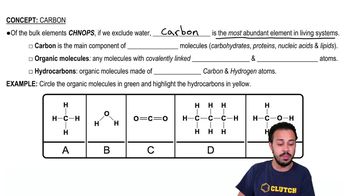
Valency of Carbon

Carbon has a valency of four, meaning it can form four covalent bonds with other atoms. In the given structure, each carbon atom is bonded to two hydrogen atoms and has a double bond with another carbon atom. This arrangement must satisfy the tetravalent nature of carbon, which is crucial for the stability of organic compounds.
Recommended video:

Double Bonds

A double bond consists of two pairs of shared electrons between two atoms, typically represented as a '=' in chemical structures. In the context of carbon, a double bond can occur between two carbon atoms, but each carbon must still fulfill its tetravalent requirement. If the structure does not allow for this, it can lead to an unstable or chemically nonsensical configuration.
Recommended video:
Guided course
05:03
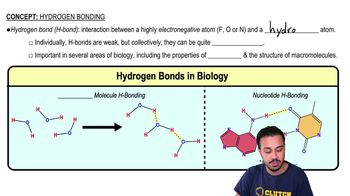
Hydrogen Bonding

Hydrocarbon Structure

Hydrocarbons are organic compounds consisting solely of hydrogen and carbon. The structure shown in the image suggests a simple alkene, but if the carbon atoms do not have the correct number of hydrogen atoms to satisfy their valency, the structure becomes chemically nonsensical. Understanding the proper arrangement of hydrogen atoms in relation to carbon is essential for determining the validity of a hydrocarbon structure.
Recommended video:
Guided course
04:25
Community Structure
Related Practice
Textbook Question

Fill in the blanks in this concept map to help you tie together the key concepts concerning elements, atoms, and molecules.

3273
views
Textbook Question
Create a concept map to organize your understanding of the life-supporting properties of water. A sample map is in the answer section, but the value of this exercise is in the thinking and integrating you must do to create your own map.
1930
views
Textbook Question

Changing the _________ would change it into an atom of a different element.

a. Number of electrons surrounding the nucleus of an atom

b. Number of protons in the nucleus of an atom

c. Electrical charge of an atom

d. Number of neutrons in the nucleus of an atom

2256
views
Textbook Question

A solution at pH 6 contains _________ H+ than the same amount of a solution at pH 8.

a. 20 times more

b. 100 times more

c. 2 times less

d. 100 times less

1841
views
Textbook Question

Most of the unique properties of water result from the fact that water molecules

a. Are the most abundant molecules on Earth's surface.

b. Are held together by covalent bonds.

c. Are constantly in motion.

d. Are polar and form hydrogen bonds.

2241
views
Textbook Question

A can of cola consists mostly of sugar dissolved in water, with some carbon dioxide gas that makes it fizzy and makes the pH less than 7. In chemical terms, you could say that cola is an aqueous solution where water is the _________, sugar is a _________, and carbon dioxide makes the solution _________.

a. solvent . . . solute . . . basic

b. solute . . . solvent . . . basic

c. solvent . . . solute . . . acidic

d. solute . . . solvent . . . acidic

1946
views