Pearson+ LogoPearson+ Logo
Ch. 37 Communities and Ecosystems
Taylor - Campbell Biology: Concepts & Connections 10th Edition
Taylor, Simon, Dickey, Hogan10th EditionCampbell Biology: Concepts & ConnectionsISBN: 9780136538783Not the one you use?Change textbook
Chapter 37, Problem 1

Fill in the blanks in the table below summarizing the interspecific interactions in a community.
Table summarizing interspecific interactions in a community for biology course.

Verified step by step guidance
1
Step 1: Understand the concept of interspecific interactions. These are relationships between different species in a community that can have positive (+), negative (-), or neutral (0) effects on the species involved.
Step 2: Analyze the table. The table lists the effects on Species 1 and Species 2 for different types of interspecific interactions. Examples are required to match the interaction type.
Step 3: Match the interaction types to their effects. For example: (1) Predation (+/-): Species 1 benefits (predator), Species 2 is harmed (prey). (2) Competition (-/-): Both species are negatively affected as they compete for the same resources. (3) Mutualism (+/+): Both species benefit from the interaction.
Step 4: Provide examples for each interaction type. For instance: (1) Predation: A lion hunting a zebra. (2) Competition: Two bird species competing for nesting sites. (3) Mutualism: Bees pollinating flowers while obtaining nectar.
Step 5: Fill in the blanks in the table using the correct interaction types and examples based on the effects provided. Ensure the examples align with the interaction type and effects on Species 1 and Species 2.

Verified video answer for a similar problem:

This video solution was recommended by our tutors as helpful for the problem above.
Video duration:
1m
Was this helpful?

Key Concepts

Here are the essential concepts you must grasp in order to answer the question correctly.

Interspecific Interactions

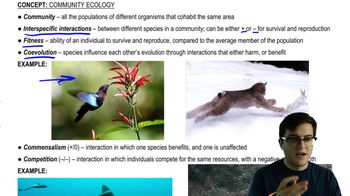
Interspecific interactions refer to the relationships between different species within a community. These interactions can be classified into various types, such as competition, predation, mutualism, and commensalism, each affecting the species involved differently. Understanding these interactions is crucial for analyzing community dynamics and ecological balance.
Recommended video:
Guided course
04:25
Interspecific Interactions

Effects on Species

The effects of interspecific interactions on species can be positive (+), negative (-), or neutral (0). A positive effect indicates that one species benefits from the interaction, while a negative effect signifies harm to one species. These effects help in understanding the ecological roles of species and their contributions to community structure.
Recommended video:
Guided course
01:34
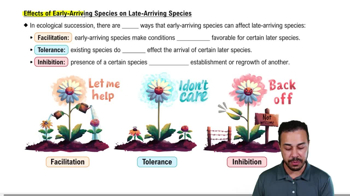
Effects of Early-Arriving Species on Late-Arriving Species

Examples of Interactions

Providing examples of interspecific interactions helps illustrate the concepts in a practical context. For instance, in predation, a predator benefits (+) while the prey is harmed (-). In mutualism, both species benefit (+/+), such as bees pollinating flowers. These examples clarify the nature of interactions and their implications for biodiversity.
Recommended video:
Guided course
02:23
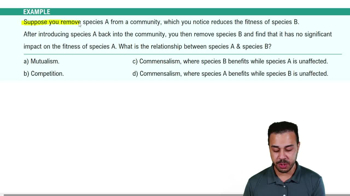
Introduction to Community Interactions Example 1