Pearson+ LogoPearson+ Logo
Ch. 37 Communities and Ecosystems
Taylor - Campbell Biology: Concepts & Connections 10th Edition
Taylor, Simon, Dickey, Hogan10th EditionCampbell Biology: Concepts & ConnectionsISBN: 9780136538783Not the one you use?Change textbook
Chapter 37, Problem 4

To ensure adequate nitrogen for a crop, a farmer would want to decrease _________ by soil bacteria.
a. Nitrification
b. Denitrification
c. Nitrogen fixation
d. a and c

Verified step by step guidance
1
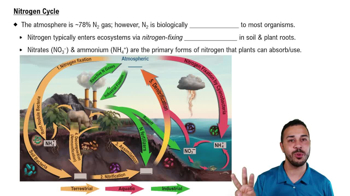
Understand the nitrogen cycle: Nitrogen is an essential nutrient for plants, and its availability in the soil is influenced by processes carried out by soil bacteria, including nitrification, denitrification, and nitrogen fixation.
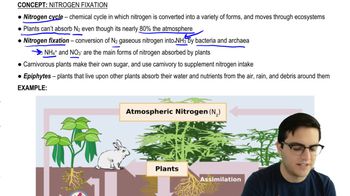
Define the processes: Nitrification is the conversion of ammonium (NH₄⁺) into nitrate (NO₃⁻) by bacteria, making nitrogen available to plants. Denitrification is the conversion of nitrate (NO₃⁻) into nitrogen gas (N₂), which removes nitrogen from the soil. Nitrogen fixation is the conversion of atmospheric nitrogen (N₂) into ammonium (NH₄⁺), making it usable by plants.
Analyze the question: The farmer wants to ensure adequate nitrogen for the crop. This means the farmer would want to prevent processes that reduce the availability of nitrogen in the soil.
Identify the relevant processes: Denitrification decreases nitrogen availability by converting nitrate into nitrogen gas, which escapes into the atmosphere. Nitrogen fixation, on the other hand, increases nitrogen availability, so decreasing it would not be beneficial for the crop.
Conclude the correct answer: The farmer would want to decrease denitrification (option b) to ensure adequate nitrogen for the crop. Option d (a and c) is incorrect because decreasing nitrogen fixation would reduce nitrogen availability, which is counterproductive.

Verified video answer for a similar problem:

This video solution was recommended by our tutors as helpful for the problem above.
Video duration:
2m
Was this helpful?

Key Concepts

Here are the essential concepts you must grasp in order to answer the question correctly.

Nitrification

Nitrification is the biological process by which ammonia is converted into nitrites and then into nitrates by soil bacteria. This process is crucial for the nitrogen cycle, as it transforms nitrogen into forms that plants can readily absorb. In the context of the question, decreasing nitrification would mean reducing the conversion of ammonia to nitrates, which could limit nitrogen availability for crops.
Recommended video:
Guided course
08:32
Nitrogen Cycle

Denitrification

Denitrification is the process by which nitrates are reduced to nitrogen gas (N2) or, to a lesser extent, nitrous oxide (N2O) by soil bacteria. This process returns nitrogen to the atmosphere and decreases the amount of nitrogen available in the soil for plant uptake. In the context of the question, a farmer may want to decrease denitrification to retain more nitrogen in the soil for crop use.
Recommended video:
Guided course
08:32
Nitrogen Cycle

Nitrogen Fixation

Nitrogen fixation is the process through which atmospheric nitrogen (N2) is converted into ammonia (NH3) by certain bacteria, making nitrogen available to plants. This process is essential for replenishing soil nitrogen levels, especially in agricultural systems. In the question, decreasing nitrogen fixation would also limit nitrogen availability, which is why it is included as a potential answer.
Recommended video:
Guided course
06:31
Nitrogen Cycle