For which chemicals are biogeochemical cycles global? Explain.
Ch. 37 Communities and Ecosystems
Taylor, Simon, Dickey, Hogan10th EditionCampbell Biology: Concepts & ConnectionsISBN: 9780136538783Not the one you use?Change textbook
Chapter 37, Problem 14
"In a classic study, John Teal measured energy flow in a salt marsh ecosystem. The table below shows some of his results.
a. What percentage of the energy in sunlight was converted into chemical energy and incorporated into plant biomass? What term describes this new biomass?
b. What percentage of the energy in plant biomass was incorporated into the bodies of the primary consumers? What became of the rest of the energy (see Figure 37.16A)?
c. How much energy is available for secondary consumers?
Based on the efficiency of energy transfer by primary consumers, estimate how much energy will be available to tertiary consumers."

Verified step by step guidance1
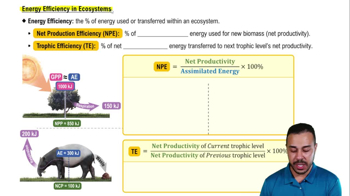
Step 1: To calculate the percentage of sunlight energy converted into chemical energy in plant biomass, use the formula: \( \text{Percentage} = \frac{\text{Chemical energy in producers}}{\text{Sunlight energy}} \times 100 \). Substitute the values: \( \text{Chemical energy in producers} = 6,585 \, \text{kcal/m}^2/\text{year} \) and \( \text{Sunlight energy} = 600,000 \, \text{kcal/m}^2/\text{year} \). The term describing this new biomass is 'Gross Primary Production (GPP)'.
Step 2: To calculate the percentage of energy in plant biomass incorporated into primary consumers, use the formula: \( \text{Percentage} = \frac{\text{Chemical energy in primary consumers}}{\text{Chemical energy in producers}} \times 100 \). Substitute the values: \( \text{Chemical energy in primary consumers} = 81 \, \text{kcal/m}^2/\text{year} \) and \( \text{Chemical energy in producers} = 6,585 \, \text{kcal/m}^2/\text{year} \). The rest of the energy is lost as heat, used in metabolic processes, or remains as unconsumed biomass.
Step 3: To determine the energy available for secondary consumers, note that the energy available to secondary consumers is the energy transferred from primary consumers. This is calculated using the efficiency of energy transfer, which is typically around 10%. Use the formula: \( \text{Energy available for secondary consumers} = \text{Chemical energy in primary consumers} \times \text{Efficiency} \). Substitute \( \text{Efficiency} = 0.10 \).
Step 4: To estimate the energy available to tertiary consumers, apply the same energy transfer efficiency (10%) to the energy available for secondary consumers. Use the formula: \( \text{Energy available for tertiary consumers} = \text{Energy available for secondary consumers} \times \text{Efficiency} \).
Step 5: Summarize the energy flow: Sunlight energy is converted into plant biomass (Gross Primary Production), a portion of which is transferred to primary consumers, then to secondary consumers, and finally to tertiary consumers, with energy losses at each trophic level due to heat, metabolism, and unconsumed biomass.

Verified video answer for a similar problem:
This video solution was recommended by our tutors as helpful for the problem above.
Video duration:
2mWas this helpful?
Key Concepts
Here are the essential concepts you must grasp in order to answer the question correctly.
Energy Conversion Efficiency
Energy conversion efficiency refers to the percentage of energy that is transformed from one form to another in an ecosystem. In this context, it measures how much of the sunlight energy is converted into chemical energy by producers (plants). This efficiency is crucial for understanding energy flow in ecosystems, as it determines the amount of energy available for subsequent trophic levels.
Recommended video:
Guided course
Energy Efficiency in Ecosystems
Primary Production
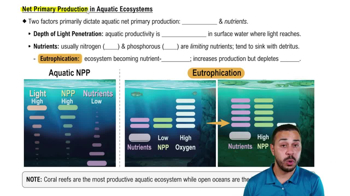
Primary production is the process by which autotrophs, primarily plants, convert sunlight into chemical energy through photosynthesis, resulting in new biomass. The biomass produced is referred to as 'net primary production' (NPP), which represents the energy available for herbivores and other consumers. Understanding primary production is essential for analyzing energy flow and ecosystem dynamics.
Recommended video:
Guided course
Primary Production in Aquatic Ecosystems
Trophic Levels and Energy Transfer
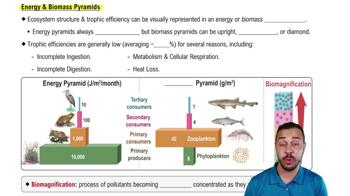
Trophic levels represent the hierarchical positions of organisms in an ecosystem based on their feeding relationships. Energy transfer between these levels is typically inefficient, with only a fraction of energy (about 10%) being passed from one level to the next. This concept is vital for estimating the energy available to secondary and tertiary consumers, as it highlights the diminishing energy available at higher trophic levels.
Recommended video:
Guided course
Energy & Biomass Pyramids
Related Practice
Textbook Question
896
views
Textbook Question
What roles do bacteria play in the nitrogen cycle?
1912
views
Textbook Question
An ecologist studying plants in the desert performed the following experiment. She staked out two identical plots, which included a few sagebrush plants and numerous small, annual wildflowers. She found the same five wildflower species in roughly equal numbers on both plots. She then enclosed one of the plots with a fence to keep out kangaroo rats, the most common grain-eaters of the area. After two years, to her surprise, four of the wildflower species were no longer present in the fenced plot, but one species had increased dramatically. The control plot had not changed. Using the principles of ecology, propose a hypothesis to explain her results. What additional evidence would support your hypothesis?
929
views