Pearson+ LogoPearson+ Logo
Ch. 37 Communities and Ecosystems
Taylor - Campbell Biology: Concepts & Connections 10th Edition
Taylor, Simon, Dickey, Hogan10th EditionCampbell Biology: Concepts & ConnectionsISBN: 9780136538783Not the one you use?Change textbook
Chapter 37, Problem 13

An ecologist studying plants in the desert performed the following experiment. She staked out two identical plots, which included a few sagebrush plants and numerous small, annual wildflowers. She found the same five wildflower species in roughly equal numbers on both plots. She then enclosed one of the plots with a fence to keep out kangaroo rats, the most common grain-­eaters of the area. After two years, to her surprise, four of the wildflower species were no longer present in the fenced plot, but one species had increased dramatically. The control plot had not changed. Using the principles of ecology, propose a hypothesis to explain her results. What additional evidence would support your hypothesis?

Verified step by step guidance
1
Identify the key components of the experiment: The ecologist is studying the effect of kangaroo rats on wildflower species in a desert ecosystem. The fenced plot excludes kangaroo rats, while the control plot allows their presence. After two years, the fenced plot shows a dramatic change in wildflower species composition, while the control plot remains unchanged.
Propose a hypothesis: Based on the principles of ecology, hypothesize that kangaroo rats play a role in maintaining the diversity of wildflower species by consuming seeds of the dominant species, preventing it from outcompeting others. Without kangaroo rats, the dominant species may outcompete the others, leading to reduced diversity.
Explain the mechanism: The hypothesis suggests that kangaroo rats act as a keystone species. By feeding on seeds of the most competitive wildflower species, they limit its population growth, allowing less competitive species to coexist. In the absence of kangaroo rats, the dominant species proliferates unchecked, outcompeting and displacing the other species.
Propose additional evidence to support the hypothesis: To strengthen the hypothesis, collect data on the following: (1) Seed consumption patterns of kangaroo rats, focusing on whether they preferentially consume seeds of the dominant wildflower species. (2) Growth rates and competitive interactions of the wildflower species in the absence of kangaroo rats. (3) Soil composition, water availability, and other abiotic factors to rule out alternative explanations for the observed changes.
Design further experiments: Conduct controlled experiments where kangaroo rats are selectively excluded from some plots while being allowed in others. Monitor changes in wildflower species composition, seed dispersal, and germination rates over time. Additionally, test whether reintroducing kangaroo rats to the fenced plot restores wildflower diversity.

Verified video answer for a similar problem:

This video solution was recommended by our tutors as helpful for the problem above.
Video duration:
2m
Was this helpful?

Key Concepts

Here are the essential concepts you must grasp in order to answer the question correctly.

Ecological Interactions

Ecological interactions refer to the relationships between organisms and their environment, including competition, predation, and mutualism. In this experiment, the presence of kangaroo rats likely influenced the survival and reproduction of the wildflower species. Understanding these interactions helps explain how species coexist and how their populations can change in response to environmental factors.
Recommended video:
Guided course
04:25
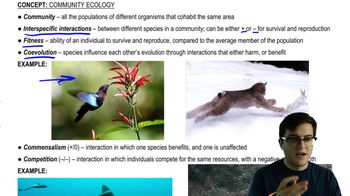
Interspecific Interactions

Species Competition

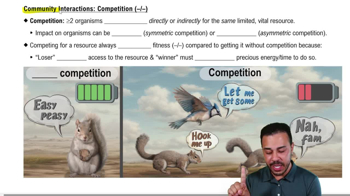
Species competition occurs when two or more species vie for the same resources, such as light, water, or nutrients. In the fenced plot, the absence of kangaroo rats may have allowed one wildflower species to outcompete others for resources, leading to its dramatic increase. This concept is crucial for understanding how species dynamics can shift in response to changes in their environment.
Recommended video:
Guided course
02:13
Community Interactions: Competition (-/-)

Hypothesis Formation

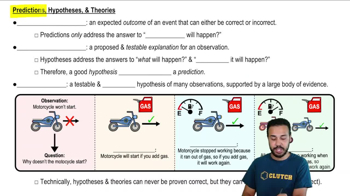
Hypothesis formation is a critical step in scientific inquiry, where a testable statement is proposed based on observations. In this case, a possible hypothesis could be that the kangaroo rats were limiting the growth of certain wildflower species through herbivory. Additional evidence, such as measuring the growth rates of the wildflowers in the presence and absence of kangaroo rats, would help support or refute this hypothesis.
Recommended video:
Guided course
08:22
Predictions, Hypotheses, & Theories