Pearson+ LogoPearson+ Logo
Ch. 37 Communities and Ecosystems
Taylor - Campbell Biology: Concepts & Connections 10th Edition
Taylor, Simon, Dickey, Hogan10th EditionCampbell Biology: Concepts & ConnectionsISBN: 9780136538783Not the one you use?Change textbook
Chapter 37, Problem 11

For which chemicals are biogeochemical cycles global? Explain.

Verified step by step guidance
1
Understand the concept of biogeochemical cycles: These are natural pathways through which essential elements and compounds move through the Earth's biosphere, atmosphere, hydrosphere, and lithosphere. Examples include the carbon, nitrogen, phosphorus, and water cycles.
Identify the difference between global and local cycles: Global cycles involve elements or compounds that can move through the atmosphere, allowing them to circulate across the entire planet. Local cycles, on the other hand, are restricted to specific ecosystems or regions.
Determine which chemicals are part of global cycles: Chemicals that exist in gaseous forms, such as carbon (in the form of CO₂), nitrogen (as N₂ or other nitrogenous gases), oxygen (O₂), and water (as H₂O vapor), are part of global cycles because they can travel long distances through the atmosphere.
Explain why these chemicals have global cycles: The ability of these chemicals to exist in gaseous states allows them to be transported by atmospheric processes like wind and weather patterns, enabling their movement across continents and oceans.
Contrast with local cycles: Chemicals like phosphorus and calcium, which do not have significant gaseous forms, are primarily cycled locally within soil, water, and living organisms, as they are not easily transported through the atmosphere.

Verified video answer for a similar problem:

This video solution was recommended by our tutors as helpful for the problem above.
Video duration:
4m
Was this helpful?

Key Concepts

Here are the essential concepts you must grasp in order to answer the question correctly.

Biogeochemical Cycles

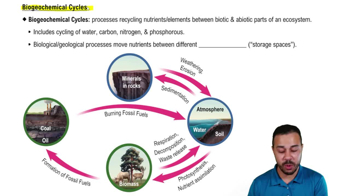
Biogeochemical cycles refer to the natural processes that recycle nutrients in various chemical forms from the environment to organisms and then back to the environment. These cycles involve biological, geological, and chemical interactions, ensuring the continuous availability of essential elements like carbon, nitrogen, and phosphorus in ecosystems.
Recommended video:
Guided course
01:55
Introduction to Biogeochemical Cycles

Global Chemicals

Global chemicals are elements or compounds that are cycled through the Earth's systems on a planetary scale. Key examples include carbon, nitrogen, and water, which are essential for life and are distributed across the atmosphere, hydrosphere, lithosphere, and biosphere, influencing global climate and ecosystems.
Recommended video:
Guided course
01:56
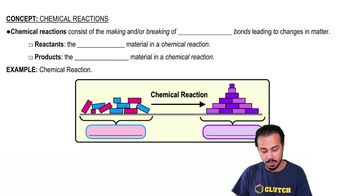
Chemical Reactions

Human Impact on Cycles

Human activities, such as fossil fuel combustion and deforestation, significantly alter biogeochemical cycles, leading to global changes. For instance, increased carbon dioxide from burning fossil fuels enhances the carbon cycle, contributing to climate change. Understanding these impacts is crucial for developing sustainable practices and mitigating environmental issues.
Recommended video:
Guided course
03:35
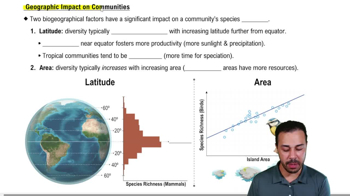
Geographic Impact on Communities
Related Practice
Textbook Question
Explain how seed dispersal by animals is an example of mutualism in some cases.
1128
views
Textbook Question

What is rapid eutrophication? What steps might be taken to slow this process?

806
views
Textbook Question
In Southeast Asia, there's an old saying: 'There is only one tiger to a hill.' In terms of energy flow in ecosystems, explain why big predatory animals such as tigers and sharks are relatively rare.
888
views
Textbook Question
What roles do bacteria play in the nitrogen cycle?
1912
views
Textbook Question

An ecologist studying plants in the desert performed the following experiment. She staked out two identical plots, which included a few sagebrush plants and numerous small, annual wildflowers. She found the same five wildflower species in roughly equal numbers on both plots. She then enclosed one of the plots with a fence to keep out kangaroo rats, the most common grain-­eaters of the area. After two years, to her surprise, four of the wildflower species were no longer present in the fenced plot, but one species had increased dramatically. The control plot had not changed. Using the principles of ecology, propose a hypothesis to explain her results. What additional evidence would support your hypothesis?

929
views
Textbook Question

"In a classic study, John Teal measured energy flow in a salt marsh ecosystem. The table below shows some of his results.

a. What percentage of the energy in sunlight was converted into chemical energy and incorporated into plant biomass? What term describes this new biomass?

b. What percentage of the energy in plant biomass was incorporated into the bodies of the primary consumers? What became of the rest of the energy (see Figure 37.16A)?

c. How much energy is available for secondary consumers?

Based on the efficiency of energy transfer by primary consumers, estimate how much energy will be available to tertiary consumers."

1106
views